Tuesday, August 24, 2010

St. Bartholomew, aka Nathanael - Consecrated Life, male and female

Today the Church recalls the first century Saint Bartholomew, one of the Twelve Apostles. All that is known of him with certainty is that he is mentioned in the synoptic gospels and Acts as one of the twelve apostles.

Bartholomew's name is a patronymic and means "son of Tolomai"; scholars believe he is the same as Nathanael mentioned in John, who says he is from Cana and that Jesus called him an "Israelite...incapable of deceit."


The Roman Martyrology says he preached in India and Greater Armenia, where he was flayed and beheaded by King Astyages. Tradition has the place as Abanopolis on the west coast of the Caspian Sea and that he also preached in Mesopotamia, Persia, and Egypt (from Catholic On Line [www.catholic.org]).

* * *

Strengthen in us, O Lord, the faith by which the blessed Apostle Bartholomew clung wholeheartedly to your Son, and grant that through the help of his prayers your Church may become for all the nations the sacrament of salvation. Through our Lord.

* * * * * *

JESUIT VOW CEREMONY, MONTREAL

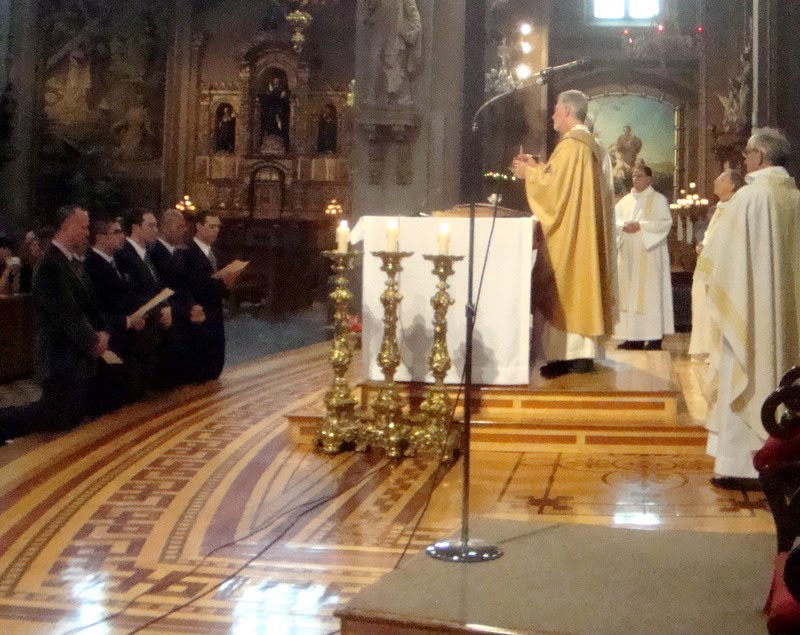
On Sunday, I attended the First Vows of five Jesuits who are completing their two-year novitiate in Montreal.

The Mass in the Church of the Gesu was presided by the new Jesuit Provinical of the Province of French Canada and Haiti, Pere Jean-Marc Biron.

Concelebrating with him were the English Canada Provincial Father James Webb and Jesuits from the two provinces.

The homilist was the director of novices, Father Erik Oland.

Following a Jesuit tradition begun at Montmartre in Paris on August 15, 1534 by St. Ignatius Loyola, St. Francis Xavier and their early companions, the vows are pronounced before the Eucharistic Lord immediately prior to Holy Communion (in that case, the presider was the only priest of their group Blessed Pierre Favre). It brought back happy memories of my First Vows on August 15, 1963.


At the close of Mass, the vovents received their "Vow Crucifix" from their respective provincial superiors.


A reception followed in the conference hall below the church:


* * * * * *

QUEENSHIP OF MARY HOUSE, OTTAWA

Members of a newly forming religious institute, under the patronage of Our Lady's title "The Queenship of Mary" celebrated their feast day on Sunday in their new quarters at Our Lady of Mt. Carmel's Parish House. They fed some 250 friends and benefactors in the parish hall after Mass.

As I could not attend, I presided at Mass yesterday as they began a week of intensive retreat and reflection on establishing their charism and its embodiment.

Following Mass, I was guided on a tour of their new quarters, then shared a coffee break and delighted in hearing recent news.

Pastor Father Stephen Liang banters with his new tenants

Monday, August 23, 2010

Rose of Lima, Saint of Peru

O God, you set Saint Rose of Lima on fire with your love, so that, secluded from the world in the austerity of a life of penance, she might give herself to you alone; grant, we pray, that through her intercession, we may tread the paths of life on earth and drink at the stream of your delights in heaven. Through our Lord.

* * *

Isabel de Santa Maria de Flores was born in Lima, Peru of Spanish parents and took the name Rose at her confirmation.

Noted for her beauty, she rejected all suitors and refused to marry. She became a Dominican tertiary and lived as a recluse in a shack in the garden she worked to help her parents.

She is depicted in this window wearing a Carmelite habit which was the customary garb of the day. She holds a red rose symbolizing her purity and her name. On her head is a crown of thorns.

She was deeply devoted to the Sacred Heart of Jesus featured at the top of the window. The heart is encircled with a crown of thorns and has a cross and flames emerging from it. This flaming heart represents religious fervor and devotion to Jesus Christ.

Rose is the patron saint of all South America.

Above the Sacred Heart is the fish and loaves of bread. The German inscription reads, "Given by the Young Ladies Sodality". In the first decades of the parish, the women of the parish had two organizations; the Young Ladies Sodality was for the unmarried young women.

This is a print of a watercolor painting by Jennifer Walterscheid in 2008. The window can be found in St. Anthony Catholic Church in Wichita, Kansas (www.stanthonywitchita.com).

of racoons at the Mount Royal lookoff

Sunday, August 22, 2010

21st Sunday: "Strive to enter by the narrow door" - The Queenship of Mary

Twenty-First Sunday in Ordinary Time (Year "C") August 22, 2010 "LORD, WILL ONLY A FEW BE SAVED?" [Texts: Isaiah 66:18-21; [Psalm 117]; Hebrews 12:5-7, 11-13; Luke 13:22-30]

Some years ago, while crossing the university campus where I worked, I was approached by a young person who asked whether I had been saved? "Yes, I believe I have..." I replied, then hurried on. As I walked away, I thought of the many nuances I would need to add to explain what was involved in saying "yes".

Many have had the same issue put to them at their doorstep or at the mall by evangelists who ask such questions as, "have you accepted Jesus as your personal Lord and Saviour?" And the coming of the year 2012--with the Mayan prophecy of the end of the world that year--will surface concerns among many about who or how many will be saved.

In other words, things have not changed much since the time of Jesus. When people had been suggesting that perhaps nothing much would become of His movement of renewal in Israel, Jesus told two parables of God's Kingdom (Luke 13:18-22).

Though a mustard seed is the smallest it soon becomes a tree in which birds may nest. Once a tiny bit of leaven is mixed in with three measures of flour it soon leavens the whole batter. Discerning His message, someone asked Jesus, "Lord will only a few be saved?"

Typically, Jesus' answer was parabolic. The door is narrow. The owner of the house will refuse entry to many who presumed they had been invited. Still others from a long way off, however, will gain admission.

Faced with these facts, what is a disciple of Jesus to do? "Strive to enter through the narrow door". Jesus invited His hearers to "strive", a word used of athletes as they discipline themselves to win a competition. Though the Kingdom is God's gift, people must vigorously engage themselves in the process of their own salvation.

Paul summarized the paradoxical nature of salvation when he urged the Philippians to "work out your own salvation with fear and trembling, for it is God who is at work in you, enabling you both to will and to work for his good pleasure" (2:12-13).

Jesus engages His hearers by inviting them to imagine themselves outside a shut door. "You begin to stand outside and to knock at the door, saying 'Lord, open to us'". All of a sudden, the disguise is dropped and Jesus is revealed as the householder. He will say to the Galileans and Judeans of the first century, "I do not know where you come from; go away from Me all you evildoers".

Then, people will claim association with Jesus, "We ate and drank with You, and You taught in our streets". True companionship with Jesus, however, involves living by faith in God. So Jesus asked people to imagine themselves cast out where "there will be weeping and gnashing of teeth" that they might have a change of heart, accept His message, and enter the end-time Kingdom.

When the Kingdom comes fully, many in Israel or the Church, who presumed themselves included, will be surprised to find themselves outside. By contrast, gentiles, the poor and outcast--whom others might have thought excluded--"will come from east and west, from north and south, and will eat in the Kingdom of God".

In reply to the question, "Lord, will only a few be saved?" Jesus effectively answered "no". But His reply challenges each person with a counter-question, "will the saved include you?"

God's saving design for the whole world, proclaimed by Jesus, was beautifully foretold in the closing words of the Book of Isaiah. God's purpose is to take people from every nation, commissioning them for priestly service to the divine praise and glory.

The challenge in following Jesus was combined with a message of encouragement in the Epistle to the Hebrews. The author argued that God's discipline which comes upon Christians as they follow Jesus' way may seem painful at times. But each should realize that such trials are like the discipline which a parent gives a child and are signs of love and acceptance.

Finally, divine discipline yields an abundant harvest of righteousness. Therefore, Christians are exhorted to lift up their drooping hands and strengthen their weak knees "so that what is lame may not be put out of joint but rather be healed".

* * * * * *

THE QUEENSHIP OF MARY

Though not observed liturgically this year, today is the octave (eighth day following) of the Assumption of Mary and known as the day on which Mary is honoured as Queen of Heaven, Queen of the Angels and the Saints.


O God, you have given us the mother of your Son to be our queen and mother.
With the support of her prayers, may we come to share the glory of your children in the kingdom of heaven. Through our Lord Jesus Christ.

Saturday, August 21, 2010

St. Pius X and Centenary of Early Childhood Communion -- Jesuits Called to Eternal Life

O God, who to safeguard the Catholic faith and to restore all things in Christ, filled Pope Saint Pius the Tenth with heavenly wisdom and apostolic fortitude, graciously grant that, following his teaching and example, we may gain an eternal prize. Through our Lord.


One hundred years ago this month on August 8, 1910, the Church began to encourage early (around age 7) admission of children to Confession and Holy Communion, recommending frequent, even daily reception of the Eucharist.

This centennial anniversary, on August 8, led the Prefect of the Congregation of Divine Worship and Discipline of the Sacraments, Cardinal Canizares to suggest that children could and perhaps should be encouraged to be admitted to the reception of Holy Communion even earlier. Parents, pastors, teachers and catechists will have thoughts on the desirability and practicability of this proposal.

Here are excerpts from the text of the decree approved by Pope St. Pius X, whose feast is celebrated today:

QUAM SINGULARI Decree on First Communion from the Sacred Congregation of the Discipline of the Sacraments

The pages of the Gospel show clearly how special was that love for children which Christ showed while He was on earth. It was His delight to be in their midst; He was wont to lay His hands on them; He embraced them; and He blessed them. At the same time He was not pleased when they would be driven away by the disciples, whom He rebuked gravely with these words: "Let the little children come to me, and do not hinder them, for of such is the kingdom of God." It is clearly seen how highly He held their innocence and the open simplicity of their souls on that occasion when He called a little child to Him and said to the disciples: "Again, I say to you, unless you turn and become like little children, you will not enter into the kingdom of heaven....And whoever receives one such little child for my sake, receives me."

The Catholic Church, bearing this in mind, took care even from the beginning to bring the little ones to Christ through Eucharistic Communion, which was administered even to nursing infants. This, as was prescribed in almost all ancient Ritual books, was done at Baptism until the thirteenth century, and this custom prevailed in some places even later. It is still found in the Greek and Oriental Churches. But to remove the danger that infants might eject the Consecrated Host, the custom obtained from the beginning of administering the Eucharist to them under the species of wine only.

Infants, however, not only at the time of Baptism, but also frequently thereafter were admitted to the sacred repast. In some churches it was the custom to give the Eucharist to the children immediately after the clergy; in others, the small fragments which remained after the Communion of the adults were given to the children.

This practice later died out in the Latin Church, and children were not permitted to approach the Holy Table until they had come to the use of reason and had some knowledge of this august Sacrament. This new practice, already accepted by certain local councils, was solemnly confirmed by the Fourth Council of the Lateran, in 1215, which promulgated its celebrated Canon XXI, whereby sacramental Confession and Holy Communion were made obligatory on the faithful after they had attained the use of reason, in these words: "All the faithful of both sexes shall, after reaching the years of discretion, make private confession of all their sins to their own priest at least once a year, and shall, according to their capacity, perform the enjoined penance; they shall also devoutly receive the Sacrament of Holy Eucharist at least at Easter time unless on the advice of their own priest, for some reasonable cause, it be deemed well to abstain for a while."

The Council of Trent, in no way condemning the ancient practice of administering the Eucharist to children before they had attained the use of reason, confirmed the Decree of the Lateran Council and declared anathema those who held otherwise: "If anyone denies that each and all Christians of both sexes are bound, when they have attained the years of discretion, to receive Communion every year at least at Easter, in accordance with the precept of Holy Mother Church, let him be anathema."

In accord with this Decree of the Lateran Council, still in effect, the faithful are obliged, as soon as they arrive at the years of discretion, to receive the Sacraments of Penance and Holy Eucharist at least once a year.

However, in the precise determination of "the age of reason or discretion" not a few errors and deplorable abuses have crept in during the course of time. There were some who maintained that one age of discretion must be assigned to reception of the Sacrament of Penance and another to the Holy Eucharist. They held that for Confession the age of discretion is reached when one can distinguish right from wrong, hence can commit sin; for Holy Eucharist, however, a greater age is required in which a full knowledge of matters of faith and a better preparation of the soul can be had. As a consequence, owing to various local customs and opinions, the age determined for the reception of First Communion was placed at ten years or twelve, and in places fourteen years or even more were required; and until that age children and youth were prohibited from Eucharistic Communion.

This practice of preventing the faithful from receiving on the plea of safeguarding the august Sacrament has been the cause of many evils. It happened that children in their innocence were forced away from the embrace of Christ and deprived of the food of their interior life; and from this it also happened that in their youth, destitute of this strong help, surrounded by so many temptations, they lost their innocence and fell into vicious habits even before tasting of the Sacred Mysteries. And even if a thorough instruction and a careful Sacramental Confession should precede Holy Communion, which does not everywhere occur, still the loss of first innocence is always to be deplored and might have been avoided by reception of the Eucharist in more tender years.

No less worthy of condemnation is that practice which prevails in many places prohibiting from Sacramental Confession children who have not yet made their First Holy Communion, or of not giving them absolution. Thus it happens that they, perhaps having fallen into serious sin, remain in that very dangerous state for a long time.

But worse still is the practice in certain places which prohibits children who have not yet made their First Communion from being fortified by the Holy Viaticum, even when they are in imminent danger of death; and thus, when they die they are buried with the rites due to infants and are deprived of the prayers of the Church.

Such is the injury caused by those who insist on extraordinary preparations for First Communion, beyond what is reasonable; and they doubtless do not realize that such precautions proceed from the errors of the Jansenists who contended that the Most Holy Eucharist is a reward rather than a remedy for human frailty. The Council of Trent, indeed, teaches otherwise when it calls the Eucharist, "An antidote whereby we may be freed from daily faults and be preserved from mortal sins." This doctrine was not long ago strongly emphasized by a Decree of the Sacred Congregation of the Council given on December 20, 1905. It declared that daily approach to Communion is open to all, old and young, and two conditions only are required: the state of grace and a right intention....

The Roman Catechism adds this: "At what age children are to receive the Holy Mysteries no one can better judge than their father and the priest who is their confessor. For it is their duty to ascertain by questioning the children whether they have any understanding of this admirable Sacrament and if they have any desire for it."


After careful deliberation on all these points, this Sacred Congregation of the Discipline of the Sacraments, in a general meeting held on July 15, 1910, in order to remove the above-mentioned abuses and to bring about that children even from their tender years may be united to Jesus Christ, may live His life, and obtain protection from all danger of corruption, has deemed it needful to prescribe the following rules which are to be observed everywhere for the First Communion of children....

1. The age of discretion, both for Confession and for Holy Communion, is the time when a child begins to reason, that is about the seventh year, more or less. From that time on begins the obligation of fulfilling the precept of both Confession and Communion.

2. A full and perfect knowledge of Christian doctrine is not necessary either for First Confession or for First Communion. Afterwards, however, the child will be obliged to learn gradually the entire Catechism according to his ability.

3. The knowledge of religion which is required in a child in order to be properly prepared to receive First Communion is such that he will understand according to his capacity those Mysteries of faith which are necessary as a means of salvation () and that he can distinguish between the Bread of the Eucharist and ordinary, material bread, and thus he may receive Holy Communion with a devotion becoming his years.

4. The obligation of the precept of Confession and Communion which binds the child particularly affects those who have him in charge, namely, parents, confessor, teachers and the pastor. It belongs to the father, or the person taking his place, and to the confessor, according to the Roman Catechism, to admit a child to his First Communion.

5. The pastor should announce and hold a General Communion of the children once a year or more often, and he should on these occasions admit not only the First Communicants but also others who have already approached the Holy Table with the above-mentioned consent of their parents or confessor. Some days of instruction and preparation should be previously given to both classes of children.

6. Those who have charge of the children should zealously see to it that after their First Communion these children frequently approach the Holy Table, even daily if possible, as Jesus Christ and Mother Church desire, and let this be done with a devotion becoming their age. They must also bear in mind that very grave duty which obliged them to have the children attend the public Catechism classes; if this is not done, then they must supply religious instruction in some other way.

7. The custom of not admitting children to Confession or of not giving them absolution when they have already attained the use of reason must be entirely abandoned. The Ordinary shall see to it that this condition ceases absolutely, and he may, if necessary, use legal measures accordingly.

8. The practice of not administering the Viaticum and Extreme Unction to children who have attained the use of reason, and of burying them with the rite used for infants is a most intolerable abuse. The Ordinary should take very severe measures against those who do not give up the practice.

His Holiness, Pope Pius X, in an audience granted on the seventh day of this month, approved all the above decisions of this Sacred Congregation, and ordered this Decree to be published and promulgated....

* * * * * *

In Hope of the Resurrection…

Two of my Jesuit confreres passed away in the last two weeks. Each had experienced a complex journey in becoming a priest and living out their ministry.

I only met Fr. Dick Macdonald on a few occasions but always found him most encouraging and supportive; he had served in Ethiopia, India, among Canada's Native Peoples and, in the last dozen years as a chaplain to the Sisters of St. Joseph of Toronto.

Though he was older than me by a dozen years, I was Fr. Joe Fülöp rector during his seminary formation. His long road to the priesthood is heroic, as was the way he lived it out in illness and suffering.

Please keep these two ministers of the gospel, Christ's priests, in your thoughts and prayers.

Father Richard Macdonald died peacefully on August 6th, 2010 at Scarborough Centenary Hospital, Scarborough, Ontario. He was in the 83rd year of his life and 63rd year of religious life.

Richard "Dick" Macdonald was born in Westmount, Quebec, son of Alain Macdonald and Frances Minton. He studied at both St. Leo’s and then Loyola High School and entered the Society on September 13, 1947 at Guelph, Ontario. He returned to Montreal to study Philosophy at the Collège de l'Immaculée-Conception.

In 1954, he moved to Ethiopia in East Africa to teach English as a regency placement. From there he went to St Mary’s College, Kurseong in the Darjeeling district of North Eastern India where he studied Nepali for a year and then commenced his Theology studies.

After ordination in 1961 in India, he served as an assistant pastor at Our Lady of the Snows Parish, North Point, Darjeeling for a year and then to St. Joseph’s College, also in North Point, where he was professor of English and Moral Science. He served in different ministries in the Darjeeling district, St. John’s Church and Hayden Hall.

In 1979, he returned to Canada and worked at first in Toronto and Pickering. In 1981 he began his ministry with the Native People, first from Martyrs Shrine in Midland and then in 1984 moving to the Manitoulin District. He helped build the church in Little Current, Ontario. He lived and worked in native and non-native parishes, until 1997. At that time he became Chaplain at St. Joseph’s Motherhouse, Bayview Avenue, Willowdale, ON, until 2010. Throughout his life he was recognized as a compassionate pastor and a fine homilist.

* * *

Father Joseph Fülöp was born in Szombathely, Hungary, on June 23rd, 1932. His elementary and high school studies were finished in his home town but, thinking already of priestly vocation, he enrolled in the Norbertine High School of St. Norbert. In 1948, the school was taken over by the State and it was renamed, so Joe graduated in the High School of Nagy Lajos, in 1950. After his graduation he began studies at the Sopron University in 1951, where he earned his geophysical engineering diploma in 1956.

In December of 1956, after the revolution, he left the country and with a branch of the University of Sopron arrived in Toronto. The Sopron Branch, with the help of the Canadian Mining Association and the University of Toronto, completed an English language course and he returned to school. In 1964, he was awarded the B.A.Sc. degree in geological engineering by the Faculty of Mining Engineering, University of Toronto. During the following year he was employed by the Gulf Oil Company in Calgary. In 1965-1967, he obtained a M.A.Sc degree (Soil Mechanics Option) at the Faculty of Civil Engineering, University of Waterloo. Between 1967 and 1971 he worked as a project geophysicist for Huntec Limited and Kenting Limited. From 1971 to 1979 he was an independent geophysical consultant conducting surveys in Canada and overseas.

On January 25th, 1979 he entered the Hungarian Jesuit novitiate in Toronto, and after two years he made his first religious vows. He completed the necessary philosophical studies at the Fordham University, New York; (then) his theological studies took place in Regis College, Toronto, being completed in 1983 with an M.Div. degree. He was ordained priest at St.Elizabeth of Hungary Church in Toronto on November 19th, 1983 by Bishop Aloysius Ambrozic, auxiliary of Toronto. In 1984 he obtained a further theological degree, the M.Th.

In 1984-85, he spent a year of pastoral work in Montreal, at the Hungarian Church of Our Lady of Hungary. In 1985 he was appointed Pastor of St.Stephen of Hungary Church in Hamilton, where he spent 15 years taking care of the Hungarian congregation. On November 21st, 2000 he suddenly was stuck with inflammation of the brain-cortex through viruses, as well as a perforated stomach-ulcer and embolism. After three months of intensive hospital treatment he gradually got better, and moved to the Hungarian parish in Toronto, where unfortunately he was not able to do much pastoral work because of his limited speech. When his illness became more serious, he moved to St.Elizabeth Home in Hamilton, but had to be hospitalized occasionally. Finally, he died in the Home on August 15, 2010, in his 78th year of his life, 31st as a Jesuit, and 27th year as priest.

Visitation will be held at St. Stephen of Hungary Roman Catholic Church (130 Barton St E at Mary, Hamilton) on Tuesday August 24, 2010 from 7-9 p.m., with the Rosary at 7:30 p.m. There, the Funeral Mass will be celebrated on Wednesday August 25, 2010 at 11 a.m. A Memorial Mass will be celebrated in Toronto at St. Elizabeth of Hungary (432 Sheppard Ave. E.) on Friday, August 27 at 7 p.m., and another Mass will be offered at 11 a.m. on Sept. 3, 2010 in the chapel of St. Elizabeth Villa, 393 Rymal Rd. W., with interment following at 3:00 p.m. in the cemetery of St. Ladislaus Church in Courtland, ON.

R.I.P.

Friday, August 20, 2010

Memorial: St. Bernard of Clairvaux - Cardinal Telesphore Toppo in Ottawa


Today's memorial recalls St. Bernard of Clairvaux, the founding abbot of Clairvaux Abbey in Burgundy, one of the most commanding Church leaders in the first half of the twelfth century as well as one of the greatest spiritual masters of all times and the most powerful propagator of the Cistercian reform.

He was born in Fontaines-les-Dijon in 1090 and entered the Abbey of Citeaux in 1112, bringing thirty of his relatives with him, including five of his brothers--his youngest brother and his widowed father followed later.

After receiving a monastic formation from St. Stephen Harding, he was sent in 1115 to begin a new monastery near Aube: Clairvaux, the Valley of Light. As a young abbot he published a series of sermons on the Annunciation. These marked him not only as a most gifted spiritual writer but also as the "cithara of Mary," especially noted for his development of Mary's mediatorial role.

Bernard's spiritual writing as well as his extraordinary personal magnetism began to attract many to Clairvaux and the other Cistercian monasteries, leading to many new foundations. He was drawn into the controversy developing between the new monastic movement which he preeminently represented and the established Cluniac order, a branch of the Benedictines. This led to one of his most controversial and most popular works, his Apologia.

Bernard's dynamism soon reached far beyond monastic circles. He was sought as an advisor and mediator by the ruling powers of his age. More than any other he helped to bring about the healing of the papal schism which arose in 1130 with the election of the antipope Anacletus II. It cost Bernard eight years of laborious travel and skillful mediation. At the same time he labored for peace and reconciliation between England and France and among many lesser nobles. His influence mounted when his spiritual son was elected pope in 1145.

At Eugene III's command he preached the Second Crusade and sent vast armies on the road toward Jerusalem. In his last years he rose from his sickbed and went into the Rhineland to defend the Jews against a savage persecution.

Although he suffered from constant physical debility and had to govern a monastery that soon housed several hundred monks and was sending forth groups regularly to begin new monasteries (he personally saw to the establishment of sixty-five of the three hundred Cistercian monasteries founded during his thirty-eight years as abbot), he yet found time to compose many and varied spiritual works that still speak to us today.

He laid out a solid foundation for the spiritual life in his works on grace and free will, humility and love. His gifts as a theologian were called upon to respond to the dangerous teachings of the scintillating Peter Abelard, of Gilbert de la Porree and of Arnold of Brescia. His masterpiece, his Sermons on the Song of Songs, was begun in 1136 and was still in composition at the time of his death. With great simplicity and poetic grace Bernard writes of the deepest experiences of the mystical life in ways that became normative for all succeeding writers.

For Pope Eugene he wrote Five Books on Consideration, the bedside reading of Pope John XXIII and many other pontiffs through the centuries. Bernard died at Clairvaux on 20 August 1153. He was canonized by Pope Alexander III on 18 January 1174. Pope Pius VII declared him a Doctor of the Church in 1830. --from M. Basil Pennington, OCSO, "St. Bernard of Clairvaux 1090-1153, Cistercian Doctor of the Church", in The Modern Catholic Encyclopedia (A Michael Glazier Book), Liturgical Press (1995) 82.

* * *

St. Bernard de Clairvaux, Abbé, Docteur de l'Eglise (+ 1153): A quoi pouvait rêver dans l'éclat de sa jeunesse le fils de Tescelin, chevalier du duc de Bourgogne, et de dame Aleth de Montbard, si bonne chrétienne? de chasses ou de tournois? de chants de guerre ou de galantes conquêtes? En tous cas, certainement pas de vie monastique comme il en fera le choix à l'âge de vingt-trois ans. D'autant qu'il entraînait avec lui une trentaine de jeunes en quête d'absolu...

Dès 1115, après trois années de vie monastique à Citeaux, Bernard est envoyé à Clairvaux pour y fonder l'abbaye dont il restera père-abbé jusqu'à sa mort. Mais loin de rester cloîtré il parcourt les routes d'Europe devenant, comme on a pu l'écrire, «la conscience de l'Eglise de son temps».

Il vient plusieurs fois à Paris, à Saint Pierre de Montmartre, à la chapelle du Martyrium, à la chapelle Saint Aignan où il vient prier souvent devant la statue de la Vierge qui se trouve maintenant à Notre-Dame de Paris. Sa correspondance abondante avec des princes, des frères moines ou des jeunes gens qui requièrent son conseil ne l'empêche pas de se consacrer à la contemplation tout autant qu'à l'action directe dans la société de son temps.

Infatigable fondateur, on le voit sur sa mule, traînant sur les routes d'Europe sa santé délabrée et son enthousiasme spirituel. Sa réforme monastique l'oppose à l'Ordre de Cluny dont il jugeait l'interprétation de la règle de saint Benoît trop accommodante. A sa mort, en 1153, ce sont trois cent quarante-trois abbayes cisterciennes qui auront surgi du sol européen.

Au cours de l'audience générale, le 21 octobre 2009, le Pape a évoqué la figure de Bernard de Clairvaux (1090-1153), considéré comme le dernier Père de l'Eglise car il relança et rénova la théologie des Pères des premiers siècles. Né en Bourgogne, il entra à vingt ans au monastère de Citeaux, et le troisième abbé, saint Etienne Harding, l'envoya fonder en 1115 celui de Clairvaux, dont il devint l'abbé. Il "y introduisit une vie sobre et mesurée à tout point de vue, nourriture, habillement, bâtiments, tournée également vers l'assistance aux pauvres".

Ce fut le succès de Clairvaux, dont la communauté ne cessa de grandir et d'essaimer. "Bernard entretint une vaste correspondance et composa de nombreux sermons et traités. A partir de 1130, il s'intéressa aux graves problèmes qui affectaient l'Eglise et la papauté. Il combattit aussi l'hérésie cathare dont les fidèles dépréciaient le Créateur en méprisant la matière et le corps. Il condamna la montée de l'anti-sémitisme et défendit les juifs".

Benoît XVI a ensuite indiqué que les aspects majeurs de la doctrine de saint Bernard regardaient Jésus et Marie. "S'il n'apporta pas d'orientations nouvelles à la recherche théologique, il s'est révélé être un théologien contemplatif et mystique" pour qui "la connaissance de Dieu est une expérience profondément personnelle du Christ et de son amour".

Ceci est valable pour tout chrétien car la foi est avant tout recherche de l'amitié de Jésus. Bernard ne doutait pas non plus que l'on parvient à Jésus par Marie. Ainsi souligna-t-il "la place privilégiée de la Vierge dans l'économie du salut, due à la participation de la Mère au sacrifice du Fils". Les réflexions de saint Bernard, a ajouté le Saint-Père, "interpellent justement, aujourd'hui encore, théologiens et croyants.

Trop souvent on entend résoudre par la seule force de la raison les questions fondamentales sur Dieu, l'homme et le monde. En se fondant sur la Bible et les Pères, Bernard montre que sans une foi profonde, alimentée par la prière et la contemplation... toute réflexion sur les mystères de Dieu risque de n'être qu'un simple exercice intellectuel sans la moindre crédibilité.

La théologie conduit à la science des saints, à leurs intuitions des mystères et à leur sagesse, don de l'Esprit, référence de toute pensée théologique... au final, le modèle le plus authentique du théologien et de l'évangélisateur est l'apôtre Jean, qui appuya sa tête sur le coeur du Maître".
(source: VIS 091021 410)

* * *

O God who made of the Abbot Saint Bernard a man consumed with zeal for your house and a light shining and burning in your Church, grant, through his intercession, that we may be on fire with the same spirit and walk always as children on light. Through our Lord.

* * * * * *

CARDINAL TOPPO IN CANADA

Yesterday, I had the honour of meeting Cardinal Toppo who is in North America to promote interest and garner support for his dream, shared by the Catholic Bishops Conference of India, that of a new teaching hospital that would serve the needs of the poor in northern India. Having met the Speaker of the Senate, Senator Kinsella on several occasions, His Eminence accepted an invitation from him to explain this project to parties interested in assisting India and to attend a reception and dinner in his honour last evening on Parliament Hill.

Here are couple of photos from his visit to my office and the dinner:


This is some of the information available on several websites on this leader of the Church in India and on the global scene:

Cardinal Telesphore Placidus TOPPO, 70, is the Archbishop of Ranchi in the Northeast of India. Named a cardinal on October 21, 2003, he is a Cardinal Priest of the Roman Church of the Sacred Heart of Jesus in Agony at Vitinia.

Born on October 15, 1939 in Chainpur (India), the 8th of 10 children, he studied in Ranchi and Rome and speaks his native Oraon, as well as Hindu, Sadri, English and Italian; he was ordained a priest on 3 May 1969. Appointed Bishop of Dumka at the age of 38 on June 8, 1978 (one of the last episcopal appointments by Pope Paul VI) and consecrated on 7 October 1978 by Archbishop Kerkatta of Ranchi. Named Coadjutor Archbishop of Ranchi on November 8, 1984, he succeeded to full governance of the Archdiocese on August 7, 1985.

A festive celebration of his Silver Jubilee as Archbishop of Ranchi will take place on October 7 this year.

Ad multos annos, Your Eminence!

Thursday, August 19, 2010

OM: St. John Eudes -- Mosaika, Sound and Light about Canada in the Capital

Today's Optional Memorial celebrates John Eudes, who was born in 1601, in the village of Ri, in Normandy, France. After completing his studies at the Jesuit College in Caen, he entered the Congregation of the Oratory of France, founded in 1611 by Cardinal de Bérulle.

Accepted by the founder himself on March 25, 1623, John Eudes was ordained to the priesthood on December 20, 1625. During that time, he assimilated the Christocentric spiritual thought of de Bérulle and shared his enthusiasm for "restoring the priestly order to its full splendor". Imbued with this spirit, as an apostolic missionary, he evangelized many towns and cities of Normandy, Ile-de-France, Burgundy and Brittany.

He recognized the pressing need for contributing to a reform of the clergy, and founding a seminary at Caen appeared to him as indispensable. To do so, he left the Oratory and, on March 25, 1643, with a few other priests, founded a congregation dedicated to the spiritual and doctrinal formation of priests and candidates to the priesthood, while pursuing the work of parish missions. Other seminaries were soon added to the one at Caen. Thus, the Congregation of Jesus and Mary was born.

A man of accomplishments, he also founded the Order of Our Lady of Charity to provide haven and assistance to women and young girls mistreated by life.

He brought people to love Christ and the Virgin Mary by speaking tirelessly about their Hearts, the sign of the love God shows for us and the communion to which we are called.

To offer them liturgical worship, he composed Masses and Offices in their honor and had the first Feast of the Holy Heart of Mary celebrated on February 8, 1648, at Autun, and the Feast of the the Heart of Jesus celebrated on October 20, 1672.

Moreover, through his many writings, he helped spread the spiritual teaching of his masters who were members of Bérulle's Oratory, while giving it his own personal touch to the point where he came to be regarded as a spiritual master in his own right.

He died on August 19, 1680 and was canonized by Pope Pius XI on May 31, 1925.

The Eudists: After the death of its founder, the Congregation continued to develop. On the eve of the French Revolution (1789), Eudists directed some fifteen seminaries as well as a few colleges and parishes.

The Revolution closed the houses and scattered the Fathers. Four of them, including François-Louis Hébert, coadjutor to the Superior General, were martyred in Paris and beatified in 1926.

Slowly and with great difficulty, the Congregation was restored in 1826 by one of its former members, Father Pierre Blanchard. The Eudists then concentrated their efforts on the urgent task of providing Christian education in colleges.

From 1883 on, the opening of several seminaries in Colombia made it possible for them to resume the traditional work of their society. In 1890, they settled in Canada (www.eudistes.org).

* * * * * *

St. Jean Eudes: fondateur des Eudistes et de l'Institut Notre-Dame de Charité (+ 1680)

Il est contemporain de saint Vincent de Paul et sa vocation s'explique en grande partie par la situation religieuse de la France à son époque.

Le peuple, écrit-il, «avait remplacé la foi par la sorcellerie et la superstition»; les puissants «donnaient l'exemple de tous les vices»; les prêtres étaient «ignorants et souvent corrompus, abandonnant leur troupeau dès qu'apparaissaient la peste ou une épidémie».

Pour y remédier, s'appuyant sur ses dons évidents pour la prédication, il organise des «missions paroissiales», en Bretagne, en Normandie, en Bourgogne et jusqu'à la cour du roi Louis XIV, pour une annonce systématique de l'Evangile, près de cent quinze missions entre 1632 et 1675.

Pour mieux se consacrer à cet apostolat, il quitte l'Oratoire en 1643 et fonde, à Caen, "la Congrégation de Jésus et de Marie" (les Pères eudistes), qui se voue aux missions ainsi qu'à la fondation des séminaires pour la formation d'un meilleur clergé.

En 1642, il crée également "l'Institut Notre-Dame de Charité", dont les religieuses se consacreront, entre autres ministères, à la réhabilitation des femmes prostituées. Son action s'appuie sur la compassion du cœur de Marie et la miséricorde du coeur de Jésus.

Ayant renoncé à la charge de premier supérieur général de sa congrégation, il s'éteint à Caen en 1680, à l'âge de soixante-dix neuf ans.

* * * * * *

O God, who wonderfully chose the Priest Saint John Eudes to proclaim the unfathomable riches of Christ, grant us by his example and teachings that growing in knowledge of you, we may live faithfully by the light of the Gospel. Through our Lord.

Mosaika – Sound and Light Show: Canada through the eyes of its people


A couple of nights back, I wandered over to Parliament Hill to take in the new sound and light show that uses the House of Commons and the Peace Tower as its backdrop. Like many Ottawa residents I had not gone before because "I can go anytime". A visitor from out of town gave it a glowing recommendation.

Truly, it takes light and sound technology to an extraordinary new level, one that literally keeps everyone in awe, drawing applause at its close.

Mosaika is the story of Canada – our story. A powerful narrative set against the spectacular backdrop of Parliament Hill, Mosaika takes the audience on an unforgettable journey of sound and light, as we explore Canada’s physical, historical and cultural landscapes.

This free, bilingual show is presented nightly at 9:30PM, through September 12, 2010.

* * * * * *

Blogging milestone: today's entry, according to the "Blogger" counter, is daily post #500 since April 2009 (H/T Fiat 500).

Wednesday, August 18, 2010

St. Alberto Hurtado - The Quarto-centenary of CUPIDS, NL

St. Alberto Hurtado Cruchaga was a social activist and founder of El Hogar de Cristo in Chile.

Alberto Hurtado Cruchaga (1901-1952) is famous as a pioneer in the Latin American Church’s activities in favor of the working poor.

The founder of El Hogar de Cristo directly experienced poverty as a young man when his mother was forced to sell the family farm after his father’s death. However, a scholarship allowed Hurtado to study at the Jesuit school in Santiago.

He joined the Jesuits in 1923 but the Spanish government dissolved the Society of Jesus in 1932 while Hurtado was studying theology; the young Chilean finished his studies in Belgium where he was ordained. On returning to Chile, Hurtado exercised a typical Jesuit ministry of teaching and giving retreats.

His concern for the poor eventually led him to become director of Catholic Action, and in 1944 to ask women on a retreat to think of the men, women and children who were without a home to live in.

The women responded with donations which Hurtado used to open first a hospice for youth and then one for women and children. This was the beginning of El Hogar de Cristo. "Hogar" means home, and the name signifies that people were welcomed into Christ's home. The movement spread beyond Chile and throughout South America.

In 1947 he founded Asociación Sindical Chilena, a trade union movement. Hurtado also wrote three books on social issues and in 1951 started a monthly magazine, Mensaje ("Message") that explains the Church's social teaching and addresses social issues.

O God, in Saint Albert Hurtado, your Priest, you have given us a magnificent sign of your love; through his intercession grant that, always faithful to your will, we may love all with the sentiments of your Son and thus ceaselessly promote your Kingdom of justice, love and peace. Through our Lord.

* * * * * *


One of the first place names I learned was that of my father's hometown, Cupids, Newfoundland. He would show us coins that he had brought from home when he left to go to Canada as a teenager to find work in Montreal (eventually as an accountant with Canada Packers for several decades).

After Dad died in 1970, news from and about that rugged outpost--mainly Protestant, the Catholics belonged to St. Patrick's Parish in nearby Brigus--was shared with me by my uncle Bill and Aunt Hazel, who lived in in an apartment in Toronto's Rexdale area after their home had been expropriated to make way for the 427-401 expansions.

Eventually, I made my way there on several occasions (while giving a retreat to the priests of Grand Falls in the early 1980s, attending meetings of the Atlantic Episcopal Assembly and even, in 2001, participating in the ordination of Martin W. Currie as the eighth bishop of my dad's home diocese [known from 1856-1958 as Harbour Grace, briefly as Harbour Grace-Grand Falls (1958-64) and since 1964 as Grand Falls].

My cousins Bill and Jim Prendergast died childless, so there are no cousins bearing the Prendergast name there (though Jim's widow Margaret still lives in Cupids Crossing), and I have have a cousin Rita Butler living in the tiny village that is the centre of some attention this week as Governor General Michaelle Jean and other dignitaries are present and natives "come home" for the jubilee.

All the best to everyone in Cupids!

Brigus, NL

* * *

THE STORY OF CUPIDS

It was called Cupers Cove. The first planned settlement in this New Founde Land.

It was a rugged vista, wild and ferocious in its beauty, cruel and unforgiving to those who took it for granted. And yet John Guy and his brave pioneers thrived, prospered, explored and conquered.

Through tenacity and daring, and no small measure of sweat and toil, they wove the fabric of a culture that has resonated across the ebb and flow of centuries.

Over the next 400 years, English settlement in Newfoundland and Labrador and the rest of British North America grew to become what is now English Canada. But it all started in 1610 with John Guy’s fateful choice of Cupids as his new home.

* * *

With the first ever English colony in Canada established at Cupids in August 1610, so began the adventure of settlement in Newfoundland. Who could have predicted when John Guy and 39 faithful followers traversed the Atlantic all those years ago, that they would plant the seed from which so many communities would appear, evolve and flourish?

Amid these blossoming settlements can be found many a fine yarn (the sort of spellbinding story that has become a mainstay of the province over the years). Many of these seemingly tall tales are founded in truth however, with pillaging pirates, devastating fires and numerous "foreigners" - both friendly and otherwise – making their way and having their say on these places that still thrive today.

Heart’s Content, for instance, was well known to the settlers of Cupers Cove. Indeed the first references to this community can be found in the writings of the Cupers Cove colonists. At the time of the establishment of Cupers Cove, Heart’s Content was the territory of the native Beothuk, and it is recorded that John Guy’s Trinity Cove expedition party of 1612 spent several nights in Heart’s Content.

Soon after, Sir Percival Willoughby, another son of the London and Bristol Company that had set in motion Guy’s ventures into Newfoundland, made numerous attempts to settle people on this land. Heart’s Content is also notable for attacks by the French towards the latter part of the 17th century, though the settlers there made a quick recovery from these advances. In more recent history, Heart’s Content became world famous as the landing site for the first Transatlantic cable, instantly establishing communications between Old World Europe and the New Word of North America.

In the spring of 1612 the colonists at Cupids established a second colony at Renews on the Southern Shore of the Avalon Peninsula. However, they were forced to abandon it shortly after due to the constant threat posed by the nefarious pirate Peter Easton. Though it took some time, Renews was eventually settled permanently as noted in the first census of Newfoundland taken in 1675, recording five families living there.

Harbour Grace is another community whose roots are a direct by-product of the establishment of Cupids. Around 1616, the Bristol Company of Merchant Venturers decided to branch out from the Cupids colony and establish their own colony at Harbour Grace which they called "Bristol’s Hope". This is not the same Bristol’s Hope we know today, for in the 17th century it was known as Musket’s Cove. Prior to this period, the area was known as the location of the pirate Peter Easton’s fort, though it can be safely assumed that the settlers that followed were far more respectable. Harbour Grace has been settled ever since and is the proudly the second oldest English settlement in Canada.

The two Perlicans, Old and New, can also be traced back to the original settlement at Cupids. Old Perlican is aptly named, as one of the oldest fishing communities in Newfoundland, and because initial references to this history-rich place actually pre-date John Guy’s Cupids settlement, coming in a 1597 report penned by Captain Charles Lee. However, it would not be until the 1630s that Old Perlican was settled, having been repeatedly mentioned by Guy during his exploits in Trinity Bay some two decades earlier.

Some years later, Old Perlican would also suffer at the hands of the French, being captured and burned on February 4, 1697, and again on March 29, 1705. The latter attack would be followed up in May of the same year, this time resulting in the settlement being completely razed to the ground. Despite these attacks, and more sporadic French invasions in the following few years, Old Perlican showed the kind of resourcefulness and determination upon which it had been built, recovering to still live on today.

* * *

Yet another modern-day Newfoundland town the roots of which can be traced back to the original Cupers Cove settlement is Bay De Verde. This unusual appellation comes from the Portuguese, literally meaning “Green Bay”. This serves as a reminder that it was not only the English and French that fished the area during the 16th century, but also the Portuguese and Spanish.

In 1610, John Guy reported that some among his men were fishing in the waters off “Green Bay”, and even saw a shallop sunk at Bay De Verde in a botched bid by his settlers to retrieve an anchor. Bay De Verde was settled proper in 1637, when, on command of King Charles I, Sir David Kirke and his partners were granted fishing rights to a number of Newfoundland harbours, including Bay De Verde. The Taverner family was among the more important to settle here, in the 1650s. Bay De Verde also fell foul of unwelcome French interest in 1697, another town burned in the furious and aggressive campaign led by d’Iberville. Despite this, and a repeat attack in 1705, Bay De Verde continued to thrive and grow into the proud community it still is today.

Other neighbouring communities, such as Brigus and Bryant’s Cove share similar stories of English heritage, French aggression, and determined survival - seemingly tall tales of intrepid survival, but as true as the proud people that still call these historic settlements home today. And, always-superb subject matter for what Newfoundlanders treasure most – a good yarn told over a steaming cup of English tea!

* * *


There was some good news, however, with the first child born on March 27. A son to Nicholas Guy and his wife, the boy became the first English child born in Canada.

In April 1613, John Guy left Newfoundland indefinitely. He would go on to enjoy great success as a Member of Parliament back in his native England, and campaigned vehemently for the rights of settlers back in Newfoundland throughout his political career.

In 1615, John Mason assumed the role of governor of the Newfoundland colony. In a highly successful 6-year reign, Mason chased out the pirate threat and would later go on to establish new colonies in Maine and New Hampshire. It is not clear who, if anyone, succeeded Mason as governor; however, the settlement at Cupers Cove carried on, growing and flourishing into the vibrant and proud community we today call Cupids (www.cupids400.com).