Monday, March 7, 2011

Saints Perpetua & Felicity, Martyrs


O God, at the urging of whose love the Martyrs Saints Perpetua and Felicity defied their persecutors and overcame the torment of death, grant, we ask, by their prayers that we may ever grow in love of you.  Through our Lord.

From The Saint of the Day (http://www.americancatholic.org/), we read of today's martyr-saints whose memorial is rarely celebrated, except possibly as a commemoration, since by March 7 the liturgical year has generally reached the start of the Lenten observance; their names are mentioned in the First Eucharistic Prayer (Roman Canon):

“When my father in his affection for me was trying to turn me from my purpose by arguments and thus weaken my faith, I said to him, ‘Do you see this vessel—waterpot or whatever it may be? Can it be called by any other name than what it is?’ ‘No,’ he replied. ‘So also I cannot call myself by any other name than what I am—a Christian.’”


So writes Perpetua, young, beautiful, well-educated, a noblewoman of Carthage, mother of an infant son and chronicler of the persecution of the Christians by Emperor Septimius Severus.

Despite threats of persecution and death, Perpetua, Felicity (a slavewoman and expectant mother) and three companions, Revocatus, Secundulus and Saturninus, refused to renounce their Christian faith. For their unwillingness, all were sent to the public games in the amphitheater. There, Perpetua and Felicity were beheaded, and the others killed by beasts.

Perpetua’s mother was a Christian and her father a pagan. He continually pleaded with her to deny her faith. She refused and was imprisoned at 22.

In her diary, Perpetua describes her period of captivity: “What a day of horror! Terrible heat, owing to the crowds! Rough treatment by the soldiers! To crown all, I was tormented with anxiety for my baby.... Such anxieties I suffered for many days, but I obtained leave for my baby to remain in the prison with me, and being relieved of my trouble and anxiety for him, I at once recovered my health, and my prison became a palace to me and I would rather have been there than anywhere else.”

Felicity gave birth to a girl a few days before the games commenced.

Perpetua’s record of her trial and imprisonment ends the day before the games. “Of what was done in the games themselves, let him write who will.” The diary was finished by an eyewitness.

Comment: Persecution for religious beliefs is not confined to Christians in ancient times. Consider Anne Frank, the Jewish girl who, with her family, was forced into hiding and later died in Bergen-Belsen, one of Hitler’s death camps during World War II. Anne, like Perpetua and Felicity, endured hardship and suffering and finally death because she committed herself to God. In her diary Anne writes, “It’s twice as hard for us young ones to hold our ground, and maintain our opinions, in a time when all ideals are being shattered and destroyed, when people are showing their worst side, and do not know whether to believe in truth and right and God."

Quote: Perpetua, unwilling to renounce Christianity, comforted her father in his grief over her decision, “It shall happen as God shall choose, for assuredly we depend not on our own power but on the power of God.”

* * * * * *

Sunday, March 6, 2011

Confirmations à la paroisse Saint Thomas d'Aquin - Arrival in Westport, County Mayo - Sainte Colette

Les confirmations des étudiants de l'école Lamoureux ont eu lieu dimanche, 27 février dans l'église St. Thomas d'Aquin. 

Voici quelques photos: 


* * * * * *
Arrival in Ireland

Jesuit colleague Laurence Murphy, spiritual director at Maynooth Seminary, picked me up at Dublin airport early yesterday afternoon and we drove across the country to Tuam, getting caught up on confreres, etc.  In Tuam the "Big Dig" is taking place, so many roads are impassable and many detours are in operation, so that even asking the locals for directions is problematic. Nonetheless, we reached the Archbishop's House, from which Diocesan Secretary Father Fintan Monahan drove me to St. Mary's Westport.

We had a lovely supper in the rectory and I got to meet the legendary Jesuit sociologist Father Micheal Mac Greil, who presented me with a copy of his book, "The Irish Language and the Irish People" (2009).

Then, Mass in the parish church, on the 16th anniversary of the inauguration of his ministry as Archbishop of Tuam by Most Reverend Michael Neary, DD.  The servers posed for a photo.


Later, at the Hotel Westport, I met members of the Diocesan Youth Council for an hour-long exchange on their experience of the church and recommendations they have for the future. Some photos:


* * * * * *

Sainte Colette - Saint Colette

I have gotten to know several persons named Colette, so I was struck by two web sites that presented material on her in French and English.

Voici quelques textes en anglais et en français qui décrivent cette sainte du jour (fête pas observée cette année parce que ça tombe le jour du Seigneur).


SAINTE COLETTE

Vierge, Réformatrice des Clarisses (1380-1447)

Elle est née à Corbie, en Picardie. Ses parents se désolaient de ne pas avoir d'enfants. Ils prièrent saint Nicolas. Lorsqu'ils reçurent cette petite fille, ils lui donnèrent le nom du saint protecteur : Nicole, en diminutif familier Colette.

Orpheline à 18 ans, elle obtint du père Abbé d'un monastère voisin, la possibilité d'entrer chez les béguines d'Amiens malgré son âge. Elle n'y reste qu'un an jugeant leur vie trop douce. Même déception chez les bénédictines, puis chez les clarisses. Son père spirituel est franciscain et comprend son désir d'austérité. Il la fait entrer dans le Tiers-Ordre de Saint François comme recluse à Corbie.

Mais elle se sent appelée à plus de pauvreté encore et, pour cela, elle veut réformer le Second Ordre de saint François, les clarisses. C'est pourquoi elle obtient de rencontrer le pape Benoît XIII qui réside alors en Avignon. Ce pape était un "antipape d'Avignon " du Grand Schisme qui déchirait alors l'Occident. Mais son sens spirituel était réel et profond. Il reçoit la profession religieuse de sainte Colette dans la règle de Sainte Claire et la nomme abbesse de tous les monastères qu'elle sera amenée à fonder ou réformer. Cette décision sera confirmée par Innocent IV, le vrai pape de Rome.

Colette vient alors en Franche-Comté et réforme en premier lieu le monastère de Besançon puis bien d'autres en Savoie, Artois, Allemagne et Belgique. Elle mourra à Gand et son corps sera, par la suite, transporté à Poligny dans le Jura (http://www.evangelizo.org/).

* * *


The nun praised by Henry VIII as a ‘diligent bee’

St Colette, whose feast day is March 6 (displaced by Sunday this year), believed the most direct path to heaven was that of suffering patiently endured.

Colette (1381-1447) was the daughter of a carpenter who felt herself called to restore the Poor Clares to the rigour which had originally been prescribed by St Francis and St Clare.

The most direct path to heaven, Colette believed, was that of suffering patiently endured. Her inspiration lay in those most challenging words from the New Testament: “If any want to become my followers, let them deny themselves and take up their cross and follow me.”

Her complete submission to this injunction gave her immense strength in overcoming early disappointments. At the same time, though, her spiritual exaltation was allied a strong practical streak. Her reputation for raising the dead did not hinder her from collecting royal and aristocratic patronesses.

Colette eventually succeeded so well in her reforming mission that her reputation spread beyond her native France.

In 1513 Henry VIII of England, then in his palmy Catholic days, compared her to “a diligent bee that gathers exquisite honey from the precious flowers of the most rare virtues”, and petitioned Pope Leo X that she should be canonized. This notion would eventually be fulfilled in 1807.

Nicolette Boylet, as Colette was christened, was born in Picardy. Her early attraction to religion may have connected with her father’s work at the abbey of Corbie.

At all events, after both parents died in 1398 Colette entered the Third Order of St Francis. In 1402 she began to live as a hermit, walled up in cell alongside Corbie parish church.

Her isolation, however, was disturbed by terrifying visions of the world being swept into the abyss of hell. And then she saw St Francis, kneeling before God and asking that she, Colette, should reform his order. At first she shrank back in alarm, both from the call and from her own presumption in countenancing it.

These doubts were conquered and, almost immediately, through the good offices of the sister of Clement VII, the Avignon anti-pope, Colette was granted an interview with Benedict XIII, Clement’s successor.

Benedict encouraged her, inducting her as a Poor Clare and appointing her as superior of any convent she would found or reform.

Such authority, conferred upon an unknown girl, naturally created resistance. Not until 1410, at Besançon, did Colette begin to succeed in her vocation. She would go on to found 17 new convents, in Flanders and Savoy as well as in France, besides reforming several existing ones.

Colette preached the gospel of austerity with irresistible charm, though without compromising her view that all evil stemmed from disobedience. Among those she was able to select as abbesses of her convents were princesses from the Bourbon house of Naples.

She died at Ghent. During the French Revolution her remains were taken to Poligny in Savoy (Saint of the Week http://www.catholicherald.uk.co/).

Saturday, March 5, 2011

Climbing Croagh Patrick - Sainte Geneviève: Confirmations

Today I am en route to the Tuam Archdiocese to complete the Apostolic Visitation to the Tuam Archdiocese.


This evening, I will preside at Mass with the Youth Council; tomorrow, I will join them in climbing the penitential mountain, asking God’s blessings on the Church in Ireland as it seeks to heal and be renewed.

Please join in prayer this week for the renewal of Church life in the country of my forebears.


Croagh Patrick, the sacred mountain of Ireland is close to the town of Westport in County Mayo, Ireland.

Croagh Patrick rises some 2,510 feet above sea level, the guide books and locals say, we need to allow 2.5 hours to climb the loose rocks to the top, and about 1.5 hours to scramble down again. We will, weather permitting, celebrate Mass on the summit.

It was at this site that Saint Patrick fasted for 40 days in AD 441, and legend has it, on this mountain he cast out all snakes from Ireland.

* * * * * *

Confirmations à Sainte Geneviève

Samedi passé, j’ai présidé les Confirmations à la paroisse Sainte Geneviève avec des étudiants des écoles Sainte Bernadette et Marius Barbeau..

Voici quelques photos :


Friday, March 4, 2011

CCO Ottawa's "Meet the Movement" Gala - Optional Memorial of St. Casimir

Last evening a large throng attended Catholic Christian Outreach (CCO)'s Spring Fund-raising Gala at Ottawa's Hellenic Centre.

Father Raymond de Souza was the M.C. for the evening, Michael Hall spoke on behalf of CCO's activities and needs, Vancouver Archbishop Michael Miller, C.S.B. gave the keynote and two university students witnessed to the change in their lives of faith through contact with the Movement.

Archbishop Pedro Lopez Quintana, the Apostolic Nuncio, was a guest of honour.

Everyone enjoyed a good time, tasted a fine meal and went home edified. 

Some pix:

Archbishop Miller and his proud nieces


The Goskis and Dominican families

Messrs. Plante, father and son

Jeff and Renee Lockert, Abps Miller, Prendergast, Lopez Quintana


* * * * * *

Saint Casimir


St. Casimir, the son of the king of Poland and grandson of the emperor of Austria, was born in 1458. His father, also named Casimir, and his mother, Elizabeth, were the parents of thirteen children; ten girls and three boys. From childhood, Casimir enjoyed spending time with the Lord in prayer, especially before the Blessed Sacrament, and in reflection upon the sufferings of Jesus. His inward practice of living in God’s presence showed itself outwardly in his pleasant and peaceful manner.


Casimir’s love for God found expression in his love for the poor. He used his royal influence for their welfare and attended to their needs through personal donations. He held a special place in his heart for Mary, the Mother of God. He often repeated the words of the hymn, “Daily, Daily Sing to Mary” as a form of prayer in her honor.

When he was only thirteen years old, Casimir’s father placed him at the head of an army, sending him to occupy the throne of Hungary by force. Beset by the desertions of many soldiers who were not receiving their pay and knowing of the large body of troops which the enemy had assembled, Casimir decided to bring the army home. Angered by his son’s decision, Casimir’s father refused to allow him to return to Cracow and exiled him to another city for several months.

Upon his return home, Casimir served as secretary of the treasury for the kingdom of Poland, conducted official correspondence for the king and took part in legal proceedings and deliberations in the Congress. When he was twenty-one, Casimir traveled to the town of Lithuania where, for two years, he fulfilled many administrative responsibilities for his father. From 1479-84, he served as viceroy of Poland during his father’s absence from the capitol.

Despite his royal environment and duties, Casimir maintained a simple way of life characterized by discipline and penance. Seeking to make God his first and only love, Casimir chose not to marry.

Weakened by a chronic lung condition, Casimir fell ill while on a journey during the winter of 1484. On March 4 at the castle of Grodno, he exchanged an earthly crown for a crown of glory as he surrendered himself into the hands of God and entered eternal life. Following reports of miracles at his tomb, Casimir was declared to be a saint in 1521. The Church celebrates his feast day (in Canada as an optional memorial) on March 4.

Thursday, March 3, 2011

St. Katherine Drexel - Holy Father's Intentions for March 2011 & the Apostleship of Prayer - Shahbaz Bhatti, R.I.P.


St. Katharine Drexel (1858-1955) was once a Philadelphia debutante and woman of high society. Her father and stepmother taught Katharine and her siblings by word and example that the wealth they had was a simple loan and was meant to be shared with others.

Saint Katharine shared her wealth with the poor and also took an avid interest in the spiritual well-being of African and Native Americans. She founded the Sisters of the Blessed Sacrament for Native and African Americans, and, until her death in 1955, she dedicated her life and a fortune of $20 million to this cause.

In addition to this work, St. Katharine also participated in the opening of the first mission school for Native Americans and founded Xavier University in New Orleans. Due to her life-long dedication to her faith and selfless service to the less fortunate, she was canonized a saint.

Her memorial is kept today in the United States.


* * *

Ever-loving God, who called St. Katherine Drexel to teach the message of the Gospel and to bring the life of the Eucharist to the African-American and Native American peoples, by her prayers and example, enable us to work for justice among the poor and oppressed, and keep us undivided in love in the Eucharistic community of your Church. Through our Lord.

* * * * * *


Pope's prayers: Could Internet increase spread of intentions?


If the pope used Twitter or Facebook to rally people together to pray for one intention, how many millions of prayers could be raised to heaven within minutes?

In some countries, Facebook and the Internet already are being used by the Apostleship of Prayer to build community and distribute the pope's monthly prayer intentions. But in most places in the world, when the pope makes a special public appeal for prayers, people hear about it only through the Catholic media.

For 167 years, members of the Apostleship of Prayer have begun each day offering their lives to God and praying for the needs of the universal church and the intentions of the pope.

The offering and the prayers are the basic membership requirements, and in most places the apostleship has "no registration, no groups, no fees, no special meetings," so no one really knows how many people belong.


Jesuit Father Claudio Barriga, who oversees the organization from the Jesuit headquarters near the Vatican, said he estimates there are about 50 million people fulfilling the membership requirements in the apostleship and its youth wing, the Eucharistic Youth Movement.

The Jesuit said he was in Vietnam in January and discovered that there are Apostleship of Prayer groups in every diocese with an estimated 1 million involved.

A government-approved bishop in mainland China reported that there is a group of people who makes the offering and prays for the pope's intentions each day in his cathedral, Father Barriga said.

In the United States, he said, "it's mainly a digital community" thriving through the use of the website www.apostleshipofprayer.org -- which includes links to a daily audiovisual meditation posted on YouTube -- and through both national and parish-based Facebook pages.

But it's also big in remote areas of Angola where many people have never even seen a computer and in Madagascar where about 250,000 young people belong to the Eucharistic Youth Movement, he said.

Father Barriga knows that for many people, the Apostleship of Prayer is seen as a way for the elderly to exercise their piety; he said it wasn't that long ago that he thought so, too.

The Jesuit does not seem particularly bothered about not having a membership list or even just a head count; he said he wants to help people pray, and if just getting the list of the pope's prayer intentions is enough, that's good.

But for many people, he said, it could be helpful to have contact with others making the same effort and to receive guidance from someone who has been making the effort even longer.

Father Barriga said the prayer life promoted by the apostleship is "simple, but not simplistic," and schoolchildren in the poorest village and business leaders in the biggest cities all can find the 10 or 15 minutes a day it takes to fulfill the apostleship's requirements.

Of course, he said, there's no guarantee that belonging won't change a person.

"It's a Jesus program, a way to live with Jesus' heart," he said.

"You have at least 50 million people praying each day for a month for something like those who do not have access to clean water -- that creates awareness" and could lead to enough action that less water would be wasted and less would be polluted, he said.

"If what you are praying for doesn't change you, then you aren't praying correctly," Father Barriga said.

But the distribution of the monthly intentions is not a publicity campaign for living more responsibly, he said. They really are prayers.

"We pray to God because God is the one who moves human hearts," the Jesuit said.

One reason the Jesuits are looking to "re-create" the apostleship is to strengthen the Jesuits' commitment to it -- whether to leading groups personally or virtually over the Internet, Father Barriga said.

Another reform at which the Jesuits are looking is helping to keep members focused on the big, important "permanent needs" of the church and the world as reflected in the monthly prayer intentions, while also being able to count on millions of people's prayers when special needs or disasters arise, Father Barriga said.

The Apostleship of Prayer is responsible for the annual distribution of "the pope's prayer intentions" for each month.

Pope Benedict XVI's general intention for March, which includes St. Patrick's Day, St. Joseph's Solemnity and the Solemnity of the Annunciation, is for Latin American Nations, "That the nations of Latin America may walk in fidelity to the Gospel and progress in justice and peace".

His missionary intention for the month is for Persecuted Christians, “That the Holy Spirit may give light and strength to those in many regions of the world who are persecuted and discriminated against because of the Gospel”

The apostleship and the Congregation for the Evangelization of Peoples help the pope draw up a year's list of monthly intentions, which are published a full year in advance. The lists for 2012 were published by the Vatican newspaper, L'Osservatore Romano, Jan. 28.

Obviously, Father Barriga said, when the prayers are chosen so far in advance, it's hard to make them very specific and timely.

But now that so many people have access to a computer, or at least to the radio, the Jesuit said it may be time to look for more instant ways to raise a call to prayer.


* * * * * *
 
 
Shahbaz Bhatti

(September 9, 1968-March 2, 2011)


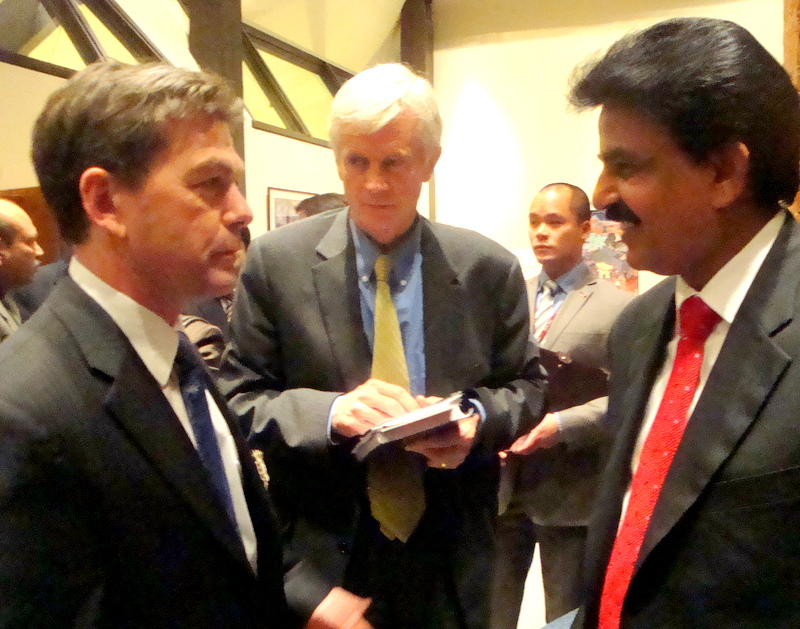
A few weeks ago the government had a reception in Ottawa for Shahbaz Bhatti (at the right in the photo)in, the Pakistanis minister for minorities. I was invited to attend, and was moved, in speaking with Mr. Bhatti, by his commitment to helping Christians and members of other religious minorities live as respected citizens.

Yesterday, he was assassinated in Islamabad.

Let us pray for the repose of his soul and the consolation of his family.

Please pray, too, for the Christians of that afflicted land.


Wednesday, March 2, 2011

Preparing for Lent with Fr. Vogels - Lettre à l'archidiocèse d'Ottawa pour le Carême


Father Walter Vogels guides scriptural reflection at Pastoral Day session

Last week at the Diocesan Centre we held two consecutive pastoral days for the francophone and anglophone sectors respectively.  Unfortunately, I had forgotten my camera on both occasions, but Deborah Gyapong attended the English Sector gathering and was kind enough to share with me her photos.

On Wednesday the Journée Pastorale featured Père Pierre-Olivier Tremblay, o.m.i. guiding us in a reflection on the shifting nature of the Catholic Parish, reflecting the changes in our society.  To assure itself of a future, he suggested each parish needs to be truly welcoming, offer programs in faith formation and development and help parishioners to become missionary in bringing the Good News to our contemporaries.

The next day, Father Walter Vogels, M. Afr. a Flemish-born scripture scholar helped participants enter into the first (Old Testament) readings for the first four Sundays of Lent. We were helped to see that the stories of the temptation and sin of Adam and Eve (first Sunday), the call of Abraham (second), the people rebelling against Moses in the desert (third Sunday) and the choice and anointing of David (fourth) were our stories, too. 

A very engaging and rewarding reflection.


Exploring the Lectionary

* * * * * *

MESSAGE DU CARÊME 2011


Mettre la parole de Dieu au cœur de nos vies

Le pape Benoît XVI s’est adressé à toute l’Église récemment, par la voie du document Verbum Domini, pour nous rappeler l’importance de la Parole de Dieu. Dans cette exhortation apostolique, le Saint-Père insiste pour que, en Église, la Parole de Dieu soit au cœur de toutes nos activités. Le carême est un temps idéal pour approfondir et mettre en pratique la Parole de Dieu.

Mieux connaître la Parole de Dieu, la méditer et la prier peut nous aider à mieux vivre notre carême cette année.

L’histoire qui est relatée dans les Saintes Écritures est celle de Dieu qui se rapproche de son peuple dans un lien d’amour. La Bible raconte comment le peuple choisi s’est souvent détourné de cet amour préférentiel de Dieu et comment Dieu l’a toujours ramené à lui.

Les textes de la Bible nous interpellent. Comme Abraham et Sarah, nous sommes appelés à vivre dans la foi et aller là où Dieu nous appelle.

Nous pouvons également nous reconnaître en David, cet homme toujours près du cœur de Dieu, qui a beaucoup péché et qui a su revenir vers Lui.

Nous sommes invités, chacun d’entre nous, à prendre Marie pour modèle, à dire oui au plan de Dieu pour nos vies, tout en cherchant intérieurement à comprendre sa pleine signification.

Dans les Saintes Écritures Dieu n’est pas seulement parole; il prend également un visage – celui de notre Seigneur Jésus Christ. Les évangiles et les épîtres nous invitent à vivre nos vies en union avec Jésus. Nous faisons cela en tant que membre de la grande famille de Dieu – l’Église – puisque c’est en son sein que nous avons été unis, par le baptême, à la vie du Ressuscité.

Durant le carême, nous sommes invités à prier pour ceux et celles qui se préparent à recevoir le baptême. De plus, par la prière, le jeûne et le partage, nous renouvelons notre engagement personnel à nous mettre en marche vers la sainteté, à laquelle nous sommes tous appelés.

L’Évangile du premier dimanche de Carême nous fait voir comment la connaissance personnelle de Dieu, qui se révèle à nous dans les Saintes Écritures, peut nous servir de guide dans nos vies. Dans le récit où Jésus tenté par Satan rejette le mal, nous voyons comment les Écritures peuvent nous nourrir alors que nous avons à lutter contre de multiples tentations qui peuvent nous éloigner de Dieu.

Les trois tentations présentées à Jésus représentent tous ces attraits qui peuvent nous éloigner de Dieu. En effet, Satan cherche à nous détourner de Dieu en faisant miroiter devant nous la recherche du confort et du bien-être, la quête du pouvoir et la possession des richesses de ce monde.

La Bible nous raconte que Dieu ne cherche pas à ‘tenter’ les humains, mais plutôt à les mettre à l’épreuve afin de voir ce qui est dans leurs cœurs. Les forces qui s’opposent à Dieu prennent souvent des allures impersonnelles : « la convoitise de la chair, la convoitise des yeux et l’orgueil de la richesse » (1 Jn 2, 16). En effet, toutes ces forces tentent d’ouvrir une brèche entre Dieu et les humains et à les amener à ne pas faire confiance à Dieu.

Jésus résiste à chacune des nombreuses flatteries du diable grâce aux forces qu’il tient de la relation intime qu’il a avec son Père du ciel.

La Parole de Dieu, telle que nous la retrouvons dans le Deutéronome, nous éclaire sur les textes qui viennent corroborer les efforts de Jésus alors qu’il résiste à chaque tentation : « l’homme ne vit pas seulement de pain, mais de tout ce qui sort de la bouche de Dieu » (Deutéronome 8, 3); « Ne mettez pas le Seigneur votre Dieu à l’épreuve » ( 6,16); « C’est le Seigneur ton Dieu que tu adoreras, lui que tu serviras » (6,13).

Le Mercredi des Cendres, les disciples de Jésus viennent l’entendre parler des grandes œuvres de toutes religions : pratiquer la charité, la prière et le jeûne ‘quand tu fais l’aumône…, quand tu pries…quand tu jeûnes’ (Mt 6, 1-18). En réaffirmant la valeur de ces anciennes pratiques, Jésus leur donne une signification nouvelle – ne cherche pas à te faire voir, mais plutôt à le faire dans le secret et la joie, seulement pour plaire à Dieu.

Comment entrer en carême avec Jésus? D’abord en participant à la messe dominicale et, lorsque cela est possible, à la célébration de l’Eucharistie en semaine. Dieu qui nous parle dans la liturgie de la Parole constitue, il va sans dire, une partie importante de la messe.

Les personnes qui ne peuvent se rendre à la messe en semaine pourront prendre quelques moments chaque jour pour lire des passages de la Parole de Dieu. Cela peut se faire seul ou en groupe : en famille, avec des voisins ou avec d’autres paroissiens, paroissiennes. Partager avec d’autres comment la Parole de Dieu nous rejoint dans nos vies peut les aider à demeurer fidèles.

En utilisant la méthode connue sous le nom de Lectio Divina (v. Verbum Domini no 86-87), une personne peut approfondir les lectures du dimanche durant toute la semaine ou prendre le temps de prier, de méditer, les passages des Saintes Écritures qui nous sont offerts chaque jour de la semaine. Le pape nous recommande fortement d’adopter cette méthode de lecture de la Bible.

Puisse le Seigneur nous accorder sa bénédiction alors que, nourris et fortifiés par la Parole de Dieu nous nous préparons à célébrer le mystère de Pâques avec un esprit et un cœur nouveau.

L’archevêque d’Ottawa

+Terrence Prendergast, s.j.


Tuesday, March 1, 2011

Ontario Auxiliary Bishops Named to Newfoundland and Labrador Dioceses - CCCB Staff Meet Pope Benedict XVI - St. David of Wales

Most Reverend Peter Hundt, bishop-elect of Corner Brook and Labrador, NL

Today it was announced in Rome that His Holiness Pope Benedict XVI has appointed as Bishop of Corner Brook and Labrador, NL the Most Reverend Peter Hundt, 54, currently Auxiliary Bishop of Toronto for the Northern Region (based in Barrie, ON), a bishop since 2006.


Archbishop Currie of St. John's, NL has been relieved of his responsibility for the Grand Falls diocese

The Holy Father has also accepted the resignation of the Most Reverend Martin William Currie as Bishop of Grand Falls, NL according to canon 401 § 2 (while remaining Archbishop of St. John’s) and has appointed as Bishop of Grand Falls, NL the Most Reverend Robert Anthony Daniels, 53, currently Auxiliary Bishop of London, based in Windsor, ON, a bishop since 2004.


Most Reverend Anthony Daniels, bishop-elect of Grand Falls, NL


* * * * * *

Leadership of Canadian Conference of Catholic Bishops
Meets in Rome with Pope Benedict XVI


Left to right with Pope Benedict XVI: CCCB President Mgr Pierre Morissette, Vice-President Archbishop Richard Smith, General Secretary Msgr Patrick Powers


From time to time the leaders of the Canadian Conference of Catholic Bishops travel to Rome to discuss with officials of the Roman Curia matters of mutual interest in the governance of the Church. When possible, the Holy Father receives our representatives, an especially fortuitous expression of the communion that is shared by the bishops of Canada with the Head of the College of Bishops. 

One such occasion was last week when Mgr Morissette and Archbishop Smith, accompanied by Msgr. Patrick Powers (incidentally, a priest of the Archdiocese of Ottawa) met with Pope Benedict at the close of their time spent visiting the various dicasteries.


* * * * * *

St. David of Wales (c. 520-c.588)


St. David's Day is celebrated as a Solemnity in Wales and a feast in England. Born probably in Cardigan about the year 520, he received his early training from St. Illtyd. He attracted many postulants to the monasteries he founded, all of which were remarkable for the austerity of their rule of life.

Consecrated bishop, according to his biographer, in Jerusalem, he was recognized as Primate of Wales and established his see at Mynyw (Menevia), the monastery of which he was abbot and where he died about the year 588. He is the principal patron of Wales.

In the image above, St. David is pictured standing on a mound with a dove on his shoulder. The legend is that once while he was preaching a dove descended to his shoulder and the earth rose to lift him high above the people so that he could be heard. Over 50 churches in South Wales were dedicated to him in pre-Reformation days.

Grant, we beseech you, almighty God, that the loving intercession of blessed David, your confessor and bishop, may protect us, and that while we celebrate his festival, we may also imitate his firmness in defending the Catholic faith.  Through our Lord.


.