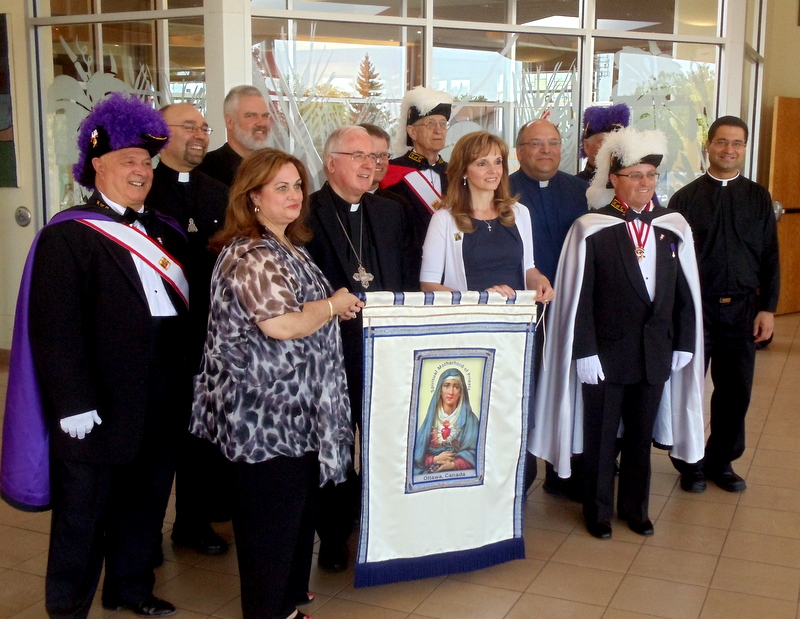
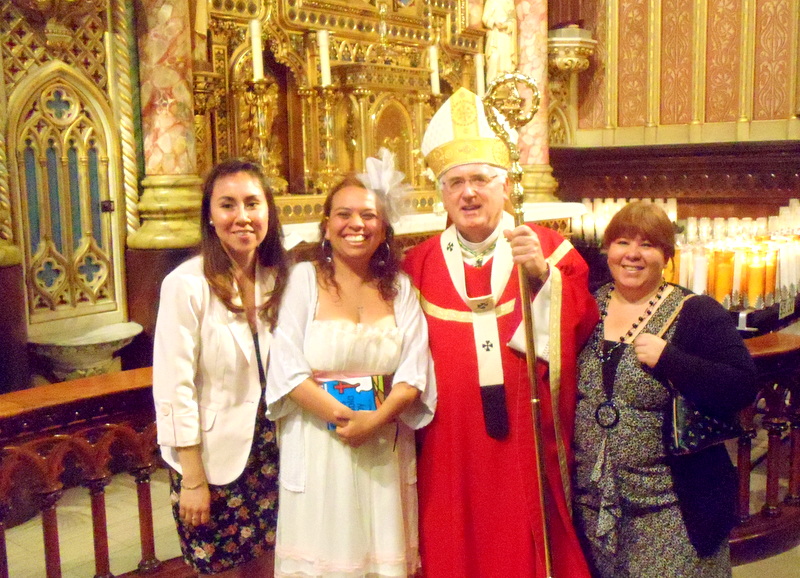
Church of Our Lady of Lourdes, Toronto, ON—May 25, 2013
JESUIT ORDINATIONS 2013: THE DIACONAL ORDINATION OF MATTHEW LIVINGSTON
& THE PRESBYTERAL ORDINATIONS OF TREVER SCOTT AND HENK VAN MEIJEL
[Texts: Exodus 3.1–6, 9–12; Psalm 89; 2 Timothy 1.6–14; John 21.15–19]

My dear Brothers and Sisters in Christ:
Since his election, Pope Francis has been surprising people with his genuine humanity and a refreshing frankness. His gestures keep on surprising Christians and many people outside the Church. He has also been witnessing to the way in which the Lord Jesus has been present in his life in the Church and the Society of Jesus.
Recently, Pope Francis spoke about a transforming moment in his life. At seventeen years of age on the first day of spring and the feast of St. Matthew in 1953, he was moved to enter a church. There, he made his confession to a priest. The priest helped him see that God desired utterly to show him mercy and called him to bear witness to that mercy in all his life.
Later, when named a bishop, Jorge Mario Bergoglio chose a motto from one of the saints, the Venerable Bede, that the liturgy recalls today. The saint described the conversion of Matthew the tax collector with the words “miserando atque eligendo.” Bergoglio used these words to describe his mission as a bishop. He would be a bishop by showing compassion and by making decisions… miserando atque eligendo. He was probably thinking about how he himself felt to have been selected by Christ to follow him. God was merciful to him and selected him. Thus, as a bishop, he would do the same. He would show mercy and make choices, in Jesuit terms, engage in discernment.
We might say that this was Pope Francis’s “burning bush” experience. Consider what happened to Moses. He was awestruck by encountering God and, simultaneously, he was called to minister to the Israelites who were caught in the bondage of slavery. So it is with our Pope. He was humbled to be chosen by God and called to share Jesus’ saving action in the sacraments and service to the poor to set people free from the bondage of sin.
Each of our ordinands has also experienced a call. Your origins are varied. For one, the life of a landscape equipment repair business.
For others, conversion from another religious tradition to life in the Catholic Church. Some of you have spent periods living in places as diverse as Europe, Asia and Africa. You are all called to the life of a vowed religious among the Jesuits in English Canada Province. You are called to serve in such varied ways as directing the Spiritual Exercises, entering into dialogue with Islam, and serving the Native Peoples of Ontario.
But the call to grow in discipleship is a continuing one. This led Jesus to invite Peter, after his three denials during the Passion, to renew his love. Peter allowed himself to be challenged to feed Christ’s flock, to care for God’s sheep. In the same vein, Paul reminded Timothy to “rekindle the gift of God that is in you through the laying on of my hands.” Ministry in the Church does not consist in cowardice, but shows forth “a spirit of power and of love and of self-discipline.”
In the days and years ahead, let us encourage our brothers who are ordained today to live out these realities as we hear the instruction that the Church sets before them and us. This is a wonderful occasion in the life of the Society of Jesus and the Church in Canada. Just as in the early Church, we do nothing without the Holy Spirit, and community is a safeguard. Please pray regularly for our brothers and their ministries. And brothers, I urge you to stay connected to your prayer support, to your confessor, and to the intercession of the Blessed Virgin.
* * *

Since these our brothers are now to be advanced to the Order of Deacons and the Order of Priests, consider carefully the nature of the rank in the Church to which they are about to be raised. They are to serve Christ the great Teacher, Priest, and Shepherd, by whose ministry his Body, the Church, is continually being built up here on earth into the People of God and the temple of the Holy Spirit.
Priests and Deacons, joined to the priestly office of Bishops, will be consecrated for the preaching of the Gospel, the sanctification and nourishment of God’s people, and for divine worship, especially in the Lord’s Sacrifice. With the help of God, they should go about all these duties in such a way that you will recognize them as true disciples of him who came not to be served, but to serve.
Now, Matthew, dear son, who are to be raised to the Order of the Diaconate, the Lord has given you an example that what he has done, you also should do.
As a Deacon, that is, a minister of Jesus Christ, who came among his disciples as one who served, do the will of God from the heart: serve the people in love and joy as you would the Lord. Since no one can serve two masters, look upon all defilement and avarice as serving false gods.
Since, by your own free choice you present yourself for the Order of the Diaconate, you should be a man of good reputation, filled with wisdom and the Holy Spirit, as were those once chosen by the Apostles for the ministry of charity.
You will exercise your ministry committed to the celibate state: know that celibacy is both a sign of pastoral charity and an inspiration to it as well as a source of spiritual fruitfulness in the world.
Compelled by the sincere love of Christ the Lord and living this state with total dedication, you will cling to Christ more easily with an undivided heart. You will free yourself more completely for the service of God and man, and minister more effectively in the work of spiritual rebirth.
Firmly rooted and grounded in faith, you are to show yourself chaste and beyond reproach before God and man, as is proper for a minister of Christ and of a steward of God’s mysteries. Never allow yourself to be turned away from the hope offered by the Gospel. Now, you are not only a hearer of this Gospel but also its minister.
Hold the mystery of faith with a clear conscience. Express by your actions the word of God which your lips proclaim, so that the Christian people, brought to life by the Spirit, may be a pure offering accepted by God. Then on the last day, when you go out to meet the Lord, you will be able to hear him say’ “Well done, good and faithful servant, enter into the joy of your Lord.”
* * *

Now, dear sons Henk and Trevor, you are to be raised to the Order of the Priesthood. For your part, you will exercise the sacred duty of teaching in the name of Christ the Teacher. Impart to everyone the word of God, which you have received with joy. Meditating on the law of the Lord, see that you believe what you read, that you teach what you believe, and that you practice what you teach.
In this way, let what you teach be nourishment for the People of God. Let the holiness of your lives be a delightful fragrance to Christ’s faithful, so that by word and example you may build up the house which is God’s Church.

Likewise, you will exercise in Christ the office of sanctifying. For by your ministry the spiritual sacrifice of the faithful will be made perfect, being united to the Sacrifice of Christ, which will be offered through your hands in an unbloody way on the altar, in union with the faithful, in the celebration of the Sacraments. Understand, therefore, what you do, and imitate what you celebrate. As celebrants of the mystery of the Lord’s Death and Resurrection, strive to put to death whatever in your members is sinful, and to walk in newness of life.
Remember, when you gather others into the People of God through Baptism, and when you forgive sins in the name of Christ and the Church in the Sacrament of Penance; when you comfort the sick with holy oil and celebrate the sacred rites, when you offer prayers of praise and thanks to God throughout the hours of the day, not only for the People of God but for the whole world--remember then that you are taken from among men and appointed on their behalf for those things that pertain to God. Therefore, carry out the ministry of Christ the Priest with constant joy and genuine love, attending not to your own concerns but to those of Jesus Christ.

Finally, dear sons, exercising for your part the office of Christ, Head and Shepherd, while united with the Bishop and subject to him, strive to bring the faithful together into one family, so that you may lead them to God the Father through Christ in the Holy Spirit. Keep always before your eyes the example of the Good Shepherd who came not to be served but to serve, and who came to seek out and save what was lost.
* * * * * *
A reception took place in the garden behind the Our Lady of Lourdes rectory.


* * * * * *
BISHOP ANTHONY KROTKI'S EPISCOPAL ORDINATION
IN RANKIN INLET, NUNAVUT

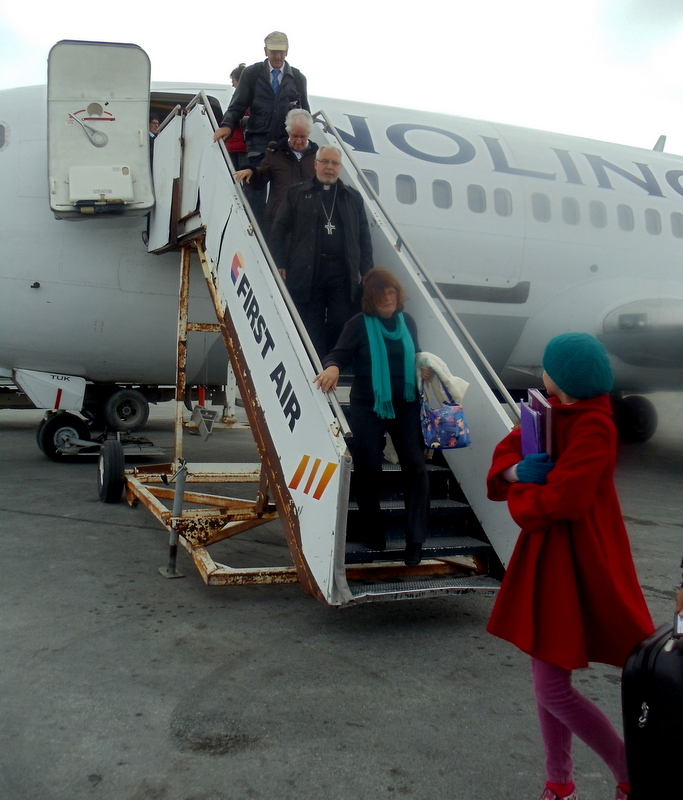
On May 30 at 5:25am EDT, a Nolinor charter flight left Ottawa airport for Rankin Inlet (via Winnipeg) for the ordination of Bishop Anthony Krotki, omi (known as "Father Tony" to the Inuit among he has served in ministry in the last 21 years since his arrival from Poland).
It was chilly (O degrees Celsius with a cold wind and lots of snow still hanging on in the town) but the 119 seat plane was filled with warmth and joy, as was the ceremony which was partly in English and partly in Inuktitut.
Following the colourful Mass, there was a feast in the town hall (with raw, frozen Arctic char and caribou meat in abundance--there was cooked food, too). Entertainment was singing and drumming, which Bishop Anthony joined in much to the delight of all present.
Thanks to Fr. Marian Gil, omi and Susan Laroche for most of the photos.



Best wishes to Bishop Krotki: ad multos annos!
* * * * * *
CATHOLIC DOCTORS MEET IN QUEBEC

For several years now, I have served as the liaison bishop for the Canadian Federation of Catholic Physicians' Societies and in that capacity attended their 5th Annual Conference in Quebec City from May 31 to June 2. We met in the Palace Royale Hotel and celebrated Mass on the Saturday in the Chapel of the Sisters of Charity of Quebec with its majestic painting of the Sacred Heart. My homily on the occasion is reproduced below.
Archbishop Gerald Lacroix presided at the Closing Mass at Notre Dame Cathedral, joined by Archbishops Christian Lepine (Montreal), Bertrand Blanchet (Emeritus of Rimouski) and Bishop Laurent Noel (Emeritus of Trois Rivieres, who will be feted for 50 years as a bishop on Friday). Photos: kindness of Dr. Ed Rzadki.
Célébration eucharistique
Colloque annuel de la Fédération canadienne des sociétés de médecins catholiques
Québec (Québec)
Le samedi de la 8e semaine du temps ordinaire – le 1er juin 2013
Messe célébrée en l’honneur de saint Justin, martyr
[LA SAGESSE], J’AI RÉSOLU DE LA METTRE EN PRATIQUE, ARDEMMENT…
[Textes : Sirac 51, 12-20 ; Psaume 18(19); Marc 11, 27-33]


Québec (Québec)
Le samedi de la 8e semaine du temps ordinaire – le 1er juin 2013
Messe célébrée en l’honneur de saint Justin, martyr
[LA SAGESSE], J’AI RÉSOLU DE LA METTRE EN PRATIQUE, ARDEMMENT…
[Textes : Sirac 51, 12-20 ; Psaume 18(19); Marc 11, 27-33]

Aujourd’hui, nous faisons mémoire de la vie et du martyr de saint Justin. Justin est né en Palestine vers l’an 100 après Jésus Christ et est mort décapité à Rome en l’an 165.
Justin est considéré comme un des plus grand philosophe et apologiste de l’Église naissante. Par ses écrits, il a été le premier à montrer la rencontre fructueuse qui existe entre la révélation chrétienne et la philosophie grecque. Il a dressé les premiers fondements d’une théologie de l’histoire.
Païen, élevé dans un environnement juif, Justin eut l’occasion d’étudier les principaux courants philosophiques qui avaient cours en son temps. Au terme d’un long itinéraire philosophique de recherche de la vérité, il parvint à la foi chrétienne et fut baptisé à Éphèse en l’an 132. Il voyagea beaucoup, cherchant toujours à proclamer auprès des gens éduqués qu’il rencontrait la philosophie chrétienne qu’il avait découverte et à les amener à se convertir au christianisme.
Suite à ses échanges avec le philosophe Crescens, père du cynisme, il fut victime de machinations de la part de ses adversaires qui le dénoncèrent comme étant une personne subversive auprès des autorités romaines. Il fut condamné à mort. Nous conservons encore des écrits attestant de son martyr.
Justin affirma que les vérités ultimes vers lesquelles tendent la philosophie grecque et la philosophie chrétienne sont comme deux voies qui mènent au Christ, au Logos. La foi chrétienne est en harmonie avec la raison.
Cette convergence tient à la relation qui existe entre la raison humaine et la pensée de Dieu. Ainsi, chaque personne, en tant que créature rationnelle, participe au Logos, porte en elle le ‘germe’ qui lui permet d’accueillir les lumières de la vérité.
Justin peut nous servir de modèle alors que nous sommes à réfléchir ensemble aux grandes questions qui se posent devant nous à ce colloque. En effet, nous avons a examiné des questions très importantes pour l’avenir de notre société, des questions qui ont trait à l’origine, au but et à la fin de la vie humaine et aux rapports qui existe ou qui doivent exister entre le médecin et son patient, entre le citoyen et les gouvernants dans notre culture contemporaine.

Le texte tiré du livre de Ben Sirac le Sage que nous venons d’entendre ressemble aux efforts de recherche de la vérité chez Justin. Ce texte peut guider notre propre recherche.
‘’Quand j’étais encore jeune et que je n’avais pas erré ça et là, aux yeux de tous j’ai cherché la Sagesse dans ma prière… (car) j’ai résolu de la mettre en pratique, ardemment j’ai désiré le bien et jamais je n’aurai à le regretter.’’
Au Canada, les catholiques ont, certainement, comme une de leurs principales missions, à promouvoir et à défendre la dignité de la vie humaine. Les enseignements chrétiens corroborent tout à fait ce que toute personne humaine souhaite pour elle-même et pour son prochain : soulager la souffrance et permettre que la mort puisse se vivre dans la paix et le respect de la dignité de la vie humaine. Voilà la mission à laquelle sont conviés le personnel des soins de santé et les hôpitaux catholiques.
Par contre, on peut dire qu’il continue d’y avoir dans ce domaine passablement de confusion et de questions laissées encore sans réponses dans la société canadienne. Par exemple, certaines réponses touchant la bioéthique, la fécondation in-vitro et la procréation assistée font objets de raisonnements douteux. Dans notre culture et dans les médias, plusieurs personnes ont évacué toutes considérations d’ordre morales ou religieuses dans le traitement de ces questions.
La raison nous permet de voir quel est notre devoir. Nous sommes en mesure de percevoir quelles sont les vérités, les considérations morales auxquelles il ne nous est pas permis de renoncer ou d’éviter. Ces vérités sont inscrites dans la loi naturelle et ont été confirmées dans les Dix Commandements et dans les enseignements de Jésus. Tu ne tueras point. Toute personne a droit à la vie.
L’euthanasie c’est tuer. Soyons francs et regardons la réalité en face. Les personnes qui préconisent le recours à l’euthanasie ont beau dire vouloir alléger la souffrance et dire vouloir permettre aux gens de mourir dans la dignité, le fait demeure que euthanasier c’est tuer, c’est mettre à mort une personne qui, le plus souvent, est faible et vulnérable en raison de sa maladie ou de son handicap.
Et il y a toutes ces perceptions fausses qui existent et qui sèment de la confusion parmi les gens et les empêchent de bien saisir la différence qui existe entre l’euthanasie et les soins palliatifs. Cesser de donner des soins médicaux en vue d’une guérison éventuelle lorsque cela n’est plus possible ou occasionnerait une trop grande souffrance – tout comme cesser de soutenir la vie artificiellement – ne constituent pas de l’euthanasie. Dans ces cas, la mort n’est pas voulue mais seulement prévue et tolérée comme inévitable (Catéchisme de l’Église catholique no.2279).
L’euthanasie n’a rien à voir avec ‘mourir dans la dignité’. Rien ne peut nous enlever notre dignité d’êtres humains, pas même les humiliations, la faiblesse et les souffrances qui peuvent survenir à la fin de notre vie.
L’euthanasie porte atteinte à la dignité de toutes personnes, surtout des plus vulnérables, des personnes dépendantes ou désavantagées. Elles deviennent des fardeaux dont nous pouvons disposées parce que trop onéreux. Les personnes handicapées et les membres de minorités de toutes sortes qui ont connus la discrimination et atteintes à leur dignité – tels les membres des premières nations – s’opposent fortement à l’euthanasie. Ces personnes considèrent, à juste titre, l’euthanasie comme une menace. Pour eux, l’euthanasie n’est pas un droit ou une liberté à acquérir, loin de là!

Les chrétiens sont appelés à alléger la souffrance dans le monde. En même temps, les chrétiens, chrétiennes savent qu’ils peuvent unir leurs souffrances à celles du Christ et les offrir pour le salut du monde (Colossiens 1, 24). Nos souffrances peuvent nous permettre de cheminer dans la foi.
Les chrétiens sont appelés à retenir trois principes essentiels lorsqu’ils ont à confronter la souffrance et la mort : la vie a une valeur tout à fait spéciale parce qu’elle est un don de Dieu; nous sommes appelés à toujours choisir de faire ce qui est bien; il ne nous est pas permis de faire le mal, même si notre intention est de faire advenir quelque chose de bien.
Nous avons le devoir de rendre visite aux malades et de prier avec eux. Voilà une grande vertu que nous sommes tous appelés à mettre en pratique. Les personnes confrontées à la mort ont besoin de se sentir aimées, de sentir qu’elles ne sont pas délaissées.
La population du Canada vieillit. Nos communautés et nos gouvernements doivent donc allouer des sommes additionnelles aux soins palliatifs afin que toutes personnes puissent avoir accès aux meilleurs soins possibles à la fin de leur vie, afin qu’elles n’aient pas à trop souffrir et puissent jouir d’une certaine qualité de vie. Si l’euthanasie était permise, plusieurs hôpitaux, des compagnies d’assurance et même certains gouvernements seraient tentés de s’en servir comme moyen d’alléger les coûts. Plusieurs y verraient une bonne façon d’épargner- en diminuant la disponibilité et la qualité des soins palliatifs.
J’espère et je prie de tout mon cœur pour que de nombreux jeunes catholiques choisissent de devenir des médecins et des professionnels de la santé – des professionnels compétents, conscients et ardents à défendre la vie humaine dans toute sa dignité.
Voilà donc la tâche importante qui nous est confiée. Nous, catholiques, sommes appelés à joindre nos forces à tous ces éthiciens, éthiciennes de bonne volonté qui, comme nous, luttent contre l’euthanasie. Nous devons faire réaliser à nos gouvernants que si la loi est modifiée pour permettre l’euthanasie volontaire, cela mènera inévitablement à la pratique de l’euthanasie involontaire. Plusieurs personnes - peut-être même la majorité des personnes euthanasiées – risqueraient d’être euthanasiées sans leur consentement. Il est presque impossible de faire en sorte qu’il en soit autrement.
La loi exerce une grande influence sur la moralité publique. Légaliser l’euthanasie nous priverait d’une grande protection que nous accordent présentement les droits de la personne. Nous sommes présentement au bord du précipice. La loi qu’entend présenter le gouvernement du Québec nous ferait plonger dans le gouffre.

Les défis auxquels nous sommes confrontés sont très grands. Comme ce fut le cas pour Jésus – tel que nous le rapporte Marc dans son évangile – nous devrons rendre compte de nos actions et de nos convictions. Nous devrons alors, un peu comme l’a fait saint Justin, montrer la logique et la justesse de notre raisonnement car, nous le savons, ce qui est inscrit dans un cœur droit et dans une pensée droite est conforme à la parole de Dieu telle que révélée dans les enseignements de Jésus.
Ne l’oublions pas - Le Seigneur nous a fait don non seulement de la Sagesse du royaume de Dieu mais également d’une nourriture qui nous permet de nous unir à lui dans l’œuvre du salut, la sainte Eucharistie.
Alors que commence cette journée d’échanges et de réflexions demandons au Seigneur de nous faire voir sa Sagesse faite chair dans le Christ et de nous donner la force de relever les défis qui se présentent à nous.
* * * * * *
SHARING THE BIBLE
IN TWO PARISHES

Two parish families (Holy Redeemer in Kanata and Assumption of the Blessed Virgin Mary in Vanier were catechized by representatives of the Neo-catechumenal Way. At the close of the first stage there is the ceremony of handing over the Word of God, a ceremony I presided at on Monday and Tuesday, May 27 and 28 respectively. Here are some photos from the two occasions.


* * * * * *
CONFIRMATIONS AT THE CATHEDRAL
ON SUNDAY OF THE MOST HOLY TRINITY

The last celebration of Confirmations in this Pastoral Year took place at Notre Dame Cathedral Basilica on Trinity Sunday (May 26). A few photos.