Friday, January 6, 2012

Congratulations to Cardinal-elect Thomas Collins! Changes in Canada's Liturgical Calendar - La porte de la foi / The Door of Faith


Today the Holy Father named Archbishop Thomas Collins of Toronto and twenty-one others Cardinals of the Church.  Congratulations, Your Eminences!  Congratulations, Archbishop Collins!


* * * * * *


Cast your kindly light upon your faithful, Lord, we pray, and with the splendour of your glory set their hearts ever aflame, that they may never cease to acknowledge their Saviour and may truly hold fast to him. Who lives and reigns with you in the unity of the Holy Spirit, one God, for ever and ever.


* * * * * *


CHANGES IN CANADA'S LITURGICAL CALENDAR


We have been accustomed to celebrating Brother Andre's feast on January 6, his "heavenly birthday" as he died on January 6, 1937.  But the Holy See did not want him to stay on this date as there are many countries in the world that still celebrate the Epiphany on this date, and their celebration of St. Andre Bessette would therefore be perpetually impeded. 

So in Canada's new liturgical calendar that came into effect with this liturgical year and the new (English) Roman Missal, we will celebrate him on January 7 (though in the USA his feast is kept on January 6).  Other changes in Canada's new liturgical calendar include the following modifications:

January 8: The transfer of the Patron of Canonists, St. Raymond of Penyafort from January 7, now dedicated to St. Andre Bessette.


Bishop Nykyta Budka

June 27: Addition of an optional memorial of the Blessed Nykyta Budka and Vasyl Velychkowsky, Bishops and Martyrs [of the Ukrainian Catholic Church];  Budka was the first Ukrainian Bishop in Canada but died in the Soviet Gulag.

Blessed Andre Grasset

September 2: Addition of Blessed Andre Grasset, Montreal-born Priest, Martyr of the French Revolution.

September 24: Transfer of Blessed Emelie Tavernier-Gamelin, Religious [because St. Pio of Pietrelcina is assigned her old date of September 23].

September 25: Transfer of Sts. Cosmas and Damian, Martyrs [because their date in the universal calendar, September 26, has been displaced in Canada by the Canadian Martyrs].

So far as I can tell, the other Canadian Saints and Blesseds retain on their feast-day dates from earlier versions of the liturgical calendar.


* * * * * *


La Porte de la foi et
L'annee de la foi 2012-2013


Communiqué à propos de la Note de la Congrégation pour la Doctrine de la Foi
relative aux indications pastorales de l'Année de la foi

L'Année de la foi a été annoncée par la Lettre apostolique Porta Fidei du 11 octobre 2011. Elle débutera le 11 octobre prochain, cinquantième anniversaire de l'ouverture du Concile oecuménique Vatican II, et se conclura le 24 octobre 2013, en la solennité du Christ Roi. Comme il l'a annoncé à l'aube de son pontificat, Benoît XVI entend replacer au centre de l'attention ecclésiale la rencontre avec Jésus-Christ, et avec la beauté de la foi qu'il dégage. Consciente des questions dont la foi est sujet, l'Eglise ressent comme tout à fait actuelle la question que le Seigneur se posait: Lorsque le Fils de l'homme reviendra sur terre, y trouvera-t-il encore la foi? (Lc 18, 8). Si la foi n'est pas revitalisée, déclarait le Saint-Père lors des voeux à la Curie Romaine (22 décembre 2011), si elle n'est pas une conviction profonde et une force tirée de la rencontre avec le Christ, aucune réforme ne sera efficace.

 A la demande du Saint-Père, en collaboration avec certains dicastères et le Comité préparatoire de l'Année de la foi, la Congrégation a rédigé une Note sur les indications pastorales de l'Année de la foi. Constitué près cette même congrégation, ce comité compte le Cardinal William Levada, le Cardinal Francis Arinze, le Cardinal Angelo Bagnasco, le Cardinal Ivan Dias, le Cardinal Francis E. George, le Cardinal Zenon Grocholewski, le Cardinal Marc Ouellet, le Cardinal Mauro Piacenza, le Cardinal Jean-Pierre Ricard, le Cardinal Stanisław Ryłko et le Cardinal Christoph Schönborn, Mgr. Salvatore Fisichella, Mgr. Luis F. Ladaria, Mgr. Mario Del Valle Moronta Rodríguez, Mgr. Gerhard Ludwig Müller et Mgr. Raffaello Martinelli.

 Daté de l'Epiphanie et publiée le lendemain, le document comprend une introduction, qui rappelle que l'Année de la foi entend contribuer à raviver chez tous les fidèles l'adhésion au Seigneur et à approfondir la foi. Ainsi pourront-ils être des témoins crédibles du Ressuscité, capable d'indiquer aux autres la porte de la foi.

 Le début de l'Année de la foi coïncide avec deux grands évènements de l'histoire de l'Eglise, l'ouverture de Vatican II (11 octobre 1962), concile voulu par le bienheureux Jean XXIII, et le Catéchisme de l'Eglise catholique (11 octobre 1992), voulu par le bienheureux Jean-Paul II.

 "A partir de la lumière du Christ, ...le Concile Vatican II a voulu approfondir la nature intime de l'Eglise et son rapport avec le monde contemporain... Après le concile, l'Eglise s'est engagée dans la réception et dans l'application de son riche enseignement, en continuité avec toute la tradition, sous la sûre direction du magistère".

"Pour favoriser une correcte réception du concile, les Souverains Pontifes ont convoqué à plusieurs reprises le Synode des évêques, ...en proposant à l'Eglise des orientations claires par le biais d'exhortations apostoliques post-synodales. La prochaine assemblée générale du Synode (octobre 2012) aura pour thème: La nouvelle évangélisation pour transmettre la foi chrétienne".

"Depuis le début de son pontificat, Benoît XVI s'est fermement engagé en faveur d'une juste compréhension du concile, repoussant comme erronée ce qu'on appelle "l'herméneutique de la discontinuité et de la rupture" et promouvant ce qu'il a baptisé "l'herméneutique de la réforme" et du renouveau dans la continuité".

Le Catéchisme de l'Eglise catholique, "fruit authentique du Concile Vatican II" qui prend place dans un "renouveau dans la continuité", comprend "du neuf et de l'ancien". Il reprend l'ordre traditionnel de la catéchèse qu'il articule en quatre parties: le Crédo, la liturgie, l'agir chrétien et la prière, tout en l'exprimant de manière à répondre à notre temps.
L'Année de la foi sera une excellente occasion pour étudier et diffuser le contenu de Vatican II et du Catéchisme.

 Les indications pastorales de la Note tendent à favoriser "la rencontre avec le Christ grâce à de vrais témoins de la foi, comme une meilleure connaissance des contenus de la foi". Celles ci n'entendent pas exclure d'autres propositions que l'Esprit pourrait susciter de par le monde parmi pasteurs et fidèles. Etant donné que ses compétences ne se limitent pas à la défense de la doctrine authentique et à la correction des erreurs, la Congrégation pour la doctrine de la foi apportera son soutien à tout ce qui favorise la vérité de la foi (Pastor Bonus, nn. 48-51).

 Les propositions de la Note s'articulent en quatre parties: 1) Eglise universelle; 2) Conférences épiscopales; 3) Diocèses; 4) Paroisses, Communautés, Associations et Mouvements, dont voici quelques exemples.

Parallèlement à l'ouverture solennelle de l'Année de la foi et aux autres manifestations présidées par le Pape, tels le Synode des évêques de 2012 ou la JMJ de 2013, on suggère des initiatives oecuméniques destinées à favoriser le rétablissement de l'unité des chrétiens. Ainsi, une cérémonie oecuménique solennelle réaffirmera la foi dans le Christ de tous les baptisés.

Les conférences épiscopales sont encouragées à améliorer la qualité de la formation catéchistique universelle comme celle des catéchismes et manuels locaux, afin qu'ils soient parfaitement conformes au Catéchisme de l'Eglise catholique. La même attention sera portée à l'utilisation des techniques de la communication et de l'expression artistique: émissions de radio et télévision, films et publications sur la foi et son contenu, sur la valeur ecclésiale de Vatican II, y compris pour le grand public.

Au niveau diocésain ensuite, cette année particulière devra être une occasion de faire dialoguer positivement foi et raison, par le biais de congrès ou de journées d'étude, notamment près les universités catholiques. Mais aussi d'organiser des cérémonies pénitentielles, qui insisteront tout particulièrement sur les péchés contre la foi.

Enfin, dans les diverses structures base de la communauté ecclésiale, on insistera sur la célébration de la foi dans la liturgie, tout particulièrement dans l'Eucharistie car, "dans l'Eucharistie, mystère de la foi et source de la nouvelle évangélisation, c'est la foi de l'Eglise qui est proclamée, célébrée et fortifiée". De toutes ces initiatives doivent naître, croître et dépendre toutes les autres propositions, en particulier celles des nouvelles communautés et mouvements ecclésiaux.

 Un Secrétariat pour l'Année de la foi sera institué près le Conseil pontifical pour la nouvelle évangélisation, qui coordonnera les initiatives des dicastères romains comme celle de dimension ecclésiale universelle. En mesure de proposer des initiatives pour l'Année, il disposera d'un site internet spécifique destiné à fournir toutes les informations sur son déroulement.

Les indications pastorales de la Note de la Congrégation pour la doctrine de la foi veulent inviter tous les fidèles à s'engager dans l'Année de la foi, afin de "partager ce que le chrétien a de plus cher, le Christ Jésus, rédempteur de l'homme, roi de l'univers, principe et finalité de la foi".


* * * * * *

The Door of Faith &
the Year of Faith 2012-2013


 Communiqué on the Note of the Congregation for the Doctrine of the Faith
with pastoral recommendations for the Year of Faith

With his Apostolic Letter Porta fidei of 11 October 2011, Benedict XVI declared a Year of Faith. It will begin on 11 October 2012, 50th anniversary of the opening of Vatican Council II, and will conclude on 24 November 2013, Solemnity of Our Lord Jesus Christ Universal King. The Holy Father's aim in promulgating this Year is to focus the attention of the Church on the theme which, since the beginning of his Pontificate, has been closest to his heart: the encounter with Jesus Christ and the beauty of having faith in Him. The Church is well aware of the problems facing the faith and feels impelled by the question Jesus Himself raised: «When the Son of Man comes, will he find faith on earth?» (Lk 18: 8). Therefore, «if faith does not take on new life, deep conviction and real strength from the encounter with Jesus Christ, then all other reforms will remain ineffective» (Christmas address to the Roman Curia, 22 December 2011).

By order of Benedict XVI, la Congregation for the Doctrine of the Faith has prepared a Note with pastoral recommendations for the Year of Faith. The Note was written in consultation with other Dicasteries of the Holy See and with the help of the Committee for the Preparation of the Year of Faith. That Committee, by pontifical mandate, is under the auspices of the Congregation for the Doctrine of the Faith and includes among its members: Cardinals William Levada, Francis Arinze, Angelo Bagnasco, Ivan Dias, Francis E. George, Zenon Grocholewski, Marc Ouellet, Mauro Piacenza, Jean-Pierre Ricard, Stanisław Ryłko and Christoph Schönborn; Archbishops Salvatore Fisichella and Luis F. Ladaria; and Bishops Mario del Valle Moronta Rodríguez, Gerhard Ludwig Müller and Raffaello Martinelli.

The Note is dated 6 January 2012, Solemnity of the Lord's Epiphany, and will be published the following day 7 January. It contains an introduction followed by a number of pastoral recommendations. The Introduction explains that «the Year of Faith is intended to contribute to a renewed conversion to the Lord Jesus and to the rediscovery of faith, so that the members of the Church will be credible and joy-filled witnesses to the Risen Lord, capable of leading those many people who are seeking it to the door of faith».

«The beginning of the Year of Faith coincides with the anniversaries of two great events which have marked the life of the Church in our days: the fiftieth anniversary of the opening of the Second Vatican Council, called by Blessed Pope John XXIII (11 October 1962), and the twentieth of the promulgation of the Catechism of the Catholic Church, given to the Church by Blessed Pope John Paul II (11 October 1992)».

Vatican Council II, «beginning with the light of Christ, ... wanted to elaborate on the intimate nature of the Church and its relationship with the contemporary world». «After the Council the Church – under the sure guidance of the Magisterium and in continuity with the whole Tradition – set about ensuring the reception and application of the teaching of the Council in all its richness».

«To assist in the correct reception of the Council, the Popes have frequently convoked the Synod of Bishops, ... providing the Church with clear guidance through the various post-Synodal Apostolic Exhortations. The next General Assembly of the Synod of Bishops, to be held in October 2012, will have as its theme: The New Evangelisation for the Transmission of the Christian Faith».

«From the beginning of his pontificate, Pope Benedict XVI has worked decisively for a correct understanding of the Council, rejecting as erroneous the so-called "hermeneutic of discontinuity and rupture" and promoting what he himself has termed "the 'hermeneutic of reform', of renewal in continuity"».

The Catechism of the Catholic Church, being an «authentic fruit of Vatican Council II» (Apostolic Letter Porta fidei, no. 4), is an integral part of that "renewal in continuity". It includes «what is new and what is old» (Mt 13: 52). On the one hand, it embraces the old and traditional order of the catechesis, being divided into four parts: the Creed, the liturgy, Christian life and prayer; but at the same time it expresses this in a new way, in order to respond to the questions of our own times.

The Year of Faith will be a propitious occasion to make Vatican Council II and the Catechism of the Catholic Church more widely and deeply known.

The pastoral recommendations contained in the Note aim «to aid both the encounter with Christ through authentic witnesses to faith, and the ever-greater understanding of its contents». Through these pastoral recommendations - which do not intend to preclude «other initiatives which the Holy Spirit will inspire among Pastors and faithful in various parts of the world» - the Congregation for the Doctrine of the Faith is seeking to offer its help, because its specific functions include not only safeguarding sound doctrine and correcting errors but also, and foremost, promoting the truth of the faith (cf. Apostolic Constitution Pastor Bonus, nos. 48-51).

The Note groups its suggestions onto four levels: 1) Universal Church, 2) Episcopal Conferences, 3) Dioceses and 4) Parishes, Communities, Associations, Movements. Some of the specific suggestions it makes are given below.

For example, along with the solemn opening celebration for the Year of Faith and other events in which the Holy Father will participate (Assembly of the Synod of Bishops, WYD 2013), various ecumenical initiatives are being planned «aimed at "the restoration of unity among all Christians"». Moreover «there will be a solemn ecumenical celebration in which all of the baptised will reaffirm their faith in Christ».

On the level of Episcopal Conferences, attention will be given to the quality of catechesis, and efforts will be made to examine «local catechisms and various catechetical supplements in use in the particular Churches … to ensure their complete conformity with the Catechism of the Catholic Church». It is also hoped that use will be made of the language of the mass media and art, with «television and radio transmissions, films and publications focusing on the faith, its principles and content, as well as on the ecclesial significance of Vatican Council II».

At the diocesan level, the Year of Faith is considered, among other things, as an occasion for «renewed creative dialogue between faith and reason in the academic and artistic communities, through symposia, meetings and days of study, especially at Catholic universities», and as a favourable time for «penitential celebrations … in which all can ask for God's forgiveness, especially for sins against faith».

At the parish level the focus remains on the celebration of the faith in the liturgy, especially in the Eucharist, because «in the Eucharist, mystery of faith and source of the new evangelisation, the faith of the Church is proclaimed, celebrated and strengthened». It is on this foundation that other initiatives will come into being, develop and spread, particularly those undertaken by Institutes, new Communities and Ecclesial Movements.

«A Secretariat to coordinate all of the different initiatives promoted by various Dicasteries of the Holy See, or other events relevant to the Universal Church, will be established within the Pontifical Council for the Promotion of the New Evangelisation». The Secretariat «can also suggest appropriate initiatives» for the Year of Faith, and «will open a dedicated website with the goal of making available useful information» on the subject.

The recommendations contained in the Note invite all members of the Church to work to ensure that, during the Year of Faith, we may rediscover and «share that which is most dear to us: Christ Jesus, the Redeemer of mankind, Universal King, "leader and perfecter of faith" (Hb 12: 2)».


Thursday, January 5, 2012

Thursday before Epiphany - St. John Neumann, CSsR - Christmas Season Images (Ottawa)


O God, who by the Nativity of your Only Begotten Son wondrously began for your people the work of redemption, grant, we pray, to your servants such firmness of faith, that by his guidance they may attain the glorious prize you have promised. Through our Lord Jesus Christ, your Son, who lives and reigns with you in the unity of the Holy Spirit, one God, for ever and ever.

* * * * * *


ST. JOHN NEUMANN
SAINTLY BISHOP OF PHILADELPHIA


Perhaps because the United States got a later start in the history of the world, it has relatively few canonized saints, but their number is increasing.

John Neumann was born in what is now the Czech Republic. After studying in Prague, he came to New York at 25 and was ordained a priest. He did missionary work in New York until he was 29, when he joined the Redemptorists and became its first member to profess vows in the United States. He continued missionary work in Maryland, Virginia and Ohio, where he became popular with the Germans.

Neumann took seriously our Lord’s words, “Go and teach all nations.” From Christ he received his instructions and the power to carry them out. For Christ does not give a mission without supplying the means to accomplish it. The Father’s gift in Christ to John Neumann was his exceptional organizing ability, which he used to spread the Good News.

Today the Church is in dire need of men and women to continue in our times the teaching of the Good News. The obstacles and inconveniences are real and costly. Yet when Christians approach Christ, he supplies the necessary talents to answer today’s needs. The Spirit of Christ continues his work through the instrumentality of generous Christians.

At 41, as bishop of Philadelphia, he organized the parochial school system into a diocesan one, increasing the number of pupils almost twentyfold within a short time.

Gifted with outstanding organizing ability, he drew into the city many teaching communities of sisters and the Christian Brothers. During his brief assignment as vice provincial for the Redemptorists, he placed them in the forefront of the parochial movement.

Well-known for his holiness and learning, spiritual writing and preaching, on October 13, 1963, John Neumann became the first American bishop to be beatified. Canonized in 1977, he is buried in St. Peter the Apostle Church in Philadelphia.


* * * * * *


IMAGES DE NOEL
(OTTAWA)


Cathédrale-basilique Notre Dame Cathedral Basilica


Crèche dehors/outside Christmas Crib


Portes formelles de l’archevêché /
Formal Doors of the Archbishop’s Residence
 

Wednesday, January 4, 2012

Wednesday before Epiphany - Sunday of the Epiphany B - St. Elizabeth Ann Seton


Grant us, almighty God, that the bringer of your salvation, who for the world’s redemption came forth with newness of heavenly light, may dawn afresh in our hearts and bring us constant renewal. Who lives and reigns with you in the unity of the Holy Spirit, one God, for ever and ever.


* * * * * *

Solemnity of the Epiphany (Year “B”) - January 8, 2012
IN WHAT YEAR WAS JESUS BORN?
[Isaiah 60.1-6; [Psalm 72]; Ephesians 3.2-3, 5-6; Matthew 2.1-12]


Elm Street, a magazine published “for Canadian women” until 2004 was distributed free in some urban centres of Canada at its launch in 1999.  One came to my house in Halifax.  The 1999 Holiday edition caught my eye because of its cover story “And Heaven and Nature Sing”, a feature on the Jesuits who work at the Vatican Observatory.

In discussing the ways in which science and faith can relate, the author, Alison Rose told how the year before, just before Christmas, Vatican workers were seen setting up a crib at Castel Gandolfo where the Observatory offices are located.  The last statues to be added were those of Caspar, Melchior and Balthazar, ancient astronomers who followed a sign in the heavens they believed would lead them to a new-born king.

When she mentioned this to Jesuit brother Guy Consolmagno, he called up on his Mac computer "Voyager", a program used by amateur astronomers to observe the stars.  After typing in 6 BC, a date commonly assigned to the birth of Jesus, the program slowly projected onto the screen a series of dots on the horizon that depicted “an extraordinary alignment of Venus, Saturn, the moon, Jupiter, sun, Mars and Mercury, all centred on the constellation Aries, in the sky over Judea, on April 17, 6 BC”.

The writer wonders whether this is “the event that the wise men calculated, that in the telling and retelling of the story over two millennia has been transformed into a star?  According to the story, this is the moment when a transcendent God entered space and time, long ago, to live a human life” (p. 40).  This is an unusual reflection in today's secular media, the type that perhaps only the Christmas story can still occasion.

Today's solemnity of the Epiphany, the “manifestation” or “revelation” of Jesus to “wise men from the East”, to non-Jews, the Gentiles, evokes the beautiful sentiments attached to gift-giving and the profound implications of a surrender to Christ:

“On entering the house, they saw the Child with Mary His Mother; and they knelt down and paid him homage”.  Then, “opening their treasure chests, they offered him gifts of gold, frankincense, and myrrh”.

This year, as people adjust to writing 2012, indicating how many years ago Jesus’ birth took place, it may seem odd to realize that he was likely born around 6 BC.  How do we arrive at this date and how could such a miscalculation have happened?

Scripture tells us that Jesus was born in Bethlehem of Judea “in the time of King Herod” (Matthew 2.1).  But we know from world history that Herod began his rule in 37 BC and died in 4 BC.  Therefore, Jesus' birth had to have been prior to this latter year.

At the close of today's gospel account, we are told that the Magi, after being warned in a dream not to return to Herod's court in Jerusalem, “left for their own country by another road”.  This infuriated Herod, who ordered the slaughter of the Holy Innocents, “all the children in and around Bethlehem who were two years old or under, according to the time that he had learned from the wise men” (2.16).  This has led scholars to assign a date for the birth of Jesus between 7 and 4 BC.

But how did the miscalculation come about, if Jesus' birth was meant to be the watershed between BC (Before Christ) and AD (Anno Domini, the “Year of the Lord”)?

Our distinction between BC and AD dates to the sixth century when a monk named Dionysius Exiguus worked out a chronology intended to centre on the birth of Christ.  Unfortunately, his calculations were off by six years!

As well, in his scheme, the year 1 AD immediately followed the year 1 BC, so there was no year 0.  Accordingly, a decade ago, many held that the second millennium could not be complete until the end of the year 2000, and so the Third Millennium only began in the year 2001.

For Christians, however, the Great Jubilee celebration was for 2000 years of the presence of Jesus in our world, the occasion for a year of thanksgiving for all the peoples of the world. 

Whatever the calculation of the years or the stars, our age—like past generations—prays with the psalmist, “May he judge your people with righteousness, and your poor with justice”.

* * * * * *


SAINT ELIZABETH ANN SETON


Today in the United States and in the Archdiocese of Halifax-Yarmouth, the feast day of Mother Seton, founder of the Sisters of Charity and architect of the Catholic school is observed.


Mother Seton is one of the keystones of the American Catholic Church. She founded the first American religious community for women, the Sisters of Charity. She opened the first American parish school and established the first American Catholic orphanage. All this she did in the span of 46 years while raising her five children.

Elizabeth Ann Bayley Seton is a true daughter of the American Revolution, born August 28, 1774, just two years before the Declaration of Independence. By birth and marriage, she was linked to the first families of New York and enjoyed the fruits of high society. Reared a staunch Episcopalian by her mother and stepmother, she learned the value of prayer, Scripture and a nightly examination of conscience. Her father, Dr. Richard Bayley, did not have much use for churches but was a great humanitarian, teaching his daughter to love and serve others.

The early deaths of her mother in 1777 and her baby sister in 1778 gave Elizabeth a feel for eternity and the temporariness of the pilgrim life on earth. Far from being brooding and sullen, she faced each new “holocaust,” as she put it, with hopeful cheerfulness.

At 19, Elizabeth was the belle of New York and married a handsome, wealthy businessman, William Magee Seton. They had five children before his business failed and he died of tuberculosis. At 30, Elizabeth was widowed, penniless, with five small children to support.

While in Italy with her dying husband, Elizabeth witnessed Catholicity in action through family friends. Three basic points led her to become a Catholic: belief in the Real Presence, devotion to the Blessed Mother and conviction that the Catholic Church led back to the apostles and to Christ. Many of her family and friends rejected her when she became a Catholic in March 1805.

To support her children, she opened a school in Baltimore. From the beginning, her group followed the lines of a religious community, which was officially founded in 1809.

The thousand or more letters of Mother Seton reveal the development of her spiritual life from ordinary goodness to heroic sanctity. She suffered great trials of sickness, misunderstanding, the death of loved ones (her husband and two young daughters) and the heartache of a wayward son. She died January 4, 1821, and became the first American-born citizen to be beatified (1963) and then canonized (1975). She is buried in Emmitsburg, Maryland.


* * *

O God, who crowned with the gift of true faith Saint Elizabeth Ann Seton's burning zeal to find you, grant by her intercession and example that we may always seek you with diligent love and find you in daily service with sincere faith. Through our Lord Jesus Christ....

Tuesday, January 3, 2012

The Holy Name of Jesus - VISITE À RICHELIEU


OPTIONAL MEMORIAL
THE HOLY NAME OF JESUS


O God, who founded the salvation of the human race on the Incarnation of your Word, give your peoples the mercy they implore, so that all may know there is no other name to be invoked but the Name of your Only Begotten Son. Who lives and reigns with you in the unity of the Holy Spirit, one God, for ever and ever.


* * * * * *


Some thoughts for the Feast of the Holy Name of Jesus from Fr. Aaron Pidel, SJ, who blogs at www.whosoeverdesires.wordpress.com:

Given the significance of the Holy Name, we might do well to reflect a bit on the commandment corresponding to this gift—“Thou shalt not take the name of the Lord, thy God, in vain.”  Since the Lord’s name is a token of both majesty and nearness, observing this commandment means approaching God from two sides.  On the side of majesty, we reverence God’s name.  We don’t call upon Him flippantly or emptily.  The Catholic liturgy models this reverence when it calls for the priest to bow his head slightly at every mention of the name of Jesus.  This is one side of the second commandment.

But there is another side that perhaps we consider less often–the side of nearness.  God has revealed his name to us, it seems, with a very definite purpose: to persuade us that He is the sort of God who sees, who judges, who has concrete plans for our lives, who expects us to call upon Him and to enter ever more deeply into His friendship.  An important way of not using God’s name in vain, therefore, is to respect this purpose—i.e., to cultivate friendship with Him.

But how does one go about cultivating such a friendship?  St. Ignatius used to describe the sort of prayer most suited to a God with a name as “colloquy” or conversation.  He first encouraged the one praying to review Jesus’ words and deeds in the Gospels, and then—like Mary—“to reflect on these things in her heart.  After reflection, the one praying, in a way both intimate and reverent, was to talk to God about what stirred within him.  In St. Ignatius’ words,

The colloquy is made by speaking exactly as one friend speaks to another, or as a servant speaks to a master, now asking him for a favour, now blaming himself for some misdeed, now making known his affairs to him, and seeking advice in them (Ex. Sp. #54).

As a servant to a master.  Yet as one friend to another.  It’s for such reverent friendship that God revealed his Holy Name.  It’s left to us to see that He not have revealed it in vain.


* * * * * *


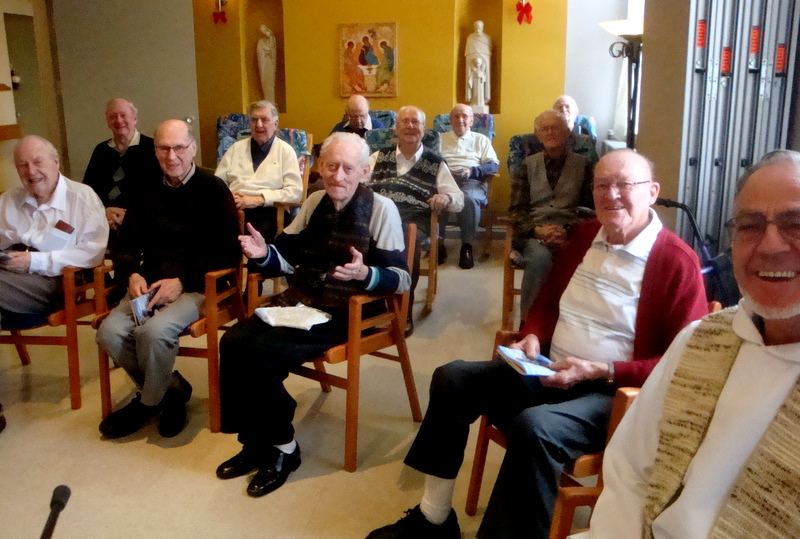
Visite aux prêtres retraités à Richelieu

 
De gauche a droite: Pere Latourelle, Mgr Quesnel, Pere Tache

 
Le 27 décembre pendant un séjour à Montréal avec ma parenté et les jésuites de Loyola, je suis allé à Richelieu pour une visite à Mgr Roger Quesnel de notre archidiocèse et aux oblats et jésuites dans leurs infirmeries là-bas.  J’ai célébré l’eucharistie avec mes confrères jésuites et j’ai diné en compagnie de Mgr Quesnel, et les pères Alexandre Taché, omi et René Latourelle, s.j.

Voici quelques photos :


Monday, January 2, 2012

The Memorial of St. Basil the Great & St. Gregory Nazianzen - Papal Prayer Intentions - Clergy Luncheon


St. Basil (329-379) was a brilliant student born of a Christian family in Caesarea, Cappadocia (Turkey).

For some years, he followed the monastic way of life.

He vigorously fought the Arian heresy.

He become Archbishop of Caesarea in 370.

Monks of the Eastern Church today still follow the monastic rules which he se down.


St. Gregory (329-389) was also from Cappadocia.

A friend of St. Basil, he too followed the monastic way of life for some years.

In 381 he became Archbishop of Constantinople.

It was during this period the Arian heresy was at it height.

He was called "The Theologian" because of his great learning and talent for oratory.


* * * * * *

O God, who were pleased to give light to your Church by the example and teaching of the Bishops Saints Basil and Gregory, grant, we pray, that in humility we may learn your truth and practise it faithfully in charity. Through our Lord Jesus Christ, your Son, who lives and reigns with you in the unity of the Holy Spirit, one God, for ever and ever.


* * * * * *


The Holy Father's January Prayer Intentions
Victims of Natural Disasters. That the victims of natural disasters may receive the spiritual and material comfort they need to rebuild their lives.

 Dedication to Peace. That the dedication of Christians to peace may bear witness to the name of Christ before all men and women of good will.


* * * * * *

CHRISTMAS CLERGY LUNCHEON


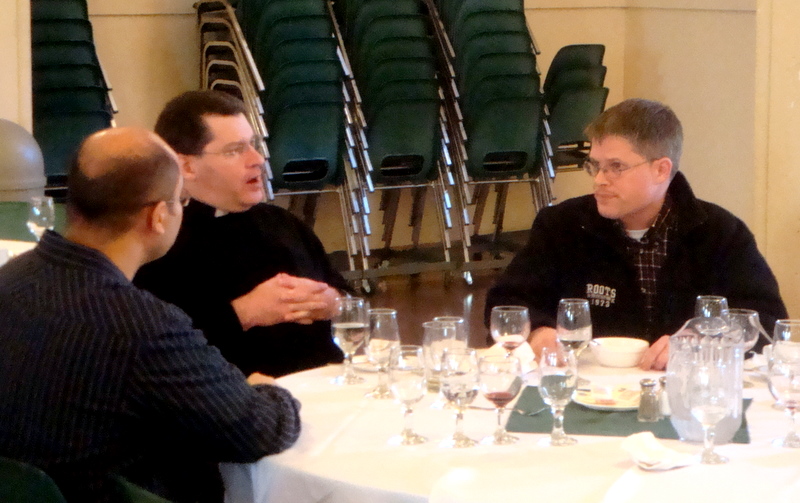
On Thursday, close to 80 priests and seminarians dropped in for the annual Christmas luncheon held between Christmas and New Year's at my residence and the Notre Dame cathedral parish hall.  Dress is casual and spirits were upbeat. 

Some photos:


Sunday, January 1, 2012

New Year's Day 2012 - Solemnity of Mary, Mother of God - World Day of Prayer for Peace


Bonne et heureuse année!
Happy New Year!


* * * * * *


Mary, the Mother of God (Theotokos)


SOLEMNITY OF MARY,
THE HOLY MOTHER OF GOD

O God, who through the fruitful virginity of Blessed Mary bestowed on the human race the grace of eternal salvation, grant, we pray, that we may experience the intercession of her, through whom we were found worthy to receive the author of life, our Lord Jesus Christ, your Son. Who lives and reigns with you in the unity of the Holy Spirit, one God, for ever and ever.

* * * * * *


45th WORLD DAY OF PRAYER
FOR PEACE

Pope Benedict speaks to, and challenges, youth:

Do not be afraid to make a commitment, to face hard work and sacrifice, to choose the paths that demand fidelity and constancy, humility and dedication.
Be confident in your youth and its profound desires for happiness, truth, beauty and genuine love!
Live fully this time in your life so rich and so full of enthusiasm.
Realize that you yourselves are an example and an inspiration to adults, even more so to the extent that you seek to overcome injustice and corruption and strive to build a better future.
Be aware of your potential; never become self-centered but work for a brighter future for all. You are never alone.
The Church has confidence in you, follows you, encourages you and wishes to offer you the most precious gift she has: the opportunity to raise your eyes to God, to encounter Jesus Christ, who is himself justice and peace.
All you men and women throughout the world, who take to heart the cause of peace: peace is not a blessing already attained, but rather a goal to which each and all of us must aspire.
Let us look with greater hope to the future; let us encourage one another on our journey; let us work together to give our world a more humane and fraternal face; and let us feel a common responsibility towards present and future generations, especially in the task of training them to be people of peace and builders of peace.


* * * * * *

PEACE

My soul, there is a country,
Afar beyond the stars,
Where stands a wingèd sentry,
All skillful in the wars.

There, above noise and danger,
Sweet Peace sits crowned with smiles,
And One born in a manger
Commands the beauteous files.

He is thy gracious Friend
And (O my soul, awake!)
Did in pure love descend,
To die here for thy sake.

If thou canst get but thither,
There grows the flower of peace,
The rose that cannot wither,
Thy fortress, and thy ease.

Leave, then, thy foolish ranges;
For none can thee secure
But One, who never changes,
Thy God, thy Life, thy Cure.

(Henry Vaughan, 1650)

* * * * * *

A VISIT FROM THE KERR FAMILY


From Barry's Bay, Ann-Marie and Colin Kerr came to Ottawa for the Mass on the Feast of the Holy Family and a visit to get caught up on recent developments, including the birth of their youngest daughter, Lauren.

Despite the bitter cold, we walked up to Parliament Hill to see the illuminations and stopped in at the Chateau Laurier to see the decorations and to warm up. 

Some photos:


Isaiah holding Lauren, Sarah-Grace and Rebecca, Stephen