Tuesday, September 7, 2010

Some Recent Visitors - A New Book: Sex au Naturel

In the last ten days, I have had the pleasure of receiving visitors, both family and friends.

It has been delightful to get caught up on relationships, tour the Capital with those who are charmed by the beauty and orderliness of Ottawa (prescinding, of course, from the construction chaos found all around on our streets).

Jesuit Matthew Livingstone dropped in while visiting his parents in Oxford Mills; we were able to catch up on his teaching of philosophy at Campion College, his studies in Damascus, Syria this summer to assist with his interest in Arabic philosophy and his anticipation of embarking on studies preparatory to the priesthood at Regis College, Toronto.

My niece Patricia and her husband Peter came from Burlington to help with their daughter Katie's move into residence at the University of Ottawa where she will start her studies in Fine Arts.

Dear friend Msgr. Michel Palud superior of the Mission Society of Mandeville, a diocese in Jamaica, was a welcome weekend visitor. Some photos:

Matthew Livingstone enjoying the sun deck with Fr. Vernon Boyd

Patricia and Peter Lawson

Katie joins us for dinner in the nearby Byward Market

The Parliament Buildings viewed from Nepean Point make a great photo backdrop

* * * * * *

A NEW BOOK ON SEXUALITY FOR CATHOLICS AND OTHERS

From time to time, I am asked to read a manuscript to provide a comment for the publisher's blurbs that are on the dustjacket or inside the book.

Recently, I did so for an author with roots in Canada (Halifax and Montreal). Though I knew the book had been published, I had not seen a copy on sale until I noticed it among the new books on display at St. Patrick's Basilica's book store (a good source for a wide selection of Catholic literature). It sells for C$15.95, and is listed at Amazon for US$12.95 (but then there are shipping and handling charges).

Here is what I said:

In Sex au Naturel, Patrick Coffin defends Pope Paul VI’s controversial encyclical Humanae vitae and John Paul II’s subsequent papal teaching on sexuality now known as The Theology of the Body.

Witty, provocative and informative, this vademecum for a new generation proud to affirm allegiance to sound Catholic principles will delight and challenge its readers.

A book that is eminently readable, I am pleased to recommend it with enthusiasm.


Here are some other details taken from the Emmaus Road publisher's website:

Sex Au Naturel: What It Is and Why It’s Good For Your Marriage by radio host Patrick Coffin is a bracing ride across the landscape of the Catholic sexual ethic. If you’re looking for intellectual ammo with which to defend and explain the teaching of Humanae Vitae, or if you reject it altogether, you’ll agree that Coffin approaches the topic from a wide array of new and persuasive angles. With humor and enthusiasm—and a total absence of moralizing—you'll learn:

• Why Paul VI’s landmark 1968 encyclical was widely rejected a generation ago and why it’s gaining new respectability now
• Where exactly the Bible teaches against birth control
• The differences between contraception and natural family planning (hint: they’re more profound than you think)
• The meaning of the natural law and how it applies to birth control
• How the dogma of the Blessed Trinity implicitly condemns birth control
• That every single Protestant denomination rejected birth control until 1930
• Why the myth of overpopulation is used against the Church, and how to answer it
• How faithful adherence to the teaching of Humanae Vitae is causally related to marital happiness and longevity
• Why it’s not too late to start over, even if you’ve been sterilized
• How to rely on the ever-present grace of God rather than your own strength in faithfully following this challenging, life-giving aspect of Christian discipleship
• Much, much more!

Patrick Coffin is the host of Catholic Answers Live, the number-one rated Catholic radio show in America, heard nationwide Monday to Friday, 3PM-8PM Eastern. He has published dozens of articles, essays, and interviews.

Born in Nova Scotia, he is an alumnus of Mount Saint Vincent University in Halifax, McGill University in Montreal, and Franciscan University of Steubenville in Ohio, where he obtained a master's degree in theology. He lives in San Diego with his wife, Mariella, and their two daughters [-- www.emmausroad.org].

Monday, September 6, 2010

New Missal in Canada - Photos of this weekend's Cathedral Dedication Anniversary - The Pope's Trip to the UK

Today is Labour Day, a transition day as the lazy, hazy days of summer become memories and give way to the activity of the approaching academic and pastoral years

* * * * * *

THE NEW ROMAN MISSAL IN CANADA

From time to time, because of my service on the Vox Clara Committee, I am asked about the status of Canada's use of the new Roman Missal. Recently there was some news on this front, to wit:

The Bishops of Canada have been informed that the Canadian Conference of Catholic Bishops (CCCB) has now received from the Congregation for Divine Worship and Discipline of the Sacraments (CDWDS) recognitio (confirmation, authorization) for use of the new Roman Missal in Canada.

However, the CCCB is still awaiting confirmation from the CDWDS regarding proposed adaptations requested for Canada, which the bishops have submitted, as well as the proposed Proper Liturgical Calendar for the Dioceses of Canada (for example, when to celebrate Blessed Kateri Tekakwitha, Saint Alfred Bessette [Brother Andre] and other such matters).

Apart from the United States Conference of Catholic Bishops, all the other English-language Conferences of Bishops are also awaiting confirmation of their respective adaptations and liturgical calendars.

The CDWDS has indicated that their staff is working through the remaining requests by Episcopal Conferences as quickly as they can.

* * * * * *

157th ANNIVERSARY OF NOTRE DAME CATHEDRAL'S DEDICATION

At the Lord's Day Masses this weekend at the basilica, we celebrated the Anniversary of the Cathedral's Dedication on September 4, 1853 as a Solemnity.

There were many visitors and incoming university students from out of town (residents of Drummondville, Gatineau, Kitchener, Montreal, Toronto, Waterloo, Winnipeg are some I met) as well as people from out of the country (citizens of England, France, India, Ireland, Japan, Mexico, Portugal, Spain, USA are some that I recall) who worshipped with the regular congregation.

Thus, there were quite a few photo ops after the Masses. Herewith a small selection of those taken:


* * * * * *

THE POPE'S VISIT TO THE UNITED KINGDOM

The Holy Father's Pastoral Voyage to England and Scotland is drawing near (September 16-19). He will meet with Catholics there but also with civic and religious leaders.

As well, Benedict XVI in his talks and homilies will address the challenges to believers in an increasingly secularized and post-Christian society. Finally, he will beatify John Henry Cardinal Newman.

It seems to me that the potential for pastoral fruitfulness is great and that there are risks as well. Those who wish to do so are invited to join me in a novena of prayer for God's blessing on this trip beginning tomorrow, September 7 and extending to September 15.

O God, who in your providential design willed that your Church be built upon blessed Peter, whom you set over the other Apostles, look, we pray, on Benedict our Pope and grant that he whom you have made Peter's successor, may be for your people a visible source and foundation of unity in faith and of communion. Through our Lord.

Sunday, September 5, 2010

Sunday 23C: "God, our dwelling place," Philemon's "dilemma" & Taking up the Cross each day

This Sunday, the Archdiocese of Ottawa recalls in prayer the 157th Anniversary of the Dedication of Notre Dame Cathedral, though the readings are those of the 23rd Sunday, whose psalm refrain sees the believer's true abode is in God ("Lord, you have been our dwelling place in all generations").

In the second reading Paul writes a letter to the church that meets in the home of Philemon and Apphia his wife. The contents of the letter are to be read aloud to the "church" so that Philemon will not be able to wiggle free of the implications of Paul's request.

Whether meeting in a house church or a cathedral, the Church is, above all, the presence of the Body of Christ in time and space: assembled to hear God's Word, meditate on it in community, celebrate the Eucharistic sacrifice and, nourished with the Bread of Life, to go forth to bear Good News to the world in service of all, especially the poor who are God's predilection.

Onesimus being received by Philemon

Twenty-Third Sunday in Ordinary Time (Year "C") - September 5, 2010 FACING THE CHRISTIAN'S DILEMMA WITH PHILEMON, [Texts: Wisdom 9:13-18; [Psalm 90]; Philemon 9b-10, 12-17; Luke 14:25-33]

Masaccio's Saint Paul

At twenty-five verses, Paul's epistle to Philemon is among the shortest of New Testament writings. And its theme, the treatment of Philemon's runaway slave Onesimus, might appear to have no relevance today. But its subtle handling of the demands of brotherhood--insofar as they surpass the requirements of justice--speak to every era, including ours.

Paul also observed that, though he could command Philemon to do the right thing, he would much rather allow the Spirit to lead Philemon to choose the loving way.

Philemon, a wealthy Christian, had experienced the loss of a valuable asset when Onesimus fled his household after defrauding him. Having come to know Paul, Onesimus sought asylum with him in prison and there became a Christian ("whose father I have become during my imprisonment").

According to Roman law, fugitive slaves had to be returned to their masters; anyone harbouring a fugitive slave was subject to a fine. Paul sent Onesimus back to Philemon bearing this letter. He asked Philemon to accept him "no longer as a slave but more than a slave, a beloved brother."

In his rhetorical appeal, Paul made a pun on Onesimus' name, which means useful ("formerly he was useless to you, but now he is indeed useful both to you and to me").

Receiving Onesimus as a brother implied that Philemon had forgiven Onesimus a debt at Paul's request. This led Paul to muse aloud to Philemon about how much he owed Paul for the gift of faith!

Lastly, though ostensibly written to Philemon, the letter was addressed also to Apphia (likely Philemon's wife) and the congregation that met in their house. Did Paul consciously put Philemon on the spot--challenging him to be generous--by asking that the letter be read in the house church assembly?

Philemon's dilemma pitted his rights (what was owed to him in justice) against letting himself be led by love's demands. Though Paul did not recommend the abolition of slavery (a major social institution of his time), he urged his fellow Christian not to treat a slave as property but as a human person.

Paul also left him free to make his own decision in love.

We do not know how Philemon handled the dilemma handed him by Paul. But an early tradition tells of a bishop named Onesimus and this may account for the preservation of this brief Pauline letter.

The gospel suggests that Paul learned to set dilemmas before Christian disciples from Jesus himself. Surrendering to the demands of the Kingdom means viewing Jesus as the only teacher.

And Jesus will not let those who want to follow Him squirm out of the implications of his teaching. Nothing must get in the way of following Jesus, not even family ties if they take one away from His way.

In the sentence, "whoever comes to me and does not hate father, mother ... and even life itself," the word hate is being used figuratively. It refers to a priority relationship, as we can see from the parallel version in Matthew's gospel, "whoever loves father and mother more than me is not worthy of me..." (10:37).

Jesus and the kingdom are the priority relationship; all else comes after.

To illustrate, Jesus tells two stories about a person building a watchtower and about a king going to war. Each must calculate the cost in resources, whether the initiative is totally one's own (building the tower) or is forced from outside (a king discovers that he is outnumbered two to one).

Entering into these exercises leaves the disciple realizing that he or she must reflect on what it will take to finish the project of being Jesus' disciple: not less than everything!

"So therefore, none of you can become my disciple if you do not give up all your possessions."

How inscrutable is this wisdom taught by Paul and Jesus in dilemmas and parables!

And this is precisely the point put in a variety of ways by the Book of Wisdom: "for who can learn the counsel of God?"

But divine wisdom helpful for living life well in this world is given by God's Holy Spirit: "people were taught what pleases you and were saved by wisdom".

* * * * * *

« Suivre le Christ coûte… » : 157e anniversaire de dédicace de la Cathédrale Notre-Dame d’Ottawa - 23e dimanche du temps ordinaire (C), 4—5 septembre 2010, [Textes : Sagesse 9, 13-18; Psaume 89; Philémon 9b-10.12-17; Luc 14, 25-33]

Les dernières paroles de l’évangile d'aujourd'hui provoquent probablement chez vous la même réaction que chez les contemporains de Jésus : « Est-ce que je suis vraiment disciple? » Nous savons que les paroles de Jésus sont vraies. Mais il faut du temps pour les laisser prendre racine en nous, pour les traduire dans nos vies.

Lorsqu’on décide de suivre le Christ, on ne doit laisser rien ni personne y faire obstacle. « Celui qui aime son père et sa mère plus que moi n’est pas digne de moi ». Il s’agit de priorités dans nos relations. Paul fait en quelque sorte allusion à ce dilemme dans la deuxième lecture.

Dans une courte lettre adressée à Philémon et à la communauté qui se réunit régulièrement chez lui, l’Apôtre rappelle les exigences de la fraternité. Paul renvoie à Philémon son esclave Onésime qui s’était enfui après lui avoir probablement fait du tort.

On découvre la délicatesse de Paul et l’esprit nouveau qu’apporte le christianisme : frère dans la foi, fais-en vraiment un frère en lui rendant sa liberté. Paul pourrait dicter que le maître reprenne son serviteur. Il préfère laisser l’Esprit susciter la générosité de son cœur.

Au livre de la Sagesse, nous avons entendu que Dieu donne la Sagesse (son Fils), et qu’il envoie son Esprit Saint pour révéler à l’humanité son plan de salut. Dieu nous a dit ce qu’il faut faire. Il ne nous laisse pas deviner. Il faut cependant prendre le temps de réfléchir sur l’aide divine nécessaire pour l’accomplir. Dieu nous a créés libres; il respecte notre liberté.

La vie spirituelle se transmet essentiellement par la parole de Dieu dite et entendue, d’un fidèle à un autre. Là où la Parole est prêchée et accueillie dans la profession de foi d’une communauté, cette communauté devient Église. Elle est présence vivante et sainte du Christ dans l’histoire. C’est vrai pour nous à Ottawa, en 2010.

Dans l’écoute communautaire au cours de la célébration, nous recevons non seulement le message, mais le Messager. Aujourd’hui, nous entendons Jésus proclamer dans l’assemblée : « Celui qui ne porte pas sa croix… » Lue dans la solitude, cette parole est difficile à entendre. On peut se décourager devant ses propres faiblesses. Lue au cœur de la célébration, elle prend une résonance nouvelle. C’est la grâce de la liturgie.

À l’eucharistie, le Christ se rend présent, dans sa parole et dans son sacrifice – sa mort et sa résurrection. Sa parole et son sacrifice nous entraînent. Portés par la prière de la communauté, nous trouvons la force de donner une réponse lorsque nous disons au moment du Notre Père : « Que ta volonté soit faite. » En recevant entre nos mains le pain de la vie qui fait de nous les disciples, nous répondons : « Amen ». Nous recevons le courage et la force de marcher à la suite du Christ.


L’église-cathédrale est l’église mère d’un diocèse. Elle est l’église de l’évêque et, d’une certaine façon, tous les fidèles du diocèse en sont les « paroissiens ». Ce fait est vécu ici non seulement lors des grandes fêtes, mais à tous les dimanches, puisque des gens viennent de partout célébrer ici.

Le 4 septembre 1853, notre magnifique cathédrale était consacrée. En union avec nous, toutes les paroisses du diocèse en font mémoire aux célébrations de ce dimanche. Bien qu’elle soit un lieu touristique très fréquenté, elle est surtout le lieu de rassemblement de « pierres vivantes », de chacun de nous.

Vous êtes les éléments les plus importants de ce lieu. Et les générations à venir pourront en profiter dans la mesure où nous nous serons mis sérieusement à la suite du Christ.

Septembre signifie la reprise du quotidien : étude, travail, autres activités. C’est au cours de la semaine que nous vivons de la grâce reçue le dimanche. Le dimanche est bien le premier jour qui répand sa clarté sur toute la semaine. Du moins, c’est ce qu’il devrait être.

On ne s’engage pas sur la voie à suivre Jésus sur un coup de tête. On devient disciple de Jésus en marchant à sa suite et en portant sa croix. L’important, c'est de persévérer, de prendre les moyens d’aller jusqu’au bout. Un de ces moyens essentiels offerts à nous est l’assemblée eucharistique du dimanche.

Saturday, September 4, 2010

Dedication Anniversary of the Ottawa Cathedral (1853)

OBSERVING THE DEDICATION OF THE CATHEDRAL IN 2010:

On September 4, the Church of Ottawa celebrates the dedication of Notre-Dame Cathedral Basilica on that day in 1853.

The importance of the cathedral church in the liturgical life of the diocese flows from the role of the Bishop as the high priest of the Lord’s flock.

Every parish community is related to the Bishop, and therefore the anniversary of the cathedral church’s dedication as a place of worship is celebrated throughout the diocese.

The anniversary of the dedication of a cathedral church is to be observed on the date of the church's consecration, with the rank of a solemnity in the cathedral itself and of a feast in the other churches of the diocese; white vestments are worn.

As this liturgical observance falls on a Saturday in 2010, it is recommended that, in the Lord’s Day Masses of Saturday evening and of Sunday, September 4&5, the Prayers and Preface of the Dedication of the Cathedral (celebrated outside the cathedral in the case of the parishes and chapels) be combined with the readings of the Twenty-Third Sunday in Ordinary Time.

At the cathedral, I will preside in French at the 17h15 Masses on Saturday and Sunday and in English at noon on Sunday.

Here are some historic notes gathered from various sources including the cathedral website where one can make a "virtual tour" or request a guided tour (www.notredameottawa.com):

The cathedral's site at Sussex and St. Patrick was originally home to a small wooden church dedicated to St. James (Saint Jacques) built in 1832. This structure was demolished in 1841 to make way for a larger church, designed by local builder Antoine Robillard and Father Cannon who requested a Neo-classical design.

However, in 1844, after the lower section was completed, the Oblate Fathers took over the parish and Father Telmon was sent from France to finish the construction.

Father Telmon decided to redesign it to be a more standard Neo-Gothic structure, a style which was growing in popularity. This left the lower features, such as the main entrance, Neo-Classical, while the rest is Neo-Gothic, for example, the large windows over the doorway features Gothic pointed arches and tracery.

The main structure was finished in 1846, but it was not until 1866 that the spires were installed. The steeples are topped with standard French-Canadian tin and bells.

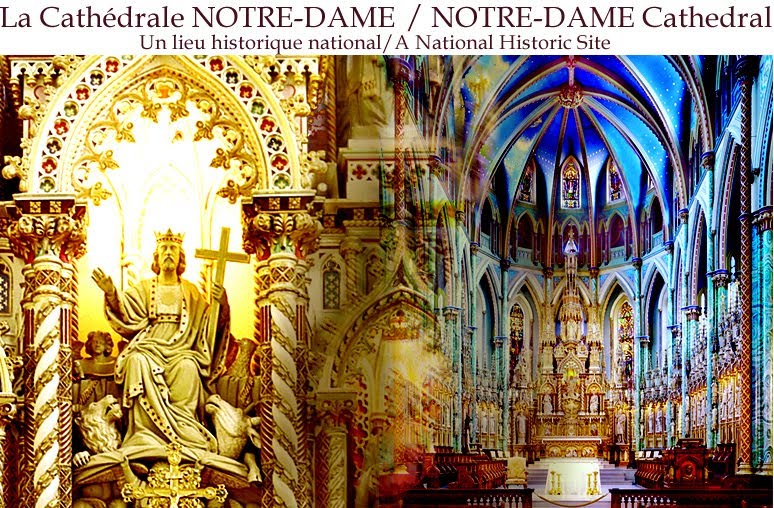
The cathedral's exterior is fairly reserved, but the interior is as far more ornate, designed by Georges Buillon; it is brightly painted and decorated with carved features, exquisite stained glass windows and hundreds of statues of various religious figures. Louis-Philippe Hébert completed thirty large wooden sculptures in the choir.


Above the high altar is Christ the King reigning in glory, bestowing a crown on his Mother Mary as the Queen of Heaven, with St. Joseph attending. Below this scene there are large statues of Saint John the Baptist and Saint Patrick, the holy patron saints of fracophone and English-speaking [Irish] Catholics.

Mgr Joseph-Eugène-Bruno Guigues, OMI, First Roman Catholic Bishop of Bytown/Ottawa

In 1847 the church became a cathedral when Most Reverend Joseph-Eugène-Bruno Guigues, O.M.I. was appointed the first Bishop of Bytown; he is honoured with a lifesize statue to the right of the Cathedral (corner of Sussex and Guigues; his successor, Archbishop Thomas Duhamel's statue is on the corner of Sussex and Guigues). The cathedral was given the honorific title of basilica in 1879.

The Cathedral Basilica of Notre Dame is the oldest church in Ottawa and the seat of the city's Catholic archbishop. Its twin spires and gilded Madonna are easily identifiable from nearby Parliament Hill and the surrounding area.

The church was recently renovated and restored in the late 1990s. Services are held in both French and English. Composer Amédée Tremblay notably served as the church's organist from 1894-1920.

With the growth of the diocese under the second Bishop of Ottawa, Most Reverend Thomas Duhamel, and with the impetus of a visionary artist, Canon Georges Bouillon, the cathedral was finally completed in 1885.

Dedicated to the Immaculate Conception on September 4, 1853, the Cathedral underwent a major restoration in the 1990's (resulting in the closure of the cathedral for close to two years), to prepare for the celebration of the diocese's sesquicentennial in 1997. This $10M updating was generously provided for by a subscription campaign.

It was the first phase of a multi-year project; most recently (2009-2010) a new steel roof was installed and, to take advantage of the scaffolding erected for this project, the exterior windows were painted and the cross on the south side o the roof was gilded. Donations to this $1.8M amelioration are still being received by the cathedral.

A marker inside Notre Dame cathedral commemorating the blessing of the cornerstone of Eglise St-Jacques-Bytown on October25, 1841

Friday, September 3, 2010

Memorial: Pope St. Gregory the Great - Death of Abbé Séguin - Stephen Hawking Dismisses God


O God, who care for your people with gentleness and rule them with love, through the intercession of Pope Saint Gregory, endow, we pray, with a spirit of wisdom those to whom you have given authority to govern, that the flourishing of a holy flock may become the eternal joy of the shepherds. Through our Lord.

* * *

Today's liturgy is a memorial of Pope St. Gregory the Great.

Son of Gordianus, a Roman regionarius, and Saint Silvia of Rome. Nephew of Saint Emiliana and Saint Tarsilla. Great-grandson of Pope Saint Felix III. Educated by the finest teachers in Rome, Italy.

Prefect of Rome for a year, then he sold his possessions, turned his home into a Benedictine monastery, and used his money to build six monasteries in Sicily and one in Rome. Benedictine monk.

Upon seeing English children being sold in the Roman Forum, he became a missionary to England.

Elected 64th Pope by unanimous acclamation on September 3, 590, the first monk to be chosen.

Sent Saint Augustine of Canterbury and a company of monks to evangelize England, and other missionaries to France, Spain, and Africa.

Collected the melodies and plain chant so associated with him that they are now known as Gregorian Chants.

One of the four great Doctors of the Latin Church. Wrote seminal works on the Mass and Divine Office, several of them dictated to his secretary, Saint Peter the Deacon.

Born c.540 at Rome, Italy; died March 12, 604 at Rome of natural causes.

* * * * * *

Abbé Gérard-Majella Séguin (1919-2010)

Demain à 10h00 dans la basilique cathédrale de Notre Dame, je présiderai les funérailles de l'abbé Gérard-Majella Séguin, décédé la nuit du 30 août.

Agé de 91 ans, l'abbé Seguin s'est dévoué au service du peuple de Dieu comme prêtre de paroisse et formateur des séminaristes:

Ordonné en 1944, l’abbé Seguin a été vicaire à Saint-André-Avellin (Québec) (1944-46) et curé de ces paroisses d'Ottawa: St Rémi (1966-69), St Louis Marie de Montfort (1969-73), Notre Dame de la Présentation (1973-85).

Il a aussi été professeur au Petit séminaire d'Ottawa (1946-62); administrateur de la Mission Nativité de N.S.J.C., Ottawa (1962-63); et vice supérieur du Petit séminaire (1963-69).

Requiescat in pace.

* * * * * *

STEPHEN HAWKING'S BOLD CLAIM: SCIENCE ELIMINATES GOD

Yesterday's on-line edition of the Ottawa Citizen featured prominently Stephen Hawking's claim in his latest book that one can no longer postulate God as an explanation for the universe. Instead, spontaneously on account of the law of gravity, everything came from nothing.

The comments following the article were extensive and many of them withdrawn as unsuited to civil dialogue.

Promptly on the Catholic Herald website, there was a rejoinder, one of many we are likely to find in coming days.

Here is an initial reflection by Quentin de la Bedoyere (www.catholicherald.co.uk):

Stephen Hawking still can’t explain how something came from nothingEven if physicists had a Grand Theory of Everything, they could not solve creation.

So that’s that then. Stephen Hawking has assured us that the laws of physics are sufficient to explain the universe we live in – and that we have no need to posit the possibility of God. His book, The Grand Design, will be published on September 9.

This is neither the time nor the place to focus on the detail of his arguments, and no doubt plenty of description will be forthcoming in the popular press and elsewhere. I want to focus initially on one remark he makes: “philosophy is dead.”

Bang goes the wisdom of two and a half millennia. But philosophy is not only not dead, it was never needed as much as it is now. One of the most important tasks in philosophy is to ensure that the right questions are asked and that the arguments which proceed stand up to rigorous examination. No wonder Hawking would like philosophy to be dead because he is wrong on both counts.

The drive of Hawking’s approach is that the theory, or rather the family of theories, he espouses leads to the possibility of 10 to the power of 500 different universes (try that on your calculator and watch it explode). Thus the extraordinary fine-tuning required for a universe which would eventually be able to support human life is not evidence for a designer God; it has in fact come about by chance. Since our universe is, by definition, the only one we can experience, we are fooled into thinking that it is the only one which exists, or has existed.

M theory, as it is known, is highly controversial within the scientific community; indeed there are eminent names who claim that it cannot properly be called a scientific theory at all. The idea of multiverses to explain the fine-tuning has been known as the “last refuge of the agnostic”. But let us assume that it is true, that there is an infinity of universes, and that our universe is an inevitable result of chance at work – where does that get us?

First, we are reminded of the theory of evolution. We have no difficulty in reconciling our belief in God as creator with evolution in which myriads of tiny chances, inevitably filtered by fitness to survive, develop into higher forms of life. God is not some sort of inventive superman who performs in the same sort of way as we do – but at an infinitely higher level. He transcends the universe; his creative action is utterly beyond our ken. If we use terms like “designer” it is only because the human mind and human vocabulary has no further reach. Our descriptions are only useful if we always bear in mind their gross inadequacy.

Similarly, if all the physical laws had been explained and proved (known as the Grand Theory of Everything) – which is a million miles from the case – our understanding of the actions of God would not be one whit greater: his existence and his actions are of a different order.

Most particularly it would not touch the question of how something existing comes out from nothing. That is a question which science cannot answer, and will never answer, because nothingness is not within its domain. Hawking apparently does not address this question – which is the true and ultimate Theory of Everything. But what philosophy can teach us is that neither he, nor you, nor I will ever explain creation, except through faith.

Thursday, September 2, 2010

The Founder of the St. Vincent de Paul Society - Visit to the Congolese Mission Mass & Confirmations

Today in places where there is deep commitment to the St. Vincent de Paul Society, the optional memorial of Blessed Frederick Ozanam (1813-53), its founder, is possible.

Frederick died on 8th September, but as that is also the Birthday of the Blessed Virgin Mary, his feast has been brought forward to the second.

An accomplished linguist and Dante scholar, he also found time to care for the poor. The society he started has over a million members in 32 countries.

Frederick was one of four out fourteen children in his family to survive infancy.
His father was an officer in Napoleon's army. Frederick was born in Milan, but the family moved back to Lyon.

He studied at the College Royal and was interested in both law and literature. He became involved with a group of liberal Catholic intellectuals - Emmanuel Bailly, historians Montalambert and Chateaubriand, the Romantic poet Lamartine and the Dominican preacher Lacordaire.

This group along with a Daughter of Charity named Rosalie Rendu began the lay institute dedicated to caring for the physical and spiritual well-being of the poor.

Frederick took his doctorate in law in 1836 and although his father died around this time, he went on to gain a doctorate in literature with a thesis on Dante's philosophy.

In 1845 Frederick moved from Lyon to Paris and married Amalie who soon gave birth to a daughter. He combined an academic career with lecturing to the Cercle catholique and visiting the poor.

An accomplished linguist, he was promoted to professor in 1846 and began a project on the literary history of the Middle Ages from the fifth century to Dante. But he contracted tuberculosis and his health began to fail.

With Lacordaire he started a journal expounding Christian socialist principles. He went to Italy in 1853 partly for health reasons but also to collect a prestigious award for his work on Dante. On the return journey he collapsed and died at Marseilles on 8th September 1853.

Pope John Paul beatified him in August 1997, expressing the hope that more married people would be canonized.

The Society of St Vincent de Paul has over a million members in 32 countires (thanks to Patrick Duffy--www.catholicireland.net).

* * * * * *

The Capital's Congolese Community Celebrates Confirmation

On Sunday afternoon, I presided at a late-summer celebration of Confirmation for six members of the Congolese community that gathers each Sunday afternoon at 3:30PM at Eglise Saint-Charles Borromee on Beechwood.

The music is rhythmical and passionate, and the dress is "Sunday best" and colourful.

Plus, after photos for all and sundry, not just the confirmands, there followed a reception in the parish hall with a tasty spread of food from Congo's best cooks.

Herewith some photos of this special occasion.


Wednesday, September 1, 2010

Terry Fox 30th Anniversary - J. Thomas Duhamel appointed 2nd Bishop of Ottawa (1874)

Today's blog features statues: for the Capital contains many of them along with explanatory plaques.

About a week ago, in reading the notation besides the Terry Fox statue on Wellington and Metcalfe streets, opposite Parliament Hill and outside the Information Office, I noticed that Terry was forced to end his 1980 Marathon of Hope on September 1 of that year, making today the 30th anniversary of that moving day.

Besides a couple of pictorial angles on the statue, here is the Wikipedia entry on Fox:

Terrance Stanley "Terry" Fox, CC, OD (July 28, 1958 – June 28, 1981) was a Canadian humanitarian, athlete, and cancer research activist.

In 1980, with one leg having been amputated, he embarked on a cross-Canada run to raise money and awareness for cancer research. Though the spread of his cancer forced him to end his quest after 143 days and 5,373 kilometres (3,339 mi), and ultimately cost him his life, his determination and example created a lasting, worldwide legacy.

The annual Terry Fox Run, first held in 1981, has grown to involve millions of participants in over 60 countries and is now the world's largest one-day fundraiser for cancer research; over C$500 million has been raised in his name.

Fox was a distance runner and basketball player for his Port Coquitlam, British Columbia high school and Simon Fraser University. His right leg was amputated in 1977 after he was diagnosed with osteosarcoma, though he continued to run using an artificial leg. He also played wheelchair basketball in Vancouver, winning three national championships.

In 1980, he began the Marathon of Hope, a cross-country run to raise money for cancer research. Fox hoped to raise one dollar for each of Canada's 24 million people. He started with little fanfare from St. John's, Newfoundland in April and ran the equivalent of a full marathon every day.

Fox had become a national star by the time he reached Ontario; he made numerous public appearances with businessmen, athletes, and politicians in his efforts to raise money. He was forced to end his run outside of Thunder Bay when the cancer spread to his lungs. His hopes of overcoming the disease and completing his marathon ended when he died nine months later.

Fox was the youngest person ever named a Companion of the Order of Canada, the nation's highest civilian award. He won the 1980 Lou Marsh Award as the nation's top sportsman and was named Canada's Newsmaker of the Year in both 1980 and 1981. Considered a national hero, he has had many buildings, roads and parks named in his honour across the country. --www.wikipedia.org

* * * * * *

MGR JOSEPH-THOMAS DUHAMEL 2ND BISHOP, 1ST ARCHBISHOP OF OTTAWA

Statue of Mgr Joseph-Thomas Duhamel outside Ottawa's Notre Dame Cathedral Basilica (corner of Sussex and Guigues)

On this day in 1874, Blessed Pope Pius IX named the pastor of the Parish of St. Eugène on the eastern boundary of the diocese as the 2nd bishop of Ottawa. Earlier that year, the first bishop of Ottawa, Mgr Joseph-Eugène-Bruno Guigues, O.M.I. had died on February 8.

On June 8, 1886, Duhamel would become the 1st archbishop when the see was elevated to metropolitan status. The following is a brief description of some of Mgr Duhamel's time of service (www.fr.academic.ru/dic.nsf/frwiki/888002):

Joseph-Thomas Duhamel (6 novembre 1841 - 1909) était le deuxième évêque d'Ottawa et le premier archevêque d'Ottawa.

Né à Contrecœur, il fut ordonné prêtre le 19 décembre 1863 après des études au collège d'Ottawa avec les oblats.

Curé de Buckingham, ses qualités admistratives sont reconnues et il fut envoyé pour construire l'église de la paroisse de Saint-Eugène. Il assista au concile Vatican I avec son évêque en tant que théologien.

Pie IX le nomma évêque d'Ottawa le 1er septembre 1874 et il fut consacré le 28 octobre suivant par Elzéar-Alexandre Taschereau.

Le 8 juin 1886, son diocèse est élevé en archevêché et il est nommé archevêque. Très dévoué à la cause de l'instruction, il fonde plusieurs écoles et paroisses dans sa région et améliore la condition des francophones catholiques.

En outre, il ordonne Jean-Marie-Rodrigue Villeneuve à la prêtrise et fonde le vicariat du Pontiac.

Il fut témoin du grand incendie de Hull de 1900 et il vit l'Université d'Ottawa tomber proie aux flammes le 2 décembre 1903. Ces événements assombrirent la fin de son épiscopat.

Après avoir donné sa vie entière pour le bien de sa communauté, il mourut le 5 juin 1909. La municipalité de Duhamel a été nommée en son honneur.