Wednesday, September 21, 2011

St. Matthew, Apostle & Evangelist - Mgr Gervais Turns 80 - Sunday 26A: Conversion to Obedience

Caravaggio, St. Matthew Composing His Gospel with the Angel

Saint Matthew, Apostle and Evangelist
O God, who with untold mercy were pleased to choose as an Apostle Saint Matthew, the tax collector, grant that, sustained by his example and intercession, we may merit to hold firm in following you. Through our Lord.

* * * * * *

HAPPY 80TH BIRTHDAY!
TO ARCHBISHOP MARCEL GERVAIS


[Mr+marcel.jpg]

Portrait by Gregory Fermanczyk


* * * * * *


Twenty-sixth Sunday in Ordinary Time (Year "A") - September 25, 2011

“WHICH SON DID THE WILL OF HIS FATHER?”
[Texts: Ezekiel 18.25-28 [Psalm 25]; Philippians 2.1-11; Matthew 21.28-32]

A proverb often stated in Israel was “the fathers have eaten unripe grapes, and the children's teeth are set on edge”.  The meaning seems clear: one generation is suffering consequences flowing from the behaviour of a previous generation.  In Ezekiel's time, people used the proverb to infer that the deportation to Babylon being suffered then was due to the sins of their ancestors.

When Ezekiel delivered his oracles, however, he declared God wanted people to stop using the proverb forthwith.  As the one providently guiding the destinies of all his children, God has determined that offspring shall not suffer death on account of the sins of their parents.  Only the specific individual who sins shall die.

So, each person must assume responsibly for their behaviour in the successive stages of life.  And it is the ultimate choices that are determinative for the success or failure of one's life.  The righteous person who commits sin dies for their iniquity.  Henceforth his or her previous righteous actions will have no bearing on their fate.

But the wicked person who repents and lives a righteous life will find his or her past sins have been forgotten by God.  “Because they considered and turned away from all the transgressions that they had committed, they shall surely live”.

Like Ezekiel, John the Baptist and Jesus preached obedience to God's call.  And their conviction that God desires all to repent and come, by conversion, to experience that those who do so “shall not die”.  Jesus' parable of the father with two sons, found only in Matthew's gospel, has affinities to the uniquely Lukan parable of the prodigal son and his brother who struggle to accept the compassionate behaviour of their father for them (Luke 15.11-32).

In the Matthean parable, the first son gives a curt refusal to his father's command to “go and work in the vineyard today”.  Yet later he “changed his mind [=repented] and went”.  By contrast, the second son gave a respectful assent (“I am going, sir”), but afterwards did not go and work.  When Jesus asked, “which of the two did the will of his father?” the answer was obvious and the religious leaders fell into the trap which passed judgment on themselves.

Indeed, the parable's overall function is polemical, preparing for Jesus' saying that “the tax collectors and prostitutes are going into the Kingdom of God ahead of you”.  The religious leaders initially had said “yes” to God's prophetic message communicated by John the Baptist.  All Jerusalem, including the Pharisees and Sadducees had flocked to the wilderness to hear John's proclamation (3.5-7).

But the religious leaders did not let the message of John move them to repent.  By contrast, the tax collectors and prostitutes—those who had in their lives been saying “no” to God's revealed message—had a change of mind and made his message their own.

In Matthew's gospel, the teaching of Jesus often emphasizes that one's deeds must agree with what one says.  One's words and deeds must be in harmony with each other.  This was notably the case with Jesus' own life, in which he was called to be fully obedient to the Father, even to death on the Cross.

Paul elaborates on the model that Jesus offers for a Christian's behaviour.  Christ did not seek to take advantage of his divine status.  Rather he emptied himself in two ways.  First, by his taking on the human condition.  Then, by accepting the full limitations of human life and dying shamefully on the Cross (“obedient to the point of death”).

Afterwards, God glorified Jesus by giving him “the name above every name”: “the Lord”.  This is the title by which God was known in Old Testament times.  All creatures human and angelic (“in heaven and on earth and under the earth”) are now subject to Jesus.  Henceforth, every knee should bend in homage to him.  And every tongue must confess “that Jesus Christ is Lord to the glory of God the Father”.

In conclusion, Paul says Christians, since they have received so much, must, like Jesus, be without “selfish ambition or conceit”.  Christians cultivate the opposite virtues.  “In humility regard others as better than yourselves ... look not to your own interests but to the interests of others”.

Tuesday, September 20, 2011

Memorial of Saint Andrew Kim Tae-gŏn, Priest, and Paul Chŏng Ha-sang & Companions, Martyrs - Jesuits Mark 400th on Sept. 26th


St. Andrew Kim Taegon, the first Korean Roman Catholic priest,
tortured and beheaded in 1846


O God, who have been pleased to increase your adopted children in all the world, and who made the blood of the Martyrs Saint Andrew Kim Tae-gon and his companions a most fruitful seed of Christians, grant that we may be defended by their help and profit always from their example . Through our Lord.


Best wishes to Ottawa's Holy Korean Martyrs Parish on their patronal feast!


* * * * * *


JESUITS IN CANADA 1611-2011
OTTAWA CELEBRATION
SEPTEMBER 26TH


jesuits400anniversary


This week the Catholic Register has a special 20-page supplement marking the 400th anniversary of the arrival of the first Jesuits in Canada in 1611 (cf. above and accessible at http://www.catholicregister.org/). 

The Jesuit Community in Ottawa will mark this special occasion in the Capital with a Mass of Thanksgiving during the annual visitation of the Jesuit Provincial, Father James Webb, S.J., next Monday evening, September 26 at 7:30 PM, that is, on the Feast of the Canadian Martyrs at Holy Canadian Martyrs Church (served by the Oblates of Mary Immaculate at 100 Main Street, Ottawa). 

Father Webb will be the principal celebrant and homilist; a reception will follow in the parish hall.

Everyone is welcome!


Monday, September 19, 2011

Optional Memorial: St. Januarius - Recent Visiting Bishops

Le Caravage, Saint Janvier

Saint Janvier (San Gennaro en italien ou Januarius en latin), évêque de Bénévent, est un saint martyr reconnu par les traditions catholique et orthodoxe. Il mourut en martyr en 305 près de Pouzzoles pendant la grande persécution de Dioclétien.

Saint Janvier est célébré comme mémorial faculatative, aujourd’hui, le 19 septembre; il est l’un des saints patrons de la ville de Naples.

Saint Janvier serait né vers 270 à Naples et serait le descendant d’une ancienne famille romaine patricienne, la Gens Januari. Il aurait été ordonné prêtre puis élu évêque de Bénévent en 302.

Vers 303-304, au début de la grande persécution de Dioclétien, deux de ses diacres, Sosius diacre de Misène et Proculus, diacre de Pouzzoles, furent arrêtés avec deux gentilshommes, Eutyche et Acuce et jetés dans les prisons de Cumes par Dragonce (Dragontius), proconsul de Campanie.

En 305, lorsque Constance et Galère succédèrent à Dioclétien et Maximilien, Dragonce fut rappelé à Rome et remplacé par Timothée et les chrétiens emprisonnés à Cumes furent relâchés.

Apprenant cette libération, saint Janvier, qui avait partagé la douleur des prisonniers, quitta son diocèse accompagné du diacre Festus et du lecteur Desiderius pour venir partager leur joie. Ils se rejoignirent dans une église aux environs de Pouzzoles et l’évêque, assisté de Sosius et Proculus y célébrait la messe quand il se fit au-dehors un grand bruit, suivi d’un long silence : une voix lisait le décret de persécution de Dioclétien que Timothée avait remis en vigueur.

À la sortie de l’église, Janvier guérit une de ses parentes paralytique et lui confia les deux burettes qui lui servaient à célébrer la messe ; alors, avec ses compagnons et la foule, il se rendit à Nola lors d’une marche qui parut un triomphe. Mais Timothée l’attendait sur la place de Nola et l’interrogea. Condamné à mort à l’issue de cet interrogatoire, saint Janvier sortit indemne du bûcher où on l’avait précipité ; il fut alors fouetté au sang et jeté en prison avec Sosius, Proculus, Eutyche, Acuce, Festus et Desiderius. Puis les sept condamnés furent menés à l’amphithéâtre de Pouzzoles pour être donnés en pâture aux fauves mais les lions, les tigres et les hyènes, bien qu’affamés, se couchèrent à leurs pieds… Timothée, pris d’un coup de sang, en perdit la vue mais Janvier la lui rendit… Devant ce miracle, cinq mille des trente mille spectateurs présents demandèrent à être baptisés par le saint ; Timothée, quelque peu agacé, ordonna alors qu’on coupe la tête de Janvier, Proculus et Sosius et rentra dans son palais à Nola.

Les deux diacres furent ainsi décapités le 19 septembre 305 dans le forum proche du volcan Vulcano de Pouzzoles, puis il en fut de même pour Janvier après que le saint eut demandé, ordonné et prié le bourreau, car ce dernier ne trouvait plus de forces pour faire sa funeste besogne ; ainsi revigoré, le bourreau coupa non seulement la tête du saint mais également un de ses doigts. Le bourreau et les hommes de troupe, partis faire leur rapport à Timothée, l’auraient trouvé dans son palais pillé et déserté : le proconsul n’était plus qu’un cadavre informe et pourri… et le bourreau et ses comparses auraient péri asphyxiés par les émanations pestilentielles qu’exhalait le corps de Timothée.

La nuit qui suivit le martyre, la parente paralytique que Janvier avait soignée recueillit du sang de l’évêque martyr avec une éponge, comme il était d’usage à l’époque, et en remplit les deux fioles qui avaient servi à Janvier à célébrer sa dernière messe puis elle emmena les ampoules chez elle, à Antignano à Naples. Un aveugle de Pouzzoles à qui saint Janvier avait rendu la vue à l’issue de son martyr récupéra la tête, le corps et le doigt du martyr et les plaça dans un coffre qu’il emmena à l’Agro Marciano (Fuorigrotta) à Naples ; puis, le corps fut ultérieurement transféré dans la catacombe dite de saint Janvier, toujours à Naples.

Pour certains, cela se serait passé le samedi précédant un premier jour de mai au début du IVe siècle. Ce jour-là, sur le chemin de Capodimonte, lorsque la relique passa à Antignano, la femme plaça les ampoules près du corps et le sang desséché du saint se liquéfia. Pour d’autres, c’est le pape Jean Ier qui fit placer les restes du saint dans cette catacombe au début du Ve siècle.

Alexandre Dumas a raconté cette histoire, avec de nombreux autres détails, dans le Chapitre XIX de son ouvrage Le Corricolo (http://www.wikipedia/).

* * *

Saint Januarius, Bishop and Martyr

O God, who grant us to venerate the memory of the Martyr Saint Januarius, give us, we pray, the joy of his company in blessed happiness for all eternity. Through our Lord.

* * * * *


Recent Episcopal Visitors


During the past ten days, I have received several bishops visiting Ottawa, namely:


 Mgr Louis Portella Mbuyu, Bishop of Kinkala
(Congo-Brazzaville)


Msgr. Đuro Hranić, Auxiliary Bishop
of  Đakovo-Osijek, Croatia


Bishop Hranić with Father Adam Tabak, pastor of
St. Leopold Mandic, our Croatian parish
celebrating this year its 25th Anniversary 


Recently ordained Montreal Auxiliary Bishop
Thomas Dowd
in the Cathedral Sacristy prior to his
Mass of Thanksgiving on Saturday


After Mass a dinner was held in my residence
in honour of Bishop Dowd
and his parents who live in Ottawa. 


Sunday, September 18, 2011

Lord's Day Collect


COLLECT FOR THE 25TH SUNDAY IN ORDINARY TIME


O God, who founded all the commands of your sacred Law upon love of you and of our neighbour, grant that, by keeping your precepts, we may merit to attain eternal life. Through our Lord.

* * * * * *

Saturday, September 17, 2011

St. Robert Bellarmine - PortiK: centre universitaire catholique


Saint Robert Bellarmine
Bishop and Doctor of the Church


O God, who adorned the Bishop Saint Robert Bellarmine with wonderful learning and virtue to vindicate the faith of your Church, grant, through his intercession, that in the integrity of that same faith, your people may always find joy. Through our Lord.


* * * * * *

PortiK

Jeudi vers midi, j’ai assisté à l’ouverture de PortiK le nouveau centre d’accueil pour les étudiants de l’Université d’Ottawa à la paroisse du Sacré-Cœur.


Bénédiction du Centre étudiant « Le PortiK » église Sacré-Cœur d’Ottawa, le 15 septembre 2011


Là où deux ou trois sont rassemblés au nom du Christ, le Christ est là au milieu d’eux. Dans ce Centre que nous voulons bénir, se rassembleront des jeunes universitaires…


On cherchera ici à équiper les jeunes par l’entremise de groupes de partage, d’échanges, d’ateliers et de célébrations afin qu’ils puissent faire le lien entre leur vécu et leur foi…


Finalement, le Centre se propose de permettre aux étudiants catholiques francophones de se rassembler afin de grandir ensemble dans la foi.


Demandons au Seigneur, ce matin, de bénir tous ceux et celles qui vont travailler ici et qui fréquenteront « Le Portik »

Prions le Seigneur.


Dieu, qui ne cesse d’inspirer notre volonté et nos actions, nous te bénissons de nous avoir donné le désir et l’audace d’établir à la paroisse du Sacré-Cœur ce Centre universitaire.

Accorde à tous ceux et celles qui vont venir en ce lieu de t’écouter avec foi, de te prier de tout leur cœur, de te chercher dans leurs réflexions et leurs échanges, de te trouver dans leurs frères et sœurs d’être des témoins de l’Évangile, et de se conformer en tout au Christ.

Ainsi parviendront-ils dans la joie à la révélation de sa gloire, Lui qui règne pour les siècles des siècles.

Amen.

Voici d'autres photos:


Friday, September 16, 2011

Sts. Cornelius and Cyprian; 2011-2012 Pastoral Year Begins

Aujourd’hui, l’Eglise garde la mémoire des saints martyrs Corneille, pape, et Cyprien, évêque, dont on a rappelé le 14 septembre la mise au tombeau du premier et la passion du second. Aujourd’hui le monde chrétien les célèbre d’une seule voix, confortés mutuellement dans la foi et liés ensemble par la charité.


St. Cyprien était devenu chrétien à quarante-six ans. Jusque là, il avait été rhéteur et avocat et ses mœurs étaient celles d’un païen célibataire. Après sa conversion, il trouva son bonheur en donnant ses biens aux pauvres. Tant et si bien que les chrétiens de Carthage le choisirent deux ans après comme évêque. Progressivement, il devint, par son influence, chef de l’Eglise d’Afrique. A la demande de ses fidèles, il se cacha durant la persécution de Dèce et fut épargné.


Lorsqu’éclata ensuite la persécution de Valérien, il fut envoyé en exil par un proconsul qui lui était favorable. Mais le successeur l’étant moins, le fit chercher, le ramena à Carthage où il fut décapité. Vis-à-vis des chrétiens qui avaient apostasié pour éviter la mort, saint Cyprien était plein de miséricorde, professant que la miséricorde divine est plus grande que le plus grand des péchés.


Le pape saint Corneille s’appuya sur lui lors de la querelle des "lapsi", des chrétiens apostats. Après saint Augustin, il est l’un des plus grands témoins de la doctrine de l’Eglise latine des premiers siècles.

* * *

Saints Cornelius, Pope
& Cyprian, Bishop, Martyrs


O God, who gave Saints Cornelius and Cyprian to your people as diligent shepherds and valiant Martyrs, grant that, through their intercession, we may be strengthened in faith and constancy and spend ourselves without reserve for the unity of the Church. Through our Lord.

* * * * * *

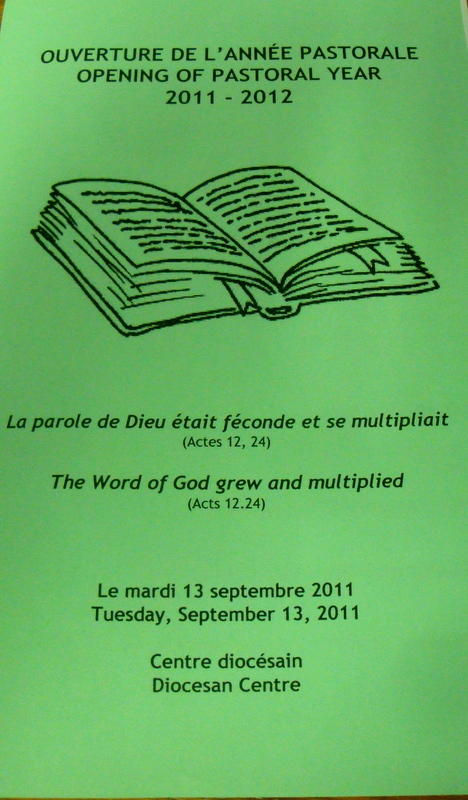
PASTORAL YEAR INAUGURATED

On Tuesday, at the Diocesan Centre, Mass was celebrated to begin the new Pastoral Year with its emphasis on the fruitfulness of the Word of God.


In the Conference after Mass, the Staff enjoyed a lovely catered lunch. Some photos: 


Thursday, September 15, 2011

Our Lady of Sorrows - Commemorative Service at Ottawa's Notre Dame Cemetery

Today is the feast of Our Lady of Sorrows well-exemplified by Michelangelo's Pieta:


Collect for the Feast
of Our Lady of Sorrows


O God, who willed that when your Son was lifted high on the Cross his Mother should stand close by and share his suffering, grant that your Church, participating with the Virgin Mary in the Passion of Christ, may merit a share in his Resurrection. Who lives and reigns with you.


* * * * * *

CEMETERY SERVICES
IN PARISHES,
AT THE DIOCESAN LEVEL


The late summer and early fall weekends are frequently chosen for the celebration of prayer (sometimes the Eucharist) in parish and diocesan cemeteries.  These anticipate the commemorations of All Saints and All Souls in the first days of November, when the weather in these parts is less propitious for gathering outside.

Last weekend, I presided at the ceremony of prayerful remembrance of the faithful departed at Notre Dame Cemetery on Montreal Road and St. Laurent Blvd. We gathered in Notre Dame de Lourdes de Vanier church for the prayers, followed by a procession to the cemetery's main entrance and the blessing of the tombs by pausing in different sections (the priests' plot, that of religious communities, the military section, with a special visit to the tomb of Bishop Marchand). A reception was held in the parish hall after the visit to the cemetery.

Despite the common impression that Notre Dame Cemetery is full, this is not the case and recently cemetery officials opened a new section of more than two hundred lots which are available for purchase.

Here are some pictures of the gathering:


* * *

Last Saturday, during my visit to Montreal, I took time to visit and pray at the tomb of my parents in Notre-Dame-des-Neiges cemetery on the slopes of Mount Royal:


This coming Sunday afternoon, September 18 at 2PM, I will take part in the service in memory of the faithful departed at Hope Cemetery/Cimetiere de l'Espoir (4660 Bank Street, Ottawa), which will include the blessing of the new columbariums in the Garden of the Resurrection.

For more information about Ottawa Archdiocesan Cemeteries: http://www.hopecemetery.ca/  or email: info@ottawacatholiccemeteries.ca.