Twenty-first Sunday in Ordinary Time (Year “A”) - August 21, 2011 - SIMON PETER'S
INSPIRED CONFESSION - [Texts: Isaiah 22:15, 19-23 [Psalm 138]; Romans 11:33-36; Matthew 16:13-20]
During my first visit to the Holy Land, my time in the Galilee—the homeland of Jesus—had been very restricted. On the eve of my departure, I felt disappointed that Caesarea Philippi was not on my itinerary. So I leased a car and drove to the northern reaches of Galilee and spent several quiet hours in prayer at the town of Baniyas, a name retaining traces of an original Panias, sanctuary of the Greek god Pan.
The motive for my idiosyncratic pilgrimage to Caesarea Philippi derived from my studies of Mark's gospel in which Caesarea Philippi—as the place where Peter confessed Jesus as Christ—plays a pivotal role.
In Mark's narrative Peter's confession lies at the centre. It both sums up the first half of the gospel concerned with Jesus' identity (1.1-8.30), then anticipates the second half (8.31-16.8), which explains how Jesus realizes his messianic destiny by suffering, dying and “after three days rising”.
In my devotion, I had wanted to draw as near as possible to the place where Simon Peter—on behalf of the Twelve and all future disciples—opened himself to the Father's revelation concerning Jesus. A similar motivation of wanting to be close to the one who first made the Christian confession undergirded construction of St. Peter's Basilica on the Vatican hill and as a place of pilgrimage.
Guided by God's Spirit (“flesh and blood has not revealed this to you, but my Father in heaven”), Peter declared that Jesus was more than Elijah returned to earth; greater than John the Baptist come back to life; and more significant than one of the ancient prophets reappearing in Israel's midst.
In Hebrew terminology, Peter declared that Jesus was “the Messiah” or “the Christ” (its Greek equivalent). Translating both Hebrew and Greek terms, we understand Peter to have been asserting that Jesus was God's “anointed one” (Mark 8.29).
In Matthew's account, the place in God's plan of the “Son of Man”—with whom Jesus identified himself (“who do people say the Son of Man is?”)—goes even beyond being another Jeremiah, the prophet whose personal experience of rejection and suffering foreshadowed the rejection and suffering of Jesus. Interestingly, only Matthew's gospel makes mention of “Jeremiah” in the disciples' reply to Jesus' question (cf. Matthew 2.17-18; 27.9-10 for other mentions of Jeremiah).
The appropriate identification of Jesus lies in the Church's confession that he is “Son of the living God”. Describing Jesus' identity in terms of his relationship to the heavenly Father, probably formulated in the light of the experience of Jesus' resurrection, effectively undermines any notion that Jesus' messiahship contained military or nationalistic implications.
In Mark's account, the confession of Peter and his fellow disciples was met with a command from Jesus to keep silence. The disciples were not to tell others about Jesus (Mark 8.30). In Matthew's version, by contrast, Jesus' response was not silence, but a blessing and declaration.
Jesus announced Peter was favoured by God (“blessed are you, Simon, son of Jonah”). Jesus then went on to change the name of his insightful disciple. Through a pun on his name (in Aramaic both the name “Peter” and the word for “rock” would be kêpha— Cephas—the name by which Paul refers to Simon Peter in Galatians and 1 Corinthians), Jesus laid out the new role of Peter in the community of faith: “You are Peter and on this rock I will build my church, and the gates of Hades will not prevail against it”.
Roman Catholics understand Jesus' statement and the promise giving Peter power “to bind and loose” to mean that he intended to build the Church on Simon Peter, a human individual prone to weakness but willing to allow God's power to be at work in his frailty. Even death (“Hades”) would not prevail against the church.
Some years ago, the International Anglican-Roman Catholic Dialogue invited Christians to regard the Petrine ministry of the pope—Bishop of Rome and successor of Peter—as part of God's “gift of authority” for the church and spoke of the need by the church to receive this gift.
We pray in gratitude for the gift of the papacy, which continues Christ's commission to Peter, and ask God's help to renew it, that it may serve all God's people.
* * * * * *
The Holy Father Arrives in Madrid Today
The public transit system operators have scheduled interruptions today at the peak time of the Pope's arrival. So that will add a touch of the unexpected to a marvellous experience that has the city of Madrid humming with joy.
Here is Cardinal Antonio Maria Ruoco Valera's welcoming homily from Tuesday that launched this year's World Youth Day. Unfortunately, the text is not yet a available in French. [J'usque maintenant le texte n'est pas disponible en francais.]
My dear brothers and sisters in the Lord
1. Welcome to Madrid for the XXVI World Youth Day announced by our Holy Father Benedict XVI in Sydney three years ago and which today begins with the solemn Eucharistic celebration at the central Plaza de Cibeles, Madrid!
Welcome Reverend Cardinals, Archbishops and Bishops! I greet all of you with fraternal affection in the Lord! We are joined by many priests, consecrated persons and a huge crowd of young people, the hope and future of our Churches, our peoples and the nations of the whole Church!
2. Allow me to speak to them directly as Pastor of the Diocesan Church of Madrid and President of the Spanish Episcopal Conference and tell them with all my heart:
Dear young people of the world: Welcome to Spain! Many of you have experienced and appreciated the warm welcome and fraternal love of your fellow young people of Spain, their families, their communities and their pastors from the Days in the Dioceses. You could verify that this attitude of open arms and warm sympathy has very much to do with the fact that this is an old country formed by a community of nations: Spain!, whose main hallmark of historical culture and life style is the profession of the Christian faith by their children in the communion of the Catholic Church. The historic character of Spain is formed from the distinctive features about the Christian vision of man and life from the very dawn of his history, which began with the first journey of the apostolic preaching in Spanish almost two thousand years ago. One of the most brilliant writers and performers of contemporary Spain could say: "Spain has been moved through out history by its Christian identity”
3. Welcome to Spain and welcome to Madrid, the Capital! The Metropolitan Cathedral of Madrid with its members dioceses of Alcala de Henares and Getafe open not only the physical doors of their parishes, schools, a wide variety of cultural buildings and sports facilities along with the generosity provided by public and private institutions for this unique event, but also they open those areas with the most humane and Christian warmth which their families and communities. In other words: They open the doors of their hearts!
May you feel as if you are in your own house, in your own home! The Church and the people of Madrid wanted-and want-this to be for all of you, during these always difficult times of arrival, in your accommodations and throughout all of World Youth Day, which culminates on Sunday, a favourable place to live in friendship and Christian fellowship in the framework of the Universal Church, at once human and divine, which is the home and family for the children of God scattered throughout the earth. And just as Spain is not intelligible without awareness of its two thousand year old Catholic tradition, Madrid, the royal residence and capital since the second half of the 16th century, in the middle of modern world, is not either. The Christian roots of this city are ancient and as we begin the second millennium of Christianity, still very much alive and strong, influencing social life, both cultural and human, but above all, its soul, the soul of their sons and daughters! Madrid is a welcoming city and friendly to all who visit it, wherever they may come!
World Youth Day, already with its long history of more than a quarter century, is inseparable from that Blessed man, whose memory we celebrate the Eucharist this evening in the Plaza de la Cibeles, very close, in fact, to the place where he presided over three major celebrations in the years 1982, 1993 and 2003. I'm talking about the unforgettable, venerable and beloved John Paul II. The Pope of the youth! With John Paul II begins a new historical period, unprecedented!, with respect to the Successor of Peter ́s relationship with the youth, and, consequently, a relationship that until then did not exist between the Church and her young: direct, immediate, heart to heart, imbued with a faith in the Lord Jesus Christ, enthusiastic, hopeful, joyful, contagious. Since that first convocation of World Youth Day 1985 in Rome all the way to World Youth Day Madrid, a beautiful story of faith, hope and love has been unfolding for three generations of young Catholics and non- Catholics who have seen how their lives are transformed in Christ and how countless vocations to the priesthood, consecrated life, Christian marriage and apostolate have emerged from them. The personal holiness of John Paul II shines with a unique appeal when it comes to the evangelization of our contemporary youth. On May 1st in St. Peter ́s Square at his beatification ceremony, our Holy Father Benedict XVI did not hesitate to highlight John Paul II's special love for the youth.
5. The secret of that brilliant personality, shaped by perfect charity, is easily revealed under the light of God's Word which has been proclaimed. The key to explaining his life, consecrated to the Lord, the Church and man, is nothing other than his burning love for Jesus Christ, from whom, like St. Paul, he never wanted to stray. In his life, John Paul II also suffered sorrow, anguish, and persecution, lacking the most basic of necessities during the years of World War II, watching the implacable and cruel occupation of his homeland and the inhuman deprivation of his people ... He suffered the pain of those that are persecuted for the cause of Christ, both before and after his election to the Holy See of Peter, literally, to the point of shedding his own blood. Indomitable witness of the truth and of Christian hope, he believed in the truth of the phrase, "If God is with us, who can be against us?", and did not fear any of the internal or external enemies of the Church. He was a brave soldier of Christ! Nothing could separate him from his love.
How exciting it is to imagine and relive the moments of his intimate dialogue with the Lord when he asked him if "he love Him more than these!" How many times did he answer during the most critical, decisive and painful circumstances of his years as Pastor of the Universal Church: "Lord, you know everything, you know that I love you!" The Pope knew very well that to graze the sheep meant to “surrender” himself for others and go he did not want to go.
 |
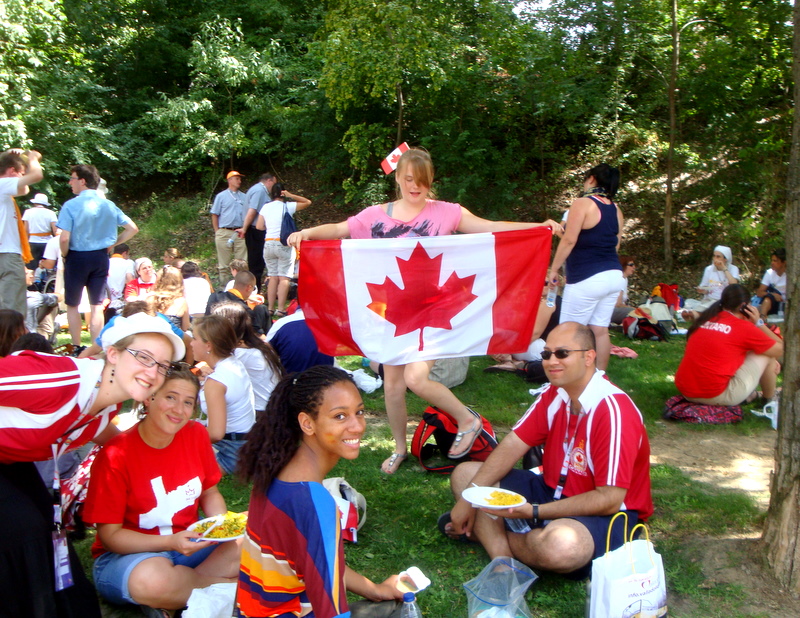
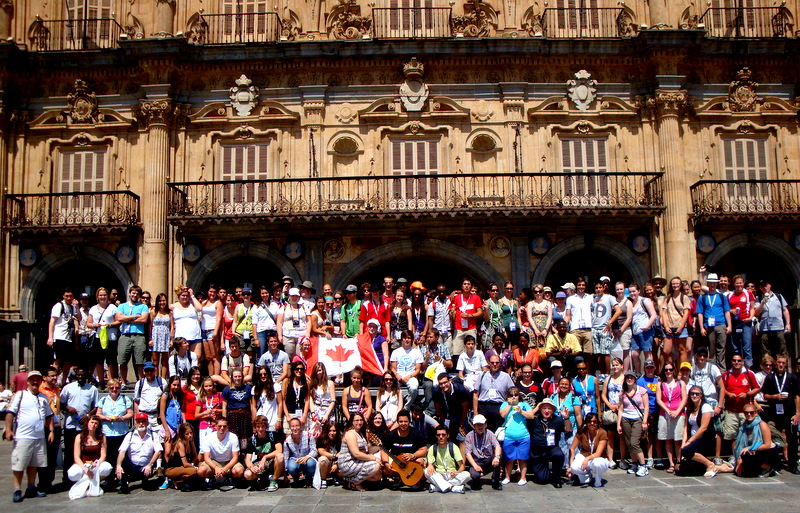
| Msgr Greg Smith and Vancouver delegates |
This passionate love of Jesus Christi is precisely what fascinates and catches young people. They were able to understand that in this way they were truly loved and liked by the Pope: without flattery, dissimulations, interest, cheating or superficiality, but with complete authenticity from someone who desired their good, the good of their lives: their happiness, their eternal salvation. And he looked for it by giving his own life without saving himself. They understood intuitively more with their heart than their brain. It does not come as a surprise, that they saw in the Pope the messenger of Jesus Christ`s grace and peace, announced by the prophet Isaiah, when he said, “How beautiful upon the mountains are the feet of him that brings good tidings, that publishes peace; that brings good tidings of good, that publishes salvation; that says unto Zion, Thy God reigns!” (Is 52:7). Whoever experienced the World Youth Day of Buenos Aires, Santiago de Compostela, Czestochowa, Denver, Manila, Paris, Rome, Toronto ...you can confirm that the way in which the Pope was welcomed, with that mixture of joy and respectful tenderness, young people showed that they recognized him as the one who came to meet them in the name of the Lord.
7. Since the fourth World Youth Day in Santiago de Compostela in 1989, no matter where the celebration has taken place, they have been designed and lived as the end of a joyful pilgrimage, conforming with this appealing Christian tradition. When inviting us to participate in this 26th World Youth Day in Madrid, the Pope is calling us to place ourselves on the path towards a new encounter with the Lord, friend, brother, Jesus Christ! He is the only one who can understand you and lead you to the truth; give everlasting life, happiness and true love! Yes, the youth of World Youth Day since Santiago de Compostela until now and forever are pilgrims of the Church. They walk in communion with her on an exceptional spiritual journey of decisive consequences for the future of their lives. They verify that the path indicated by the Successor of Peter indeed leads to Christ and no human power can prevent it; the path for their search, but above all, the way to meet Him. He is taking the initiative. John Paul II reminded us at the Vigil on the "Monte del Gozo" in Santiago de Compostela on the 19th of August, 1989 that "the spiritual tradition of Christianity not only underlines the importance of our search for God but also it highlights something even more important: it is God who seeks us. He comes to meet us." Christ is, dear young people, the one that is looking for you and is coming to meet you at World Youth Day Madrid 2011! The key to the success of any World Youth Day is to let yourself be found by Him and, of course, it is the key to this one, as well. It will be your success!
8. Benedict, our Holy Father has presided over WYD in Cologne in August 2005 and Sydney in July 2008 in creative continuity with John Paul II. Both were unforgettable! The day after tomorrow, August 18, the Holy Father will arrive in Madrid, to preside over what we are beginning today with Thanksgiving and the Eucharistic Prayer this evening in the Plaza de Cibeles in Madrid. His appeal addressed to you, young people of the Third Millennium, resonates with new and charming accents but the same paternal request and the same love that moved Blessed John Paul II when he instituted World Day of Youth. You, the young people that are here, and many others who have wished to participate in our WYD in Madrid but were unable or unwilling to be here, you are the generation of Benedict XVI. It is not the same as that of John Paul II. Your "place in life" has its peculiarities. Your problems and life circumstances have changed. Globalization, new technologies in communication, the economic crisis, etc., has been a determining factor in your life sometimes for better and often times for worst.
The youth of today, with weakened existential roots due to a rampant spiritual and moral relativism, "imprisoned by the dominant power" (Benedict XVI. Message for WYD 2011, 1), and can find no solid foundation on which to build your life in today ́s culture and society, even sometimes, in the family ... you are tempted to your absolute limit to lose your way in life: How could your faith not be sometimes shaken? Youth of the 21st century need, even more than previous generations, to find the Lord through the only path that has proven spiritually effective: that of a humble and simple pilgrim seeking God ́s face. The youth of today need to see Jesus Christ when He comes to meet them in the Word, the sacraments, "as well, and most importantly, in the Eucharist and the Sacrament of Penance, the poor and the sick, in those brothers experiencing difficulty and in need of help "(Benedict XVI. Message, 4). They need to see and enter into an intimate dialogue with Him, who loves them without asking anything in return except that you answer with your own love. The intention of the Pope who loves you so much, is to guide you in this very way: that you may experience in the Communion of the Catholic Church the truth and the urgency of making the theme of World Youth Day 2011your life: "rooted and built up in Christ, firm in the faith "(cf. Col 2.7).
9. John Paul II conceived World Youth Day as a valuable instrument of the new evangelization. Our Holy Father Benedict XVI as well.
Dear young people: you need to live this Eucharistic Celebration of the World Youth Day, saying thanks to the Lord, for being called from this moment to become his disciples and witnesses! Do not doubt it! Jesus Christ shows you the way and the aim of the real happiness. Not only to you; but also to your fellows and friends who moved away from religious practice and, even, from their faith or who do not have any knowledge about it. Jesus is searching you to put down roots in the heart of young people of the Third Millennium. Live the celebration as the great Prayer of the Church, which offers the Sacrifice of Jesus Christ Crucified and Resurrected to the Father as your own, for the salvation of all people ; and in the Eucharistic Communion of his Body and Blood do not reject that he will make you as part of himself. Keep in mind during these days that the Lord, through the Pope, is going to ask you:
Do you accept the wonderful and beautiful challenge of “the new evangelization” of your young peers?
Answer him yes, remembering that vibrant and brave call of John Paul II in the Homily on Monte del Gozo on the 20th of August, 1989:
“Do not be afraid to be saints”! “Let Christ reign in your hearts”! Answer him yes with a complete hope and a generous opening to the big life’s goals, as it is typical to young people. Answer the renewed call of Benedict XVI with a clear and coherent engagement of life! You can evangelize with words and works, today more then ever. John Paul II said to young Spanish people on the Vigil of Mary at “Cuatro Vientos”, the 3rd of May, 2003, that the new evangelization is everyone’s task in the Church: “Lay people have a leading role in it, especially married couples and Christian families, nevertheless, the evangelization today requires priests and consacrated people with urgency. Therefore, if these days you hear God’s calling “that is saying to you: «Follow me!» (Mc 2, 14; Lc 5.22), do not silence it. Be generous, respond as Mary did offering your joyful yes of your person and your life”.
10. We entrust ourselves to the maternal protection of Virgin Mary, the Mother of our Lord and the Mother of the Church at the beginning of the World Youth Day 2011. People in Madrid call on her as their Patron with the name of “Saint Mary, Royal of the Almudena”. Mary has always watched over the strength of faith, the certainty of hope and burning charity of all her sons and daughters of Madrid. I pray that, especially, these days she will watch over all of you, young people of this World Youth Day 2011, pilgrims to Madrid, the town that is devoted to Mary, in particular, to celebrate the meeting with the Holy Father. I pray that she will take care of you as only she can do, as well as our Holy Father Benedict XVI, the Bishops and priests, all your Pastors and those accompanying you. I pray that she takes care and protects your families. Remembering the prayer of John Paul II, said at the end of the unforgettable Rosary Vigil, already mentioned −the perfect end− I invite you to implore to Mary tonight with his own words:
“Hail Mary, full of Grace.
Tonight I beg for the young people
Who came to Madrid from all other the World, Full of dreams and hopes.
They are the guards of tomorrow,
The people of the Beatitudes:
They are the living hope of the Church and of the Pope. Holy Mary, the Mother of the young people,
Please intercede so that they are witnesses of Risen Christ,
Humble and brave disciples of the Third Millennium, Generous heralds of the Gospel.
Holy Mary, Immaculate Virgin,
Pray with us,
Pray for us”. Amen.
Saintly Patrons of the WYD 2011 − Saint Isidore the Farmer and Saint Mary de la Cabeza, Saint Ignatius of Loyola, Saint John of Avila, Saint Francisco Xavier, Saint John of the Cross, Saint Rose of Lima, Saint Raphael Arnáiz − pray for us!
Blessed John Paul II pray for us, pray for all young people of the WYD 2011 so that they open their hearts wide to the saving grace of Christ, the only Redeemer of human kind, these extraordinary days of the Holy Spirit during which we want to “count the wonders of the Lord to the nations”!
Amen.