Friday, April 22, 2011

GOOD FRIDAY/Vendredi saint

/


WERE YOU THERE


Were you there when they crucified my Lord?
Oh, sometimes it causes me to tremble, tremble, tremble.
Were you there when they crucified my Lord?

Were you there when they nailed him to the tree?
Oh, sometimes it causes me to tremble, tremble, tremble.
Were you there when they nailed him to the tree?

Were you there when they laid him in the tomb?
Oh, sometimes it causes me to tremble, tremble, tremble.
Were you there when they laid him in the tomb?

Were you there when God raised him from the tomb?
Oh, sometimes it causes me to tremble, tremble, tremble.
Were you there when God raised him from the tomb?
[Text: Negro Spiritual]

* * * * * *
 
 
Prayer for Friday of the Passion of the Lord
 

God, who by the Passion of Christ your Son, our Lord, abolished the death inherited from ancient sin by every succeeding generation; grant that just as, being conformed to him, we have borne by the law of nature the image of the man of earth so by the sanctification of grace may we bear the image of the Man of heaven. Through Christ our Lord.

* * * * * *

Vendredi saint


Trahi par son disciple Judas, le Christ est arrêté. Il est accusé de semer le désordre par ses enseignements et surtout d'usurper le titre de Messie, c'est-à-dire de Fils de Dieu envoyé pour sauver les hommes. Interrogé par Ponce Pilate (gouverneur romain de la région), flagellé par les soldats, Il est condamné à être cloué sur une croix - supplice alors réservé aux criminels.

Chargé de la croix, le Christ gravit la colline du Golgotha (littéralement « Mont du crâne », autrement appelé « Calvaire ») et tombe plusieurs fois d'épuisement. Crucifié, Il expire au bout de quelques heures. Descendu de la croix par ses proches, Il est enveloppé dans un linge blanc (le « linceul ») et mis au tombeau.

Les chrétiens sont appelés au jeûne (qui consiste à se priver de nourriture suivant l'âge et les forces du fidèle), démarche de pénitence et de conversion, expression de l'attente du Christ.

L'office du Vendredi Saint, appelé « célébration de la Passion du Seigneur », est centré sur la proclamation du récit de la Passion (Évangile selon saint Jean 18, 1 - 19,42). Il est proposé aux fidèles un chemin de Croix qui suit les étapes de la Passion du Christ.


* * * * * *
 
La nuit qu'il fut livré, le Seigneur prit du pain;

En signe de sa mort le rompit de sa main:
"Ma vie, nul ne la prend mais c'est moi qui la donne
Afin de racheter tous mes frères humains."


Après qu'il eut soupé pour la dernière fois
S'offrit comme victime au pressoir de la Croix:
"Mon sang, versé pour vous est le sang de l'Alliance
Amis, faites ceci en mémoire de moi."


Et nous, peuple de Dieu nous en sommes témoins.
Ta mort, nous l'annonçons par ce pain et ce vin.
Jésus ressuscité ton église t'acclame.
Vainqueur, passé du monde à la gloire sans fin.


Tu viens revivre en nous ton mystère pascal.
Eteins en notre chair le foyer de tout mal:
Nous sommes tes sarments, Sainte vigne du Père,
Fais nous porter du fruit pour le jour triomphal.


Seigneur, nous attendons ton retour glorieux;
Un jour, tu nous prendras avec toi dans les cieux.
Ton Corps est la semence de vie éternelle:
Un jour, tu nous prendras à la table de Dieu.

Thursday, April 21, 2011

HOLY THURSDAY: The Chrism Mass and the Mass of the Lord's Supper

THE MASS OF THE HOLY OILS
THE MASS OF CHRISM

On Tuesday evening, the Archdiocese of Ottawa gathered for the Mass of Chrism; some photos (courtesy of Robert Du Broy):


Pouring balsam into the olive oil before consecration of chrism


a large number of priests took part


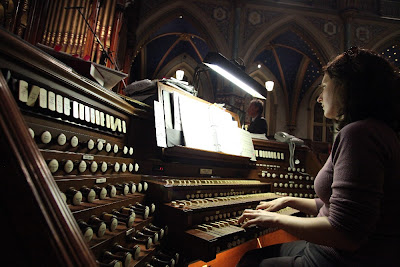
the organist


blessing the people during the recessional

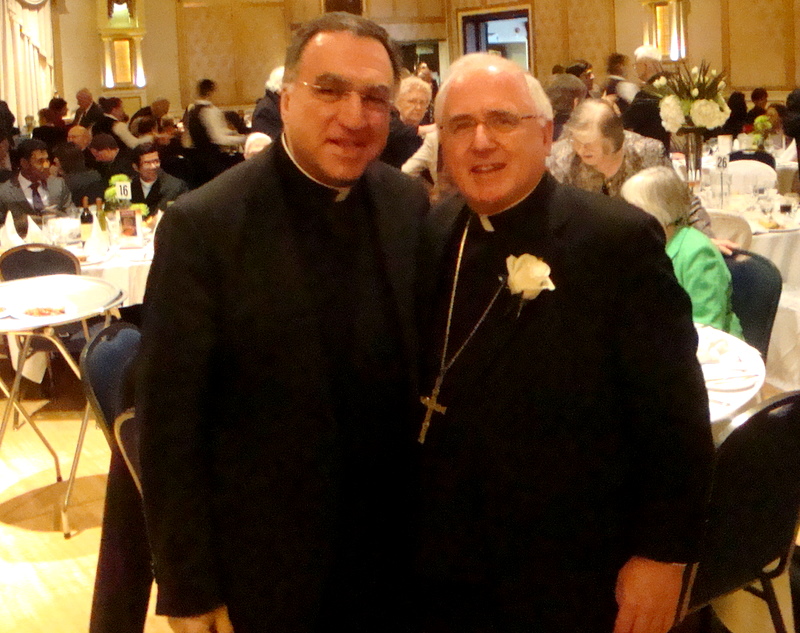
the reception in the parish hall

On Holy Thursday morning or a date nearby (in Ottawa it is on the Tuesday evening of Holy Week), the bishop and the priests of the diocese gather at the Cathedral to celebrate the Chrism Mass, sometimes referred to as the Mass of the Holy Oils).  This Mass manifests the unity of the priests with their bishop.

Here the bishop blesses three oils — the oil of catechumens (oleum catechumenorum or oleum sanctorum [OS on some vessels]), the oil of the infirm (oleum infirmorum [OI]) and holy chrism (sacrum chrisma [SC]) — which will be used in the administration of the sacraments throughout the diocese for the year.


This tradition is rooted in the early Church as noted in the Gelasian Sacramentary (named after Pope Gelasius I, d. 496), but was later absorbed into the Holy Thursday evening Mass; Pope Pius XII issued a new Ordinal for Holy Week, which reinstituted a special Mass of the chrism distinct from the evening Mass.

Throughout the Bible, various references indicate the importance of olive oil in daily life. Oil was used in cooking, particularly in the making of bread, that basic food substance for nourishment (e.g. Nm 11:7-9); as a fuel for lamps (e.g. Mt 25:1-9); and as a healing agent in medicine (e.g. Is 1:6 and Lk 10:34). Moreover, with oil the Jews anointed the head of a guest as a sign of welcome (e.g. Lk 7:46), beautified one’s appearance (e.g. Ru 3:3) and prepared a body for burial (e.g. Mk 16:1).

In religious practices, the Jews also used oil to offer sacrifices (e.g. Ex 29:40); to dedicate a memorial stone in honor of God (e.g. Gn 28:18); and to consecrate the meeting tent, the ark of the covenant, the table, the lampstand, the laver, the altar of incense, and the altar of holocausts (e.g. Ex 31:26-29). The use of oil was clearly a part of the daily life of the people.

Sacred Scripture also attests to the spiritual symbolism of oil. For instance, Psalm 23:5 reads, “You anoint my head with oil,” signifying favor and strength from the Lord; and Psalm 45:8 reads, “You love justice and hate wickedness; therefore, God your God, has anointed you with the oil of gladness above your fellow kings,” signifying the special designation from God and the joy of being His servant.

Moreover, to be “the anointed” of the Lord indicated receiving a special vocation from the Lord and the empowerment with the Holy Spirit to fulfill that vocation: Jesus, echoing the words of Isaiah, spoke, “The spirit of the Lord is upon me; therefore, He has anointed me” (Lk 4:18). St. Paul emphasized this point, “God is the one Who firmly establishes us along with you in Christ; it is He Who anointed us and has sealed us, thereby depositing the first payment, the Spirit in our hearts” (2 Cor 1:21). Therefore, the symbolism of oil is rich sanctification, healing, strengthening, beautification, dedication, consecration and sacrifice.

Given this heritage, the early Church adopted the use of olive oil for its sacramental rituals. The Oil of Catechumens is used in connection with the sacrament of baptism. St. Hippolytus, in his Apostolic Tradition (A.D. 215), wrote of an “oil of exorcism” used to anoint the candidates immediately before baptism. This practice continues: In the current baptismal liturgy, the priest offers the prayer of exorcism and then with the oil of catechumens anoints the person to be baptized on the chest, saying, “We anoint you with the oil of salvation in the name of Christ our Savior; may He strengthen you with His power, Who lives and reigns forever and ever.”

Anointing with the oil of catechumens following a prayer of exorcism may also take place during the period of the catechumenate on one or several occasions. In both cases this anointing symbolizes the person’s need for the help and strength of God to sever the bondage of the past and to overcome the opposition of the devil so that he may profess his faith, come to baptism and live as a child of God.

The oil of the infirm is used in the sacrament of the anointing of the sick. St. James wrote, “Is there anyone sick among you? He should ask for the priests of the Church. They in turn are to pray over him, anointing him with oil in the name of the Lord. This prayer uttered in faith will reclaim the one who is ill, and the Lord will restore him to health. If he has committed any sins, forgiveness will be his” (Jas 5:14-15).

The Apostolic Tradition of St. Hippolytus recorded one of the earliest formulas for blessing the oil of the infirm. Also, in the early Church, a priest (or several priests) would bless this oil at the time it was to be used, a tradition that has been retained in the Eastern Churches. However, in the Latin Rite, at least since the time of the Middles Ages, priests have used oil blessed by the bishop; for instance, St. Boniface in 730 ordered all priests in Germany to use the oil of the infirm blessed by bishops only.

Presently, the priest, anointing the forehead of the person, says, “Through this holy anointing, may the Lord in His love and mercy help you with the grace of the Holy Spirit,” and then anointing his hands, says, “May the Lord who frees you from sin, save you and raise you up.” Another body part may also be anointed if the hands are not accessible or if there is another particular need.

Finally, holy chrism is a mixture of olive oil and balsam, an aromatic resin. This oil is linked with the sanctification of individuals. In the Old Testament times, the priest, prophets and kings of the Jewish people were anointed. This oil is used in the sacraments of baptism, confirmation, and holy orders, since they impart an indelible sacramental character.

The blessing of the holy chrism is different from that of the other oils: Here the bishop breathes over the vessel of chrism, a gesture which symbolizes both the Holy Spirit coming down to consecrate this oil, and the life-giving, sanctifying nature of the sacraments for which it is used. (Recall how our Lord “breathed” on the Apostles on the night of Easter, saying, ‘Receive the Holy Spirit’” (Jn 20:22).)

The concelebrants at the Chrism Mass also extend their right hands toward the chrism as the bishop says the consecratory prayer, signifying that in union with their bishop they share “in the authority by which Christ Himself builds up and sanctifies and rules His Body,” the Church (Vatican II, Decree on the Ministry and Life of Priests, No. 2).

Regarding baptism, St. Hippolytus in the Apostolic Tradition spoke of an anointing after the actual baptism with the “oil of thanksgiving.” Similarly, right after the actual baptism in the present rite, the priest anoints the person on the crown of the head with chrism, saying, “God the Father of our Lord Jesus Christ has freed you from sin and given you a new birth by water and the Holy Spirit. He now anoints with the chrism of salvation. As Christ was anointed Priest, Prophet and King, so may you live always as a member of His body, sharing everlasting life. Amen.”

In the sacrament of confirmation, the bishop anoints the forehead of the candidate with chrism saying, “Be sealed with the gift of the Holy Spirit.”

Sacred chrism is also used in the sacrament of holy orders. In the ordination rite of a priest, the bishop anoints with chrism the palms of each new priest. In the ordination rite of a bishop, the consecrating bishop anoints the head of the new bishop.

Finally, holy chrism is used in the dedication ceremony of a church. Here the bishop anoints the altar, pouring holy chrism on the middle of the altar and on each of its four corners. It is recommended that the bishop anoint the entire altar. After anointing the altar, he anoints the walls of the church in 12 or four places marked by crosses.

As our bishop blesses these three oils at the Chrism Mass this year, our hearts turn to our gracious Lord who bestows His infinite love and mercy to us through these sacraments. Let us also pray for our bishop and the priests who are the ministers of the sacraments in the parish, that they may be the humble and generous servants of the Lord (--Father William Saunders, Arlington Catholic Herald).

* * * * * *

HOLY THURSDAY

Today's liturgy marks the Lord's three-fold institution of the Eucharist, the Priesthood and the Commandment of Fraternal Love:


Prayer for Holy Thursday
of the Lord’s Supper
Grant to those, O God, who participate in this most sacred Supper, in which your Only Begotten Son, when about to hand himself over to death, entrusted to the Church a sacrifice new for all eternity, the banquet of his love; that drawing upon so great a mystery we may have fullness of charity and of life. Through our Lord.

Wednesday, April 20, 2011

Wednesday in Holy Week - Preparing for Easter Sunday

Prayer on the Wednesday of Holy Week

O God, who willed your Son to submit for our sake to the yoke of the Cross, so that you might drive from us the power of the enemy, grant us, your servants, to attain the grace of its effects. Through Christ our Lord.


Detail, The Isenheim Altarpiece


O SACRED HEAD, SURROUNDED


O sacred head, surrounded
by crown of piercing thorn!
O bleeding head, so wounded,
reviled and put to scorn!


Our sins have marred the glory
of thy most holy face,
yet angel hosts adore thee
and tremble as they gaze


I see thy strength and vigour
all fading in the strife,
and death with cruel rigor,
bereaving thee of life;


O agony and dying!
O love to sinners free!
Jesus, all grace supplying,
O turn thy face on me.


In this thy bitter passion,
Good Shepherd, think of me
with thy most sweet compassion,
unworthy though I be:


beneath thy cross abiding
for ever would I rest,
in thy dear love confiding,
and with thy presence blest.
[Words: Henry Williams Baker (1821-1877), 1861;
after Bernard of Clairvaux (1091-1153); and Paul Gerhardt (1607-1676)]


* * * * * *

Easter Sunday (Year "A") - April 24, 2011

Benvenuto di Giovanni, The Resurrection (circa 1491)

CHRIST HAS BECOME OUR PASCHAL SACRIFICE [Texts: Acts 10.34, 36-43 [Psalm 118]; 1 Corinthians 5.6-8 (or Colossians 3.1-4); Matthew 28.1-10 (or John 20.1-18)

God's fulfilment of Old Testament promises in the glory of the risen Jesus serves as a key for comprehending the scripture passages of the Easter Vigil and the early Church's proclamation of Jesus' resurrection in the Acts of the Apostles. As Peter put it, “All the prophets testify about [Jesus] that everyone who believes in him receives forgiveness of sins through his name”.

During the Easter season we will hear Peter's powerful preaching from the Acts of the Apostles, as well as reflections on his ministry drawn from First Peter. All of these early Christian writings witness to the earth-shattering change that has taken place with Christ's resurrection.

For the evangelist Matthew, the paschal mystery--the death and resurrection of Jesus viewed as a whole—is summarized in the earthquake. At Jesus' death, a great earthquake took place, powerfully communicating Jesus' victory over death (Matthew 27.54).

In today's gospel, a second earthquake precedes proclamation of Jesus' resurrection to the faithful women at the tomb. It heralds the arrival of the new creation in the risen life Christians share with Jesus.

No one was eye-witness to the resurrection. Through the earthquake, Matthew symbolized Jesus' resurrection breaking into the static world of human beings. God's glory became visible in the angel's appearance (“like lightening, and his clothing white as snow”) and powerful intervention (“an angel of the Lord ... rolled back the stone and sat on it”), as well as in the utter fear that came over the guards (“the guards shook and became like dead men”). Clearly God was at work in raising Jesus from death.

The angel's interpretive word referred to the crucifixion in the Greek perfect tense (“you are looking for Jesus who was crucified”). This past tense indicates that the completed events of Jesus' Cross and Resurrection continue to have implications now. So, Jesus remains forever the “Crucified One”; his atoning death continues to bring salvation to all who believe.

As well, Jesus remains for all time the Risen One, communicating eternal life to those who follow in His way. In His glorified state, Jesus shares the on-going dimension of His death and risen life with others in such a way as to transform their lives (“Our paschal lamb, Christ has been sacrificed. Therefore, let us celebrate the festival ... with the unleavened bread of sincerity and truth”).

Paul's words “sincerity” and “truth” stand for a way of life that is guileless, without pretence or pseudo-sophistication. This is what living the risen life of Christ should mean for his followers. In a false sense of Christian freedom, the Corinthians had allowed themselves, instead, to tolerate sexual immorality in their midst (a man living in an incestuous relationship with his step-mother [1 Corinthians 5.1-5]).

Paul demanded the man's expulsion from the community on the principle that “a little leaven leavens the whole batch of dough”. This Jewish saying was the equivalent of our idiom, “a bad apple spoils the whole barrel”.

Leaven was a fermenting agent (like yeast), which was normally added to a batch of bread dough by using an unbaked portion of dough from a previous batch. Besides being a religious feast, the observance of Unleavened Bread probably also was a health provision. Week after week the fermentation process increased the danger of infection. So, once a year, the Israelites had to purge their homes of all leaven (Exodus 12.14-20).

Both in rabbinic literature and the New Testament, leaven came to symbolize an evil which spreads insidiously within a community until everyone is infected (cf. Mark 8.15). Because the feasts of Unleavened Bread and Passover had become joined in Jewish celebration, Paul easily passed from the symbol of leaven to the image of the paschal lamb in his challenge to the Corinthians.

Paul explains how Christians have become “a new batch, as you really are, unleavened”. As in John's Gospel where Jesus is identified with the paschal lamb slaughtered on Passover Eve (19.36-37), Paul applies the death of Christ to the killing of the paschal lambs on the first day of Unleavened Bread. Christ has been sacrificed, Paul says. Through Jesus' self-offering, Christians have received forgiveness of past sins, and true freedom enabling them to live a new life in and with Christ.

* * * * * *

Tuesday, April 19, 2011

MILESTONES: Benedict XVI Election Anniversary & Father Rosica 25 Years a Priest Today - Tonight Ottawa Chrism Mass

Congratulations to Pope Benedict XVI on the Sixth Anniversary of his election as Supreme Pontiff!


* * * * * *

Best Wishes to Father Thomas Rosica, C.S.B. on his Silver Jubilee of Priestly Ordination!


* * * * * *

Prayer for Tuesday of Holy Week


Almighty ever-living God, grant us to celebrate the mysteries of the Lord’s Passion that we may merit to receive your pardon. Through our Lord.

* * *

This evening the Presbyterate of Ottawa gathers around their bishop for the special Mass of the Oils, blessing the holy oils: the Oil of the Cathechumens, the Oil of the Sick and the Sacred Chrism.

Opening Prayer of the Chrism Mass
O God who anointed your Only Begotten Son with the Holy Spirit and made him Christ and Lord, graciously grant that being made sharers in his consecration, we may bear witness to your Redemption in the world. Through our Lord.

* * * * * *

Monday, April 18, 2011

Le nouvel évêque d'Amos: Mgr Gilles Lemay - Monday of Holy Week - Passion Sunday in Rome & at St. Patrick's Basilica

Nouvel évêque d’Amos


Mgr Lemay et Mgr Tremblay

Vendredi le 15 avril, j’ai voyagé en auto au nord, vers Amos pour l’inauguration du nouveau ministère pastorale de Mgr Gilles Lemay, 5ième évêque du diocèse.


La cérémonie s’est déroulée dans l’immense cathédrale dédiée à Sainte Thérèse d’Avila, érigée en 1922-23.

Voici quelques photos de la messe et des autres évènements alentour.


* * * * * *
Prayer for Monday in Holy Week

Grant, we pray, almighty God, that though in our weakness we fail, we may be revived through the Passion of your Only Begotten Son. Who lives and reigns with you.

* * * * * * 

Ne descends pas dans le jardin


Christ est allé dans le jardin, Alléluia.
Christ a laissé lier ses mains, Alléluia.
Christ a voulu souffrir la croix, Alléluia.
Christ a laissé percer son cœur, Alléluia.
Christ a dormi dans le tombeau, Alléluia.

 
* * * * * *

PALM SUNDAY CELEBRATIONS

Yesterday, the Church around the world began Holy Week with the liturgical commemoration of the Lord's entry into Jerusalem and the reading of the Passion in St. Matthew's gospel.

Pope Benedict XVI celebrated in St. Peter's Square with youth from around the world, anticipating this summer's World Youth Day in Madrid. 


For Palm Sunday, I was pleased to preside at concelebrated liturgies at St. Patrick's Basilica, namely the 12:15 PM and 9:00PM Masses.


Thanks to Father Larry McCormick for the following photos:


Blessed Holy Week!


Sunday, April 17, 2011

Passion [Palm] Sunday: The Entry into Jerusalem & St. Matthew's Passion - Passiontide Hymns - The New Missal


Prayer for Passion [Palm] Sunday

Almighty ever living God, who as an example of humility for the human race to follow caused our Saviour to take flesh and submit to the cross, graciously grant that we may heed its lesson of patient suffering and so merit a share in his Resurrection. Who lives and reigns with you.


* * * * *

Ne descends pas dans le jardin


Ne descends pas dans le tombeau,
Oh! Jésus,
Ne descends pas dans le tombeau
Qu’ils ont creusé!
Si je ne descends pas dans le tombeau
Comme un froment,
Qui donc fera lever de vos cercueils
Vos corps sans vie ?
Je descendrai dans le tombeau
Pour y dormir.


* * * * * *

WHEN I SURVEY THE WONDROUS CROSS

When I survey the wondrous cross
on which the Prince of Glory died;
my richest gain I count but loss,
and pour contempt on all my pride.


Forbid it, Lord, that I should boast,
save in the death of Christ, my God;
all the vain things that charm me most,
I sacrifice them to his blood.


See, from his head, his hands, his feet,
sorrow and love flow mingled down.
Did e'er such love and sorrow meet,
or thorns compose so rich a crown.


Were the whole realm of nature mine,
that were an offering far too small;
love so amazing, so divine,
demands my soul, my life, my all.
[Text: Isaac Watts, 1674-1748]

* * * * * *

From Saturday's National Post...

Archbishop Terrence Prendergast:
the missal is a new way to speak to God


Charles Lewis Apr 16, 2011 – 5:00 AM ET
Terrence Prendergast, the Roman Catholic Archbishop of Ottawa, served on the committee that oversaw the translation of the new Roman Missal, which will be introduced in November, on the first Sunday in Advent. He spoke to Charles Lewis this week about the importance of the new missal and how it may help strengthen the faith of Catholics.

Q. Why do you think the new missal is superior to the one the Church has used for the past 40 years?

A. It is better because it is more faithful to the original [Latin texts] and more appropriate for worship. The translation principle in vogue in the 1960s and early 1970s was called “dynamic equivalence,” which, frankly speaking, tends to be more subjective about what the text means. On trips to Rome, for example, I would bring with me Living with Christ and Prions en Eglise (the two Canadian missalettes) and would sometimes also hear the prayers in Italian. At times, it was hard to conceive that these texts were translations of the same Latin base text.

Q. Is it more sacred language?

A. There are different types of speech: for the pub, at work, on television talk shows; and another more suitable for worship. The early translation was more pedestrian, let us say; this one has a higher literary register, though still familiar, as is fitting for sons and daughters of God.

Q. Proponents of the new missal say if nothing else the new language will force people in the pews to think more about what they’re saying and think about what it means. Do you agree?

A. Yes, especially at first when the translation will be strikingly novel. I believe the people in the pews will adapt to the translation fairly quickly; however, the priests will need a bit more time and the laity will need to be patient with them.
When it comes to certain terms — for example, speaking of the death of Jesus “for many” rather than [the current] “for all” — it will be an apt opportunity for teaching and clarifying Church doctrine. Similarly with the statement in the Creed that says Jesus is “consubstantial” with the Father rather than “one in being.” People will wonder and puzzle over texts and this will give priests and deacons an opportunity to teach the nuances of the faith.

Q. Will this be the last translation for the forseeable future?

A. I would hope so; there are many other liturgical texts that need to be translated besides the Mass, the rite of baptism, the marriage ceremony, funeral rites. Perhaps after another 40 years we can look at the present translation of the Missal and decide whether another version is needed. The way language keeps evolving, however, I suspect we may need another version in half that time.

Q. This translation is closer to the Latin. Some critics say the closer to the Latin the more difficult to translate into English, creating awkwardness. What do you say?

A. Well, I used to teach Latin, so working on this project was a wonderful challenge. The awkwardness is only the initial response, until one understands what the text is trying to say. Then, my experience is one of discovering the riches in prayers that come from as far back as the fifth and sixth centuries. One realizes these were prayed by Sts. Benedict and Scholastica, Francis and Clare, Teresa of Avila and John of the Cross; we missed out on some of the richness of these texts and now we will benefit from them.

National Post clewis@nationalpost.com


Saturday, April 16, 2011

St. Benedict Labre - Saturday of Lent Week V - Death of Mgr Jean Gratton, emeritus of Mont-Laurier


In some places, including our parish in Wendover, April 16 is the liturgical memorial of a patron saint of street people. Benoît-Joseph Labre (1748-83) is the patron saint of the homeless. Having failed in his first ambition, to become a monk, he became for five years a perpetual pilgrim, before abandoning himself to the life of a derelict in Rome.

The eldest of 15 children of a prosperous shopkeeper, Benoît-Joseph was born in the village of Amettes, near Boulogne. Even as a young boy he manifested both extreme devotion and an inextinguish-able horror for anything which smacked of sin.

At 12 he was sent to live with an uncle who was parish priest of Erin, some 40 miles from Amettes. There, he immersed himself in reading the Bible and the lives of the saints.

Although Benoît-Joseph was not gloomy – indeed, he seemed to be cheerful in the depths of his soul – he was never sociable. His first ambition was to join the strictest possible religious order and submit himself to the most rigorous mortification.

Something about him, though, made monasteries wary. The Trappists, the Carthusians and the Cistercians all decided that he was unsuitable for any form of community.

Around 1770, when he was 22, Benoît-Joseph conceived the idea of becoming a pilgrim. He set out for Rome, travelling on foot and depending entirely on alms. His aim, in imitation of his Master (Luke 9.58), was to have nowhere to lay his head.

Such gifts as he received he often passed on to those whose need he considered greater than his. He had no possessions save his increasingly disgusting clothes, and three books, the New Testament, the Breviary and The Imitation of Christ.

As he walked he became totally absorbed in prayer and meditation, rarely speaking to fellow pilgrims. Nor, it must be admitted, were they keen to talk to him, given his stinking condition.

So, over the years, Benoît-Joseph made his way to all the main pilgrim shrines in western Europe, including Loreto and Assisi in Italy, Compostela in Spain, Paray-le-Monial in France and Einsiedeln in Switzerland, which he visited five times.

From 1774, however, he settled in Rome (save for an annual visit to Loreto), sleeping rough in the Colosseum until forced by illness to enter a hospice for the poor.

He spent his days in churches, becoming known as “the saint of the Forty Hours” in consequence of the long periods he spent in contemplation before the Blessed Sacrament.

Finally, on April 16, 1783, worn out by his sufferings and austerities, Benoît-Joseph sank down exhausted on the steps of his favourite church, the Madonna dei Monti, and was carried to a neighbouring house, where he died.

Canonized in 1883, Benoît-Joseph has been called a “representative example of those who have refused, in the name of Christ, to be respectable”. H/t to Anna Arco, catholicherald.uk.co


* * * * * *

On Thursday, Bishop Jean Gratton, a native of our diocese (Wendover, ON) and a member of the Ottawa presbyterate, passed away in Montreal after being in declining health for several years.  His funeral will take place in Mont-Laurier, where he had been bishop for more than twenty years.  When I was named a bishop he was always supportive of me at my first sessions of the CCCB. May the Lord grant him a merciful judgment and a blessed reward of his labours.  His funeral will be in Mont-Laurier on April 26.

Please join me in praying the Lord to receive him into the heavenly dwellings.

R.I.P. 


Décès de Mgr Jean Gratton, évêque émérite de Mont-Laurier
(1924-2011)


Le 14 avril 2011, Mgr Jean Gratton, évêque émérite de Mont-Laurier, est décédé à l’âge de 86 ans. Nommé évêque par le Pape Paul VI, le 13 mai 1978, il a été ordonné évêque de Mont-Laurier le 29 juin 1978, poste qu’il a occupé durant 23 ans, soit jusqu’à sa retraite le 8 septembre 2001 où il laissait place à son successeur Mgr Vital Massé.

Né le 4 décembre 1924, à Wendover, en Ontario, il est le fils de Joseph Aldéric Gratton et de Rhéa Séguin. Il était deuxième d’une famille de douze enfants. Après ses études théologiques au Grand séminaire Saint-Thomas d’Aquin à Ottawa, philosophiques à l’Université Angelicum à Rome et exégétiques et bibliques à l’Université de Montréal, il est ordonné prêtre le 27 avril 1952, à Wendover par l’archevêque d’Ottawa, Mgr Alexandre Vachon.

Professeur au petit Séminaire d’Ottawa (1952-1967), puis supérieur de l’endroit en 1966, il prend par la suite la direction de la Maison Paul VI et de la Pastorale des vocations (1967-1969). Codirecteur du Conseil diocésain de l’apostolat laïque (1968-1970) et du Concile diocésain (1971), curé de la paroisse Saint-Victor d’Alfred (1970-1973), puis vicaire général pour l’archidiocèse d’Ottawa (1973-1975) et enfin curé à la paroisse Saint-Charles de Vanier (1975-1978) avant d’être nommé évêque de Mont-Laurier.

Quatrième évêque de Mont-Laurier (1978–2001), Mgr Gratton aura marqué le diocèse surtout par sa proximité avec les gens, sa gestion sobre et efficace et un engagement marqué des laïques.

Mgr Gratton a aussi rempli de nombreuses fonctions au sein de la Conférence des évêques catholiques du Canada où il a été, notamment, président de la Commission épiscopale de l’éducation chrétienne (1989-1993) et président du Comité des communications (1990-1996) à l’Assemblée des évêques catholiques du Québec. Il a également été président d’assemblée des évêques de l’Inter-Ouest durant une bonne partie de son épiscopat à Mont-Laurier.

La dépouille de Mgr Gratton sera exposée au funérarium Ouellette, le 24 avril 2011, de 19 h à 22 h, le 25 avril de 14 h à 17 h et de 19 h à 22 h ainsi que le lendemain, 26 avril, en la cathédrale de Mont-Laurier, de 10 h à 14 h, moment de ses funérailles, au même endroit.

* * * * * *

Prayer for Saturday of Lent Week V

O God, who have made all those reborn in Christ a chosen race and a royal priesthood, grant us, we pray, the grace to will and to do what you command, that the people called to eternal life may be one in the faith of their hearts and in the homage of their deeds. Through our Lord.

* * * * * *

Ne descends pas dans le jardin


Ne laisse pas percer ton cœur,
Oh! Jésus,
Ne laisse pas percer ton cœur
Par tes bourreaux !
Si je ne laisse pas percer mon cœur
Comme un fruit mûr,
Qui donc vous baignera de sang et d’eau
Pour vous guérir ?
Je laisserai percer mon cœur
Comme un fruit mûr.