Monday, November 22, 2010

Memorial of St. Cecilia, Virgin & Martyr - Le renouveau charismatique d'Ottawa - "Condom Controversy"

Today, the Church celebrates a memorial of St. Cecilia, virgin-martyr of the early church.


St Cecilia is one of the seven women saints, besides Mary, mentioned in the Roman Canon (First Eucharistic Prayer) of the Mass, showing that these saints were venerated in 5th century Rome. Patrick Duffy (www.catholicireland.net) tries to unravel what the stories say about St Cecilia and how she became patron of music:


The 5th century Acta of St Cecilia tell of events in the early 3rd century. A Christian Roman maiden from a patrician family wanted to dedicate herself to God as a virgin, but her father had arranged her marriage to a young man named Valerian. After the marriage ceremony, she told Valerian about Jesus, adding that her virginity was protected by an angel. She said he could choose between serving the angel if he respected it and being being punished by the angel if he tried to consummate the marriage.

Perplexed, Valerian went off to find Pope Urban I (222-230), who was living among the poor along the Appian Way, and asked to be baptised. On his return, he found the angel standing beside his wife, and they both received a crown of flowers. Then his brother Tiburtius arrived, was told the story, and also went off to be baptised. The two then devoted themselves to good works and were arrested for burying bodies of martyred Christians. Refusing to recant, they were beheaded outside Rome, together with an official named Maximus, who was converted by their example. Cecilia then buried their bodies.

A crowd then gathered at her house, and Pope Urban baptised some 400 people there, one of whom established that house as a church - the detail which probably accounts for the origin of the story. Cecilia was condemned to be suffocated in her bathroom. The attempt failed. Then she was beheaded, but this was bungled, so she lingered for three days. She was buried in the catacomb of San Callisto.

Valerian, Tiburtius, and Maximus were actual martyrs, historically identifiable and buried in the catacomb of Praetextatus. Mention is made of an ancient Church of St. Cecilia in Trastevere in the fifth century, where Pope Symmachus held a council in the year 500. In 821 Pope Paschal I wished to restore this church which had fallen into decay, and had their remains moved there to be together with her supposed body, which he had been told in a dream was there and not in San Callisto. He had this enclosed in a cypress coffin in a marble tomb. Pope Paschal founded a monastery in honour of these saints, near the Church of St. Cecilia, that the monks might perform the office day and night.

Another restoration under Cardinal Sfondrati in 1595 led to their tombs being opened. Cecilia's body was found to be incorrupt, and remained so for some days, long enough for a graphic altar sculpture of St. Cecilia to be made by the late-Renaissance sculptor Stefano Maderno (1600), before contact with the air caused the body to disintegrate. It was seen by many people, and full descriptions were written of it by the reputable historian Cardinal Baronius. The statue depicts evidence of decapitation, thus helping to confirm the identity of the saint. Incorrupt bodies are not a feature of earlier stories of saints, and no mention was made of it in 821; by the 16th century they had become quite "fashionable", and this discovery was seen as a great coup for the Church of Santa Cecilia in Trastevere.

Up to this stage there had been no association between Cecilia and music. Till then, those regarded as the patron saints of music were: Pope St Gregory I, credited with originating the style of liturgical singing known as Gregorian chant; from the Old Testament, King David, a fabled harpist and a composer of psalm tunes and texts and Job, who in Job 30:31 says: ''My harp is turned to mourning, my flute to the sound of weepers.''

The Acta of St Cecilia telling how she converted her husband Valerian, her brother-in-law Tiburtius and the Roman official Maximus and her death set out the basis for her sainthood (= canonisation). How she became the patroness of music and musicians can be traced to a misunderstanding of the account of Cecilia's prayer during her wedding as reported in the Acta. What the Acta say is: "So at the ceremony, while musical instruments played around her, she prayed that she might remain as pure in body as she was in spirit". Her prayers were answered when she converted Valerian to Christianity.

But by the 15th century the Vespers antiphon for her feast day highlighted the words: Cantantibus organis, Caecilia Domino leaving out the words in corde suo (in her heart) and the content of her prayer from the Acta account of the wedding. This led to an interpretation of Cecilia as actually herself singing and playing the organ. By Handel's time, Cecilia, as well as being a virtuoso performer, had become a great appreciator of music!

Soon Cecilia is depicted in paintings as singing and playing the organ and is declared as the patron of music by musicians’ guilds. This led to an extraordinary growth in her popularity, especially when Palestrina helped set up the Accademia di Santa Cecilia in Rome in 1584. She was even said to have invented the organ.

* * *

O God, who gladden us each year with the feast of St. Cecilia, grant, we pray, that what has been devoutly handed down concerning this handmaid of yours may offer us examples to imitate and proclaim the wonders worked in his servants by Christ your Son.  Who lives and reigns with you.

* * * * * *
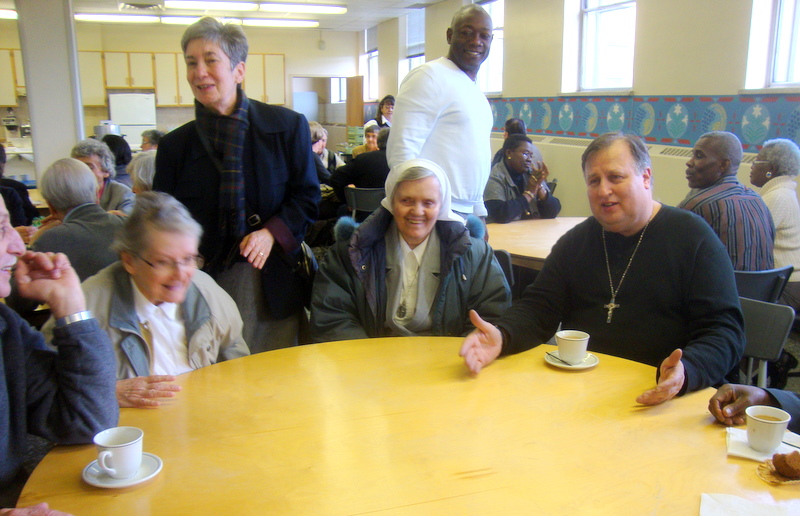
Samedi, c’était ma rencontre annuelle avec les représentants du renouveau charismatique dans l’archidiocèse et la région. 

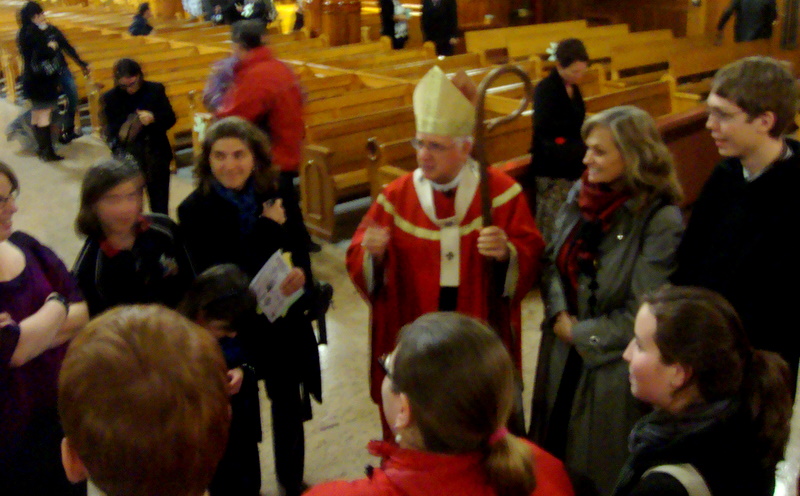
Nous avons partagé louange et prières, chants et danse, la sainte messe et un repas. Je n’ai pas pu assister aux sessions de l’après-midi à cause d’une célébration de confirmations à l’église St. Joseph, d’Orléans pour les étudiants de l’école Les Voyageurs.

Aucune photo des confirmations, mais voici quelques photos de la réunion du matin.


* * * * * *

Leak of Condom Statement from Pope's Book Overshadows Consistory


Between a meeting with charismatics, some Confirmations and a diaconal ordination Saturday and three Confirmation celebrations yesterday, I have not had much time to peek into the news coming out of the Vatican regarding what the new papal interview said about a rare use that might be permitted for a condom.

Too bad the media feeding frenzy overshadowed the significant homily and addresses the Pope gave on the occasion of creating twenty-four new cardinals in his third consistory.

I have not seen the book of Peter Seewald's interview with the Holy Father, but the blogosphere has been full of commentary by those who have not read the book,  as well by those who have but, even under media pressure, have decided to observe the embargo which is set to end at noon (Rome time) tomorrow or 6 o'clock tomorrow morning in Ottawa.

One who has seen the book and will comment on it once the embargo is lifted is the American Catholic commentator Amy Welborn whose blog "Charlotte Was Both" (http://www.amywelborn.wordpress.com/) yesterday roasted the Pope's newspaper for violating publication convention; she also gives a hint as to what we can expect, including more surprises:

What’s most unbelievable about today is who broke the embargo – L’Osservatore Romano that’s who. With a mistranslated section that’s what.


(I think – I’m assuming. The Italian translation had a feminine article with prostitute and the English version that I read ... is specific about male prostitute.)


The point? No the Pope did not have a “condom conversion” as Ruth Gledhill so idiotically put it on Twitter. What he said – whether he should have said it or not is another issue – but whatever the case it really is nothing new and has nothing to do with the Church’s teaching on contraception either.


It’s an articulation of his concern for and interest an individual’s moral progress – ironically enough.


Here’s what I’m going to say – this whole conversation is going to be flipped on its head when the rest of the interview comes out and the people who are either crowing about or mourning the Pope changing the Church’s teaching on contraception or sexuality or something are really not going to know what to say next.

Interesting days ahead...!

Sunday, November 21, 2010

Jesus Christ the KING - The "all-sufficient" Lord of history and of our lives

Titian (1477/89-1576), Jesus Christ and the Good Thief, c. 1563


The Solemnity of Christ the King (Year "C") - November 21, 2010


LIVING IN THE KINGDOM OF GOD'S SON [Texts: 2 Samuel 5:1-3; [Psalm 122]; Colossians 1:12-20; Luke 23:35-43]

The Second Book of Kings tells of David's designation as king over all Israel, the union of northern tribes (Israel) with the southern kingdom (Judah) under his leadership.

Israelite motivation for their choice of David as 'shepherd' and 'ruler' lay in his military leadership and God's decision to take the throne from Saul and entrust it to David (cf. 2 Samuel 3:10).

David was depicted as a pastoral ruler leading by persuasion. But Israel's union was only surface-deep. Underneath, internal conflicts raged, ready to boil over at any time--as David's 33-year rule showed. True and lasting kingship would await another 'anointed one' in David's lineage.

In the gospel, Jesus exercises His rule as God's anointed with kingly right to open the doors of Paradise to those who come into fellowship with Him.

Luke's depiction of the crucifixion shows three negative responses to the Crucified balanced by three positive responses including one offered by the so-called "good thief". Those humiliating Jesus were the religious leaders, the soldiers and a criminal. The positive dispositions toward Him came, in reverse order, from a criminal and--beyond today's gospel reading--from a centurion and the people (cf. 23:46-48).

The catcalls tempted Jesus to hang on to His life ('let Him save Himself'; 'save Yourself'; 'save Yourself and us' as well), a stance completely at odds with His teaching about the true way to life (cf. 9:24).

Jesus' fate on the Cross embodied that of the world's marginalized in every age: 'scoffed at', 'derided' and 'rebuked'. Jesus accepted it all with serenity and inner peace, or so it seemed to one of the criminals crucified with Him.

Inwardly, this became a moment of grace for him. He responded by defending Jesus's innocence to the abusive criminal, admitting his own guilt and asking Jesus to 'remember me when You come into Your kingdom'.

The meaning of 'remember' has been interpreted as asking for a share in the mercy that only a king can give. Perhaps the criminal was conscious that, because of his deeds, his personal fate would differ from the one awaiting Jesus. Or perhaps he knew that he could do nothing now to merit God's favour.

Whatever his intention, the criminal's gesture of humility moved Jesus--as often happened during His ministry--to reach out with comfort and a saving word. As St. Ambrose put it, "More abundant is the favour shown than the request made".

Christ the king, ruling on the Cross, offered salvation to one who unexpectedly repented. The generalized 'when' of the criminal's petition became 'today' in Jesus' assurance that 'you will be with Me in paradise'. The day of his crucifixion became the day of the criminal's entry into Paradise.

The word 'today' on Jesus' lips echoes its frequent use elsewhere in the gospel, showing that in Him the era of salvation has become a reality for the world (cf. 2:11; 4:21; 5:26; 19:11).

'Paradise' is a Persian loan-word meaning "garden" or "park" and, though having secular connotations, was used to refer to the Garden of Eden (Isaiah 51:3). It came to symbolize the future bliss of God's people.

In 2 Corinthians 12:4 and Revelation 2:7, Paradise symbolizes Heaven and its happiness. It is the realm where Jesus exercises His kingly rule. In Christian thought, Paradise became known as the intermediate resting place for the souls of the righteous dead.

Colossae was located in the Lycus Valley, in today's southwestern Turkey. In the mid-first century a Christian community existed there, perhaps founded by Epaphras (Colossians 1:7-8). The precipitating cause of the letter, written by Paul or possibly a disciple, was the appearance of a philosophy or tradition that was troubling because it suggested that Christ was not all-sufficient to the spiritual needs of the Colossians.

The precise nature of the Colossian heresy has been much debated: some were demanding circumcision (2:11), the keeping of sabbaths, new moons, festivals and dietary restrictions. But the inspired author insists that men and women have no need to retreat from the world into some esoteric cult or practice to live good and upright lives. Here and now they have the power, from Christ and through their baptism, to live a high degree of morality. This is what it means to live in the kingdom of God's Son.

Saturday, November 20, 2010

Summary of Papal Text "Verbum Domini" - Administrator elected for Newfoundland and Labrador

The website of the Canadian Conference of Catholic Bishops this week made available a five-page summary of the Holy Father's recent post-synodal Apostolic Exhortation Verbum Domini (The Word of the Lord) on the Bible in the life and mission of today's Church.


Here are excerpts from that summary:

This Apostolic Exhortation of His Holiness Pope Benedict XVI is a response to the 2008 Ordinary General Assembly of the Synod of Bishops, whose theme was The Word of God in the Life and Mission of the Church. One of the goals of the Synod was to review the implementation of the directives on Scripture found in the Second Vatican Council, especially its Dogmatic Constitution Dei Verbum, and to confront new the challenges of our day. The continuation of this task is one of the main objectives of Verbum Domini (no. 3).


The document consists of three parts, entitled Verbum Dei (The Word of God), Verbum in Ecclesia (The Word in the Church), and Verbum Mundo (The Word to the World).

This summary will provide some important highlights from the document, particularly those which may have pastoral importance. It is in no way, however, a summary of the whole of the document, which deals with far more themes than could be dealt with here.

Part One: Verbum Dei (The Word of God)


Part One begins by outlining the significance of the Incarnation, in which the Word became flesh. It then briefly discusses the human response to God’s word, before an extended treatment of the topic of the interpretation of Scripture....

The Bible’s unity is grounded in the fact that all the Scriptures ultimately point to Christ, the Word (nos. 38-39). This means that the Old Testament remains valid for Christians, even if it has been fulfilled (no. 40). The close relationship between the Old and New Testaments must be brought out in both pastoral and academic settings (no. 41)....


The lives of the Saints, who allowed their lives to be shaped by the word of God, provide the most profound interpretation of Scripture. “Every saint is like a ray of light streaming forth from the word of God” (no. 48). Their holiness is an interpretation “which cannot be overlooked” (no. 49)....

Part Two: Verbum in Ecclesia (The Word in the Church)


Part Two considers the place of the word of God in the Church, particularly in the liturgy and in the sacraments. The liturgy is not only the privileged setting in which we hear the word of God, but it is also the goal to which a faith-filled understanding of Scripture must always refer (no. 52). Unfortunately, the close relationship between word and sacrament is not always understood by the faithful, and so it is the task of priests and deacons to explain this unity when they administer the sacraments (no. 53).


Given the importance of the Mass readings, which are proclaimed by a reader, more training should be provided for those who carry out this task in the liturgy. This training should be in the areas of biblical formation, liturgical formation, and technical preparation (no. 58).


Because of the importance of the word of God in the sacred liturgy, the quality of homilies needs to be improved . . . [I]t should lead to an understanding of the mystery being celebrated, serve as a summons to mission, and prepare the assembly for the profession of faith, the universal prayer and the Eucharistic liturgy. . . . Generic and abstract homilies which obscure the directness of God’s word should be avoided, as well as useless digressions which risk drawing greater attention to the preacher than to the heart of the Gospel message. The faithful should be able to perceive clearly that the preacher has a compelling desire to present Christ, who must stand at the centre of every homily (no. 59)....


Part Three: Verbum Mundo (The Word to the World)

Part Three deals with the theme of mission and evangelization. The word of God given to us makes us not only hearers, but also heralds so that we share in Christ’s mission and are empowered by the Holy Spirit (no. 91). The word that we receive is meant for all; it cannot be kept to ourselves. Since it is true, it belongs to everyone (no. 92).


Every area of society needs the light of Christ. “It is not a matter of preaching a word of consolation, but rather a word which disrupts, which calls to conversion and which opens the way to an encounter with the one through whom a new humanity flowers” (no. 93).


This task of proclaiming the word of God belongs to all the baptized. Consciousness of this mission “must be revived in every family, parish, community, association and ecclesial movement” (no. 94). Because many people, particularly in the Western world, are “baptized, but insufficiently evangelized,” there is need for a “new evangelization” (no. 96). This mission must not neglect the poor (no. 99) and the need to strive for justice (no. 100). In this regard, the faithful should receive formation in the Church’s social teaching (no. 100)....


Conclusion


Although this Apostolic Exhortation deals with a number of themes, we conclude our summary with Pope Benedict’s impassioned plea at the end of the document:

I remind all Christians that our personal and communal relationship with God depends on our growing familiarity with the word of God. Finally, I turn to every man and woman, including those who have fallen away from the Church, who have left the faith or who have never heard the proclamation of salvation. To everyone the Lord says: “Behold, I stand at the door and knock; if anyone hears my voice and opens the door, I will come in to him and eat with him, and he with me” (Revelation 3.20) (no. 124).

Commission for Doctrine
Canadian Conference of Catholic Bishops
November 17, 2010


The full text of the summary may be accessed at: http://www.cccb.ca/ ("What's New?"); en francais: http://www.cecc.ca/ ("Quoi de neuf?")

* * * * * *

Cornerbrook & Labrador Diocese Elects Administrator

Monsignor Edwin J. Gale P.H. has been elected Diocesan Administrator for the Diocese of Corner Brook and Labrador, Newfoundland by the College of Consultors on November 15, 2010. He will ensure the leadership of the Diocese until a new Bishop is named.


Born in Searston, Codroy Valley in Newfoundland and Labrador on June 13, 1942, he was ordained to the priesthood on June 12, 1966. He was appointed pastor of St. Joseph’s parish in Harbour Breton in 1974 and later served as pastor in the parishes of Immaculate Conception, Deer Lake and Star of the Sea, Benoit’s Cove. From 1994 to 2000 he became pastor of St. Stephen’s Parish, and in 2000 pastor of Holy Redeemer Parish, Corner Brook.

Friday, November 19, 2010

Ottawa Priests Study Days


The English Sector Priests and I have just returned from several days at the NAV Canada Training and Conference Centre in Cornwall, where we held our biannual Priests' Seminar.

This year, our focus was two-fold (in addition to building priestly fraternity through prayer and socializing): Christian Stewardship with presentations by one of our own priests from the French Sector, Maurice Dionne, and the implementation of the new translation of the Roman Missal (due to begin Advent 2011), with presentations by Msgr. James Moroney, rector of St. Paul's Cathedral, Worcester, MA and executive secretary of the Vatican's Vox Clara committee (above centre).

Herewith some photos taken at the gathering:


Thursday, November 18, 2010

The Dedication of the Basilicas of Saints Peter and Paul, Apostles - Visite pastorale, Paroisses Ste. Euphémie & St. Albert

“It is extraordinarily interesting that Roman pilgrimage began at an…early time. Pilgrims did not wait for the Peace of the Church [Constantine’s edict of toleration] before they visited the tombs of the Apostles. They went to Rome a century before there were any public churches and when the Church was confined to the tituli [private homes] and the catacombs. The two great pilgrimage sites were exactly as today—the tombs, or memorials, of St. Peter upon the Vatican Hill and the tomb of St. Paul off the Ostian Way” (H.V. Morton, This Is Rome).


Defend your Church, O Lord, by the protection of the holy Apostles, that as she received from them the beginnings of her knowledge of things divine, so through them she may receive, even to the end of the ages, an increase of heavenly grace.  Through our Lord.

* * *

St. Peter’s is probably the most famous church in Christendom. Massive in scale and a veritable museum of art and architecture, it began on a much humbler scale. Vatican Hill was a simple cemetery where believers gathered at St. Peter’s tomb to pray. In 319 Constantine built on the site a basilica that stood for more than a thousand years until, despite numerous restorations, it threatened to collapse. In 1506 Pope Julius II ordered it razed and reconstructed, but the new basilica was not completed and dedicated for more than two centuries.

St. Paul’s Outside the Walls stands near the Abaazia delle Tre Fontane, where St. Paul is believed to have been beheaded. The largest church in Rome until St. Peter’s was rebuilt, the basilica also rises over the traditional site of its namesake’s grave. The most recent edifice was constructed after a fire in 1823. The first basilica was also Constantine’s doing.

Constantine’s building projects enticed the first of a centuries-long parade of pilgrims to Rome. From the time the basilicas were first built until the empire crumbled under “barbarian” invasions, the two churches, although miles apart, were linked by a roofed colonnade of marble columns.

Peter, the rough fisherman whom Jesus named the rock on which the Church is built, and the educated Paul, reformed persecutor of Christians, Roman citizen and missionary to the Gentiles, are the original odd couple. The major similarity in their faith-journeys is the journey’s end: Both, according to tradition, died a martyr’s death in Rome—Peter on a cross and Paul beneath the sword. Their combined gifts shaped the early Church and believers have prayed at their tombs from the earliest days (http://www.americancatholic.org/).

* * * * * *
Visite Pastorale aux Paroisses Ste-Euphémie et St-Albert

De jeudi le 11 novembre a dimanche le 14, l’abbé Daniel Berniquez, vicaire épiscopal et moi sommes allés aux paroisses Sainte Euphémie de Casselman et St. Albert (St. Albert, ON).

Nous avons rencontré les élèves dans les écoles le Pavillon St. Paul, et l’École catholique secondaire de Casselman, visité les aines dans les deux villages et traité avec les conseils de pastorale et d’affaires temporels. Aussi, j’ai présidé les célébrations de Confirmation dans chaque paroisse.

L’Église Ste. Euphémie a été ferme au mois de mai alors que la structure du jubé et la sécurité de l’édifice ont été compromis; après six mois de messes dans une école, la communauté a recommencé l’usage de l’Église avec la messe dominicale le dimanche, 7 novembre.

Voici des photos de la grande joie dans les deux paroisses!

Saint Albert:


Sainte Euphémie:


Wednesday, November 17, 2010

St. Élisabeth d'Hongrie - Confirmations in Embrun & Marionville

Ste Élisabeth de Hongrie donnant l'aumône - Galerie d'art Beaverbrook
Bartholomäus Bruyn l'Ancien (Allemand, v.1493-1555)
Ste Élisabeth de Hongrie donnant l'aumône, v. 1530


L'Eglise fait mémoire aujourd'hui de Sainte Élisabeth de Hongrie (1207-1231): « La reine pauvre et la reine des pauvres.»
«Le pape Grégroire IX fut le protecteur et l'ami d'Élisabeth. Il la rapprocha de saint François d'Assise, dont elle sut imiter les héroïques vertus; il la protégea dans son veuvage et son abandon; et quand Dieu l'eut appelée à lui, il proclama ses droits à la perpétuelle vénération des fidèles, en l'inscrivant parmi les saints.» (Montalembert)

* * *

Elle aimait à porter aux pauvres de l'argent et des provisions. Selon une légende bien digne d'elle, un jour qu'elle descendait par un petit sentier très rude, portant dans son manteau du pain, de la viande, des oeufs et autres mets destinés aux malheureux, elle se trouva tout à coup en face de son mari: "Voyons ce que vous portez" dit-il; et en même temps il ouvre le manteau; mais il n'y avait plus que des roses blanches et rouges, bien qu'on ne fût pas à la saison des fleurs.

Parmi les malheureux, elle affectionnait surtout les lépreux; elle lavait leurs plaies et les baisait à genoux. Un jour, elle soigna et plaça dans son propre lit un enfant souillé de la lèpre; son mari, prévenu contre elle, allait se livrer à l'impatience, quand, à la place de l'enfant, il aperçut Jésus crucifié.

* * *

« Fille du roi André II et, par alliance, duchesse de Thuringe, née à Presbourg en 1207, morte à Marbourg en 1231. Elle fut, à l’âge de quatre ans, fiancée à Louis, fils aîné du landgrave de Thuringe, Hermann Ier, et élevée dans son château de Wartbourg, au sein d’une cour chevaleresque, la plus brillante et la plus lettrée de toute l’Allemagne. Tendre et pieuse nature, Élisabeth se livra dès son enfance aux pratiques de l’ascétisme, aux mortifications, aux jeûnes, ne cessant de prier que pour aller voir les pauvres, « ses plus chers amis ».

En 1221, elle épousa son fiancé Louis IV le Charitable, qui venait de monter sur le trône de Thuringe. Ce prince, à la différence des courtisans qui raillaient la dévotion d’Élisabeth, avait toujours admiré sa vertu. Partageant la sollicitude de sa femme pour les misères du peuple, le landgrave lui laissa toute liberté de continuer ses exercices religieux; il l’aida même à fonder près de son château un hôpital de lépreux. Tout le monde connaît les poétiques légendes auxquelles donnèrent lieu plusieurs épisodes de sa charité vraiment héroïque.

Restée veuve en 1227, Élisabeth eut d’abord à souffrir des persécutions de ses beaux-frères qui, l’accusant de dissiper en aumônes les trésors de l’État, la privèrent de la régence et la chassèrent brutalement avec ses quatre enfants de la résidence souveraine. Son oncle, alors évêque de Bamberg, lui offrit un asile jusqu’au moment où on lui proposa de reprendre le pouvoir, qu’elle refusa. La duchesse vint alors, à Marbourg, revêtir l’habit du tiers ordre de Saint-François et consacra les dernières années de sa vie à des œuvres de charité; mais, sous l’influence de son confesseur Conrad de Marbourg, elle se livra à des mortifications qui abrégèrent sa vie.

Elle mourut à vingt-quatre ans. Sa canonisation fut prononcée en 1235 par Grégoire IX. Une superbe basilique fut construite à Marbourg (1235-1283) en souvenir de ses bienfaits. Les reliques de la sainte, enfermées dans un cercueil richement orné de bas-reliefs et de pierreries, y reposèrent jusqu’en 1539. À cette époque, le landgrave Philippe de Hesse les fit enlever de cette châsse, pour couper court aux actes superstitieux dont ils étaient l’objet de la part de nombreux pèlerins, et enterrer dans une partie de l’église, connue de peu de personnes. La basilique de Sainte-Élisabeth, qui est du plus style gothique, a été restaurée en 1860. »

G. Bonet-Maury, article « sainte Élisabeth de Hongrie », La grande encyclopédie: inventaire raisonné des sciences, des lettres et des arts. Réalisée par une société de savants et de gens de lettres sous la direction de MM. Berthelot, Hartwig Derenbourg, F.-Camille Dreyfus [et al.]. Réimpresion non datée de l'édition de 1885-1902. Paris, H. Lamirault, [191-?]. Tome quinzième (Duel-Eoetvoes), p. 842 ( http://www.agora.qc.ca/).

* * *

O God, by whose gift Saint Elizabeth of Hungary recognized and revered Christ in the poor, grant, through her intercession, that we may serve with unfailing charity the needy and those afflicted. Through our Lord.

* * * * * *

 Wrap-Up of Pastoral Visitation to St. Theresa d'Avila [Marionville] and St. Jacques [Embrun]

The earlier posting (November 7) on the Canonical Visitation of the parishes of Embrun and Marionville did not include photos of the Confirmation ceremonies or of the meeting with the parish representatives of Marionville. 

Here are some images for the record.

St. Jacques, Embrun


St. Therese d'Avila, Marionville