Sunday, October 24, 2010

Mission Sunday - More Photos from the Benefit Dinner

30th Sunday in Ordinary Time (Year "C") - October 24, 2010—HUMILTY IN PRAYER [Texts: Sirach 35:15-17, 20-22; (Psalm 34); 2 Timothy 4:6-8, 16-18; Luke 18:9-14]


Last week, Jesus offered a widow badgering a judge for justice as a model for unceasing prayer. This week He teaches that the prayer which wins acceptance from God stems from humility of heart.

Today's parable has unwittingly contributed to negative stereotypes many people hold of religiously observant Jews. The fact that a Pharisee is one of two types of persons approaching God does not mean that all Pharisees fit this description.

Even some of Jesus' disciples may fit the bill of those “who trusted in themselves that they were righteous, and regarded others with contempt”. Christians must be wary of regarding Jews with impressions drawn from the Pharisee of this parable.

We know from literature contemporary with the New Testament that many good and observant Jews confessed themselves sinners. For example, in the Psalms of Solomon, an apocryphal writing, the righteous are those who know they are not sinless, accept chastisement from God for their sins and receive God's blessing after making atonement for sins.

So the Pharisee and tax collector of the parable, then, were “types” of Palestinian Jews drawn by Jesus to illustrate a point about true religious dispositions. The Pharisee was chosen because he represented the observer of Mosaic law who surpassed others in piety. The tax collector was depicted as he was because he represented a type of non-observant Jew whose piety was negligible. The parable implies that one person's outlook is worthy of imitation and the other person's attitude is to be shunned.

The parable extols humility (“all who exalt themselves will be humbled, but all those who humble themselves will be exalted”). It points to pride as the fatal trap of all who make serious efforts to follow a religious life or make a career of religion.

The exaggerated contrast Jesus draws between the two individuals makes them cartoon-like characters. Jesus' audience knew that the Pharisee was a lay person who aimed at putting into practice in his life the ideal of holiness by complete observance of the law. And that the tax collector—as an agent of the occupying power—was lax in carrying out the law and considered unclean in the religious sense.

Though the Pharisee's prayer appears hypocritical, it paralleled Israel's thanksgiving for its election by God (cf. Deuteronomy 26:18-19). The Pharisee's thanksgiving began by praising God for the fact he did not live in sinful ways (“not like other people: thieves, rogues, adulterers, or even like this tax collector”). He went on to mention that he was grateful (to God) that he was able to carry out positive religious duties: fasting (out of penitence for his compatriots' sins?) and tithing (on “all my income”), possibly to engage in almsgiving to the poor.

The fact that the Pharisee avoided sinful practices and performed righteous acts seems to put him above reproach. But the combination of these in a prayer that put himself forward (as well as his implied denigration of the tax collector) makes even religious zealots squirm.

One senses the presence of pride, that religious zeal has become twisted and deformed. His thanksgiving makes no mention of what God has done for him. God does not need to do anything for him. He makes no request of God, nor does he strive to honour or praise God. One wonders whether such a person needs God.

Even the tax collector's posture (he “would not even look up to heaven”) and gesture of beating his breast spoke volumes. Still, his words were few and simple, “God, be merciful to me, a sinner”. The outcast's only access to God is through divine mercy, something no one can earn but all may receive as God's free gift.

* * *


Today marks the eight-fourth anniversary of the Universal Church's observance of “World Mission Sunday”. Established by Pope Pius XI in 1926, Mission Sunday keeps consciousness of Jesus' mandate to proclaim the gospel to all the world front and centre in Catholic life.

The Society for the Propagation of the Faith, which has two national offices in Canada for French- and English-speaking Catholics, promotes Mission Sunday as “a day of prayer and promotion of God's universal mission by the People of God, to be celebrated on the same day in every diocese, parish and institute of the Catholic world...and to encourage offerings for the missions”.

Mission, Pope John Paul II declared, is “the joyful proclamation of a gift meant for all and to be offered to all with the greatest respect for the freedom of each one: the gift of the revelation of the God who is Love, the God who ‘so loved the world that He gave His only Son’ (John 3:16)....

“The Church therefore cannot forego her missionary activity among the peoples of the world. It is the primary task of the missio ad gentes (mission to the nations) to announce that it is in Christ, ‘the Way, the Truth and the Life’ (John 14:6) that people find salvation” (Novo Millennio Ineunte, #56).

Fidelity to the missionary enterprise demands commitment and humble prayer, the kind Jesus proposed in his parable in today's gospel.

* * * * * *

MORE PICTURES FROM THE 3RD ANNUAL ARCHBISHOP'S DINNER


(Photos credit: Garry Bourgeois)

Saturday, October 23, 2010

Last Photos in Rome: Reception at Canadian Embassy to the Holy See - St. John of Capistrano


Her Excellency Anne Leahy, Canadian Ambassador to the Holy See, held a reception last Sunday evening at Villa Laurier, her official residence (via di Porta San Sebastiano)--her office is near the Vatican on via della Conciliazione.

During the reception to honour the Canonization of Brother Andre, International Affairs Minister, the Honourable Lawrence Cannon spoke briefly.

A few photos taken as dusk was falling on the gathering:


On my way home, walking down a side street I hardly ever take, I ran into some parishioners from Ottawa's Blessed Sacrament Parish who said they had been looking out for me all weekend.  They say there are plans for a statue of Brother Andre to be placed in an alcove in their church.


One last shot of the Tiber River at night...arrivederci, Roma!


* * * * * *

Today's liturgy allows for an optional memorial of St. John of Capistrano:

Son of a German knight, his father died when John was still young. The young man studied law at the University of Perugia, and worked as a lawyer in Naples, Italy. Reforming governor of Perugia under King Landislas of Naples. When war broke out between Perugia and the House of Malatesta from Rimini, Italy in 1416, John tried to broker a peace, but when the opponents ignored the truce, John became a prisoner of war.

During his imprisonment, John came to the decision to change vocations. He had married just before the war, but the marriage was never consummated, and with his bride’s permission, it was annulled. He joined the Franciscans at Perugia on 4 October 1416. Fellow student with Saint James of the Marches. Disciple of Saint Bernadine of Siena. Noted preacher while still a deacon, beginning his work in 1420. Itinerant priest throughout Italy, Germany, Bohemia, Austria, Hungary, Poland, and Russia, preaching to tens of thousands. Established communities of Franciscan renewal. John was reported to heal by making the Sign of the Cross over a sick person. Wrote extensively, mainly against the heresies of the day.

After the fall of Constantinople, he preached Crusade against the Muslim Turks. At age 70 he was commissioned by Pope Callistus II to lead it, and marched off at the head of 70,000 Christian soldiers. He won the great battle of Belgrade in the summer of 1456. He died in the field a few months later, but his army delivered Europe from the Muslims.


O God. who raised up Saint John of Capistrano to comfort your faithful people in tribulation, place us, we pray, under your safe protection and keep your church in everlasting peace. Through our Lord. 

Friday, October 22, 2010

Annual "Red Mass" with the St. Thomas More Lawyers Guild


Yesterday afternoon, I presided at the annual Red Mass (the colour of Pentecost to symbolize the invocation of the Holy Spirit on the legal profession, courts and public service) sponsored by Ottawa's St. Thomas More Lawyers' Guild.

Following the Mass in Notre Dame Cathedral Basilica, a reception was held in the Parish Hall.  A few photos:


Thursday, October 21, 2010

The Third Annual Ottawa Archbishop's Benefit Dinner


Last evening we held the 3rd Archbishop's Benefit Dinner in support this year of three centres affirming life by coming to the aid of women coping with an unwanted/unexpected pregnancy and giving aid prior to and after birth: Centre Maguerite de Prescott-Russell, Miriam Centre (Orleans), Youville Centre (Ottawa).

Here are my remarks at the close of the festivitiesDinner at the Hampton Inn (the text, as delivered, was bilingual):

SHAPING A CULTURE OF LIFE

Your Excellencies, Reverend Fathers, dear Religious Sisters, dear Faithful and Friends of the Archdiocese of Ottawa and supporters of the culture of life:

Ignatius Loyola was ordained a priest on June 24, 1537 in Venice. Yet despite his love for the Eucharist, he did not celebrate his first Mass until a year and a half later.

The reason for the delay was profound: the future saint and Jesuit founder wanted to travel from Venice to the Holy Land so that he could celebrate Mass in Bethlehem where the Word of God had been born in the flesh.

To his disappointment, military conflicts thwarted this plan to honour the Prince of Peace. Unable to travel by sea, he offered his first Mass on Christmas Eve 1538 in the church of St. Mary Major in Rome. He celebrated at an altar above what is believed to be the manger in which the Christ Child had been placed, wrapped in swaddling clothes.

On an earlier pilgrimage to the Holy Land, Ignatius had no doubt seen the inscription in the Church of the Nativity, hic ex Maria virgine Jesus Christus natus est (“here Jesus Christ was born of the Virgin Mary”).

Ignatius was obviously moved by a profound devotion to the Christ Child, born in poverty in a stable, born to a Virgin under stressful circumstances, born, as Ignatius was wont to say “out of love for me” and “for my sins.” But at the same time he was affirming the dignity of every child born or ready to be born into our world.

In a sense, this sixteenth century knight turned soldier of Christ espoused the culture of life that has brought us here tonight in support of three centres in our archdiocese that help those facing an unexpected pregnancy to “choose life”.

* * *

In April, I had the exceptional privilege of seeing the Shroud of Turin when it was displayed in honour of the Year of the Priest. It was a very moving experience, and remains a point of reference for my spiritual life.

Before lining up to pass before the Shroud, I gazed at it from the back of the Church and tried to sort out what I saw. But I needed some help to interpret it. This came by means of a special DVD presentation shown in the antechamber to the exhibition and which helped us to “read” the Shroud.

Moments later, we were confronted directly by the brutality behind the blood stains and other marks of torture. We were challenged to go back, in spirit, to Calvary; to go back two thousand years in order to picture the sufferings endured by a man tortured to death, which could leave such traces of man’s inhumanity to man.

The face of the One who suffered that brutality seems nonetheless, in the sleep of death, at once resolute, peaceful, solemn, indeed, filled with pity and goodness. We can see in his image the depths of the misery of the human condition, and thereby open our hearts to the merciful compassion of the Father who sent His Son into our world to show us how to live and, yes, how to die.

Etched onto the linen winding sheet I saw the drama of the human condition—of everyone who suffers on a hospital bed, or languishes in prison, struggles as a refugee or strains as a victim of war—and, as well, God’s answer to this pain, the word of life pronounced by the Risen One, the Lord of History, God our Saviour.

On the face of that suffering Man, we see the rebuttal to calls for assisted suicide in our day; we see acceptance. It is not a face that looked on death as a mere “exit,” as the euthanasia advocates like to call it.

Just before travelling to Turin, I had gone to Montreal to say farewell to a lifelong friend, Father David Fitzpatrick, as he prepared for a good death in the palliative care centre where, ministering in his retirement, he had visited others and helped them to die well. We shed tears and said our goodbyes, turning over in our memories and in very few words, all that our lives had meant to each other.

This tenderly human farewell got repeated many times over with some of those whose personal histories had become woven into the fabric of this lovely priest’s ministry and life. For many people, such final moments are, with good pain management, times to seek reconciliation with estranged family members, to pray together, to laugh at human foibles, to reminisce, and to experience death both as the summation and closure of a life lived well or, in the end, made well. Here is the true culture of life, indeed the culture of true life.

* * *

And what are we to make of the period in between conception and natural death? Between birth and one’s last breath?

There are many things that can be said about developing a culture of life, but tonight I would like to use the example of our newest Canadian saint, St. AndrĂ© of Montreal, God’s doorkeeper, one of the gatekeepers of Heaven.

According to the priest who presented his cause to the Holy See for canonization, three things that characterized Brother André were his unconditional acceptance of people, his compassion for them, and his trust in God.

From his earliest days as porter at the Holy Cross College of Notre Dame he welcomed visitors and the parents of students. People were important for Brother Andre: you see, he became expert at opening himself to others just as, from childhood, he had opened himself to God in simplicity and humility.

Brother Andre avoided falling into the habit of closing himself off from others and being interested only in isolating himself with God, something he might have been prompted to do by the many trials he endured from his frail health, lack of learning, the death of his parents at a young age, and having to go off to work in another country.

And so Brother Andre truly learned the message of the gospel of life, namely that one cannot truly love God without loving God who is present in one’s neighbour. Nor can we love others without somehow, implicitly even, recognizing God in them. Welcome, compassion and openness to others thus became central traits of his personality.

These qualities of a spirit of welcome, of compassion—and of listening ears joined to helpful hands—are also found in the three centres we focus on tonight. The beneficiaries of tonight’s fundraising banquet will help women faced with an unintended or unwanted pregnancy, their families and the men in their lives, as they seek out ways to affirm the new life that has come to them.

Brother Andre was not just a builder of structures made of wood and stone, but helped to create a vibrant community of Christian faith. He contributed to a culture of life, even if that phrase was not current in his time. May we be such builders ourselves in our time, not counting the cost but confident in the gifts we have received to assist with the great tasks ahead.

And may our newest saint intercede for us, inspire us to trust in the intercession of St. Joseph, and assist us in building a culture of life.

God bless you all.


Wednesday, October 20, 2010

Pope to Create Cardinals at Christ the King Consistory - Canonization Reception Photos


Pope Benedict XVI Names 24 New Cardinals

At the close of today's General audience, Pope Benedict XVI announced that he has summoned a consistory for the Vigil of the Solemnity of Christ the King, November 20th when a number of prelates will be created (this is the term used) Cardinals of the Roman Catholic Church (those under 80 years of age will be electors of a future Pope). They are:

Angelo Amato, prefect of the Congregation for the Causes of Saints;


Antonio Naguib, patriarch of Alexandria of the Copts,

Robert Sarah, president of the Pontifical Council Cor Unum,

Francesco Monterisi, archpriest of St Paul's Outside the Walls,

Fortunato Baldelli, major penitentiary of the Roman church,

Raymond Burke, prefect of the Supreme Tribunal of the Apostolic Signatura,

Kurt Koch, president of the Pontifical Council for Promoting Christian Unity

Paolo Sardi, pro-Patron of the Order of Malta,

Mauro Piacenza, prefect of the Congregation for the Clergy

Velasio DePaolis CS, prefect for the Economic Affairs of the Holy See (& papal delegate to the Legionaries of Christ)

Gianfranco Ravasi, president of the Pontifical Council for Culture (who is scheduled to speak at the CCCB Plenary Assembly in Cornwall next week)

Medardo Joseph Mazombwe, archbishop-emeritus of Lusaka (Zambia)

Raul Eduardo Vela Chiliboga, archbishop-emeritus of Quito (Ecuador)

Laurent Monsengwo Pasinya, archbishop of Kinshasa

Paolo Romeo, archbishop of Palermo (and former Apostolic Nuncio to Canada)

Donald Wuerl, archbishop of Washington

Raymundo Damasceno Assis, archbishop of Aparecida

Kazmierz Nycz, archbishop of Warsaw

Malcolm Ranjith, archbishop of Colombo

Reinhard Marx, archbishop of Munich and Freising

...and those who have served the Church in an exemplary way and merit the cardinalatial dignity (being over 80 years of age, they will not be Cardinal-electors in a future conclave):

Archbishop Jose Manuel Estepa Llaurens, Military Ordinary-emeritus of Spain

Bishop Elio Sgreccia, president-emeritus of the Pontifical Academy for Life

Msgr Walter Brandmuller, president-emeritus of the Pontifical Commission for Historical Sciences

Msgr Domenico Bartolucci, director-emeritus of the Sistine Choir

Congratulations, Your Eminences!

* * * * * *

PHOTOS FROM CANONIZATION DAY (4)

These photograghs give a sense of the enthusiasm of the pilgrims after the Sunday Canonization Mass for Saint Brother Andre, particularly at the reception at the Pontifical Canadian College:


Tuesday, October 19, 2010

North American Martyrs feted today in the Universal Church (except in Canada)

THE CANADIAN MARTYRS

The feast was not observed in Canada on September 26 (the date set for Canada's secondary patrons in our liturgical calendar) as it fell on a Sunday.  This is the date when it is celebrated by the Universal Church.  As the focus of our Archdiocese's Pastoral Year is "The Call to Holiness--the Saints Among Us", I have encouraged parishes that wish to do so to celebrate an optional memorial today. 


O God, who chose to manifest the blessed hope of your eternal kingdom by the toil of Saints John de BrĂ©beuf, Isaac Jogues and their companions and by the shedding of their blood, grant graciously that, through their intercession, the faith of Christians may be strengthened day by day. Through the Lord.

PHOTOS AROUND THE CANONIZATION (3)

The Vigil of the Canonization Mass there was a Concert given in Honoour of the Holy Father in the Paul VI Audience Hall to which a good number of visitors were able to join Members of the Middle East Synod and benefactors of the Holy See


Verdi's Requiem Seen as "Cry to the Father"

Benedict XVI described a concert performance of Verdi's "Requiem" as a "moment of true beauty able to lift the spirit."

The Pope said this Saturday after Maestro Enoch zu Guttenberg and the Choir Community Neubeuern and the Orchestra of the KlangVerwaltung performed the piece at a concert in the Holy Father's honor.

In his German and Italian remarks, the Pontiff spoke of the composition as a "great cry to the eternal Father in an attempt to overcome the cry of despair in face of death."

Giuseppe Verdi (1813-1901) wrote the Requiem Mass in 1873 as a tribute to Italian writer and humanist Alessandro Manzoni. The musician had admired Manzoni all his life.

"In the spirit of the great composer, this work should be the apex, the final moment of his musical production," the Pontiff suggested.

"It was not only a tribute to a great writer," he explained, "but also the response to an interior and spiritual artistic need that confrontation with the human and Christian stature of Manzoni aroused in him."

Benedict XVI said that Verdi's "Requiem" expresses with the words of Catholic liturgy and music "the gamut of human sentiments in face of the end of life, man's anguish before his natural frailty, the feeling of rebellion in face of death, disconcert on the threshold of eternity."

Though Verdi described himself as "somewhat of an atheist," the Pope recalled, this Requiem Mass is as "a great cry to the Father, in an attempt to overcome the cry of despair in face of death, to rediscover the aspiration to life which becomes a silent, heartfelt prayer: Libera me Domine."

According to the Pontiff, Verdi also describes man's "spiritual drama" before God, for whom he yearns in the depth of his being as the only One who can give peace and rest (http://www.zenit.org/).


* * * * * *

Back in Ottawa
Monday was the day for my return from Rome and, after my absence, the agenda is full the next few days.  There was a Mass of Thanksgiving for the Canonization of St. Andre Bessette yesterday in Rome presided by Cardinal Turcotte.  Other photos of the recent days in Rome, at the Vatican, will be published in due course.

Monday, October 18, 2010

St. Luke the Evangelist Canonization Photos


Lord God, who chose Saint Luke to reveal by his preaching and writings the mystery of your love for the poor, grant that those who already glory in your Name may persevere as one heart and one soul, and that all nations may merit to see your salvation. Through the Lord.


* * * * * *

LUKE’S GOSPEL MESSAGE

More than other evangelists, Luke stresses the “world-affirming” dimension of Jesus' ministry.

For Luke locates Jesus not only within the salvation history of God's chosen people but within the history of the whole human race.

Thus, Luke refers both to the leaders of Israel and to figures like the Caesars (Augustus and Tiberius) who played key roles on the world's stage where Jesus of Nazareth belongs.
Luke's gospel highlights God's designs as the reversal of human values and expectations. God demonstrated a preferential love for the poor, the afflicted and the outcast as the starting-point for summoning all humanity to salvation.

Luke underlines the importance of faith and of prayer, giving prominence to the Holy Spirit's role in the life of Jesus and his disciples.

Luke shows that conversion implies a change in one's behaviour and accentuates the presence and contribution of women among Jesus' disciples.

Above all, Luke emphasizes the orderly transition from the ministry of Jesus to the mission of the Twelve Apostles. He shows that God blessed the transition from early church patterns in the apostolic era to later structures governed by elders appointed in apostolic succession.

Though many of the early church's struggles might appear to have been chaotic, the development of the Church came about following a divinely-ordained plan so that people's faith might be firmly grounded (Luke 1:1-4).

As one reads his Gospel, one sees how Luke explores dimensions in the disciples' experiences with Jesus that get below surface appearances.

For example, Peter's sense of unworthiness at his call (Luke 5:1-11).

Or a forgiven woman's love overflowing into tears that bathed the feet of Jesus (7:36-50).

Or a cleansed leper's joy that had to say “thank you” (17:11-19) and the recollection by the Emmaus disciples that their hearts burned within them as Jesus opened the meaning of the scriptures to them (24:13-35).

These themes and others are found in parables and narratives unique to the Third Gospel.

We should not be surprised then, that when Luke came to transmit Jesus' words concerning the end of human history, he gave them a special focus (Luke 21:5-36). In his account, Luke highlighted Jesus' role as the prophet who could and truly did foretell the future.

All through the Acts of the Apostles, Luke shows that Jesus correctly foretold the persecution of Christians after Pentecost (Luke 21:12-19).

As they read Luke's two-volume work late in the first century, Christians would have been aware that Jesus also had accurately predicted the fall of Jerusalem and the destruction of the Temple in 70 A.D. (Luke 21:8-11, 20-24).

Accordingly, they would have had confidence in Jesus' predictions about happenings still to come.

Jesus' words about the end speak of the cosmic portents that will take place and of the reactions then of people who do not understand what these happenings mean (“people will faint from fear and foreboding of what is coming upon the world”).

Christians who are taught by Jesus, however, are to have a different outlook. They are urged to hold their heads high because “your redemption is drawing near.”

Jesus warned that there remains a danger even for Christians. It derives from “the worries of this life” which may overwhelm their hearts and so weigh them down that they abandon themselves to “dissipation and drunkenness.”

In that case, the Day of the Lord may suddenly spring on them “like a trap.” One's only defence against this is “being alert at all times, praying for strength to escape” and to stand confidently before the Son of Man on Judgment Day. Here is the link with yesterday’s Gospel in which Jesus urged all his disciples to “pray always without becoming weary”


The ox, symbol of St. Luke

* * * * * *

PHOTOS AROUND THE CANONIZATION (1)
 
Mass with CCO Founders [Angele and Andre Regnier who were celebrating that day their 22nd wedding anniversary] and Staff [Scott from Vancouver, Carol from HQ in Ottawa and Etienne from Quebec City] in the Rooms of St. Ignatius (next to the Church of the Gesu, Rome), lunch on the piazza outside the Chiesa San Ignazio, coffee at Casa Santa Maria, house of graduate studies by the Gregorian University:


PHOTOS AROUND THE CANONIZATION (2)


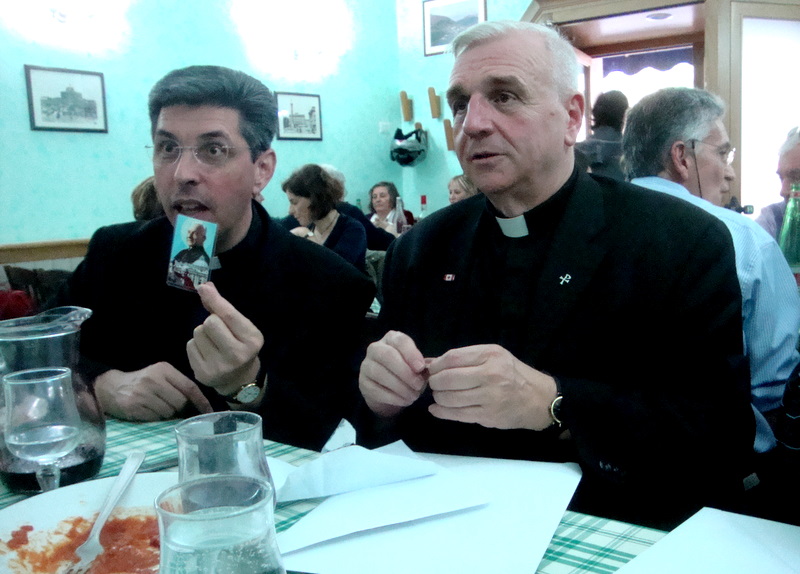
Several priests of the Archdiocese took part in the festivities (Mgr Andre Drouin, Episcopal Vicars Daniel Berniquez and Joseph Muldoon, Sainte-Marie Pastor Michel Pommainville and our man in Rome, Msgr. Jose Bettencourt. We managed to get together for a meal, meeting at the obelisk in front of St. Peter's and heading to a family restaurant nearby.


We also met at the Collegio Canadese (Pontifical Canadian College), where Father Muldoon seems to have been transformed into a Redemptorist (the Reds, at whose Generalate he found lodging, provided him with one of their cassocks so he could distribute Holy Communion at the Canonization Mass in St. Peter's Square: