Thursday, September 23, 2010

Memorial of St. Pius of Pietrelcina (Padre Pio) - Servants of the Lord called home

Today the liturgy recalls "Padre Pio", who was born in the small Italian village of Pietrelcina, joined the Capuchin Friars at the age of fifteen, and was ordained a priest seven years later.

For fifty years he lived at the monastery of San Stefano Rotundo, where his miraculous abilities as spiritual advisor, confessor and inercessor attracted the attention of the world.

Still, Padre Pio's humility--manifested through his constant devotion to the Eucharist--was perhaps the more impressive. He would often remark, "I only want to be a friar who prays."


Almighty ever-living God,
who, by a singular grace,
gave the Priest Saint Pius
a share in the Cross of your Son
and by means of his ministry
renewed the wonders of your mercy,
grant that, through his intercession,
we may be united constantly
to the sufferings of Christ,
and so brought happily
to the glory of the resurrection.
Through our Lord.


* * * * * *

"WELL DONE, GOOD AND FAITHFUL SERVANT..."

The Lord called to himself recently in death two religious priests, natives of Toronto, who served God's people in Peru and Saskatchewan.

Msgr. Albano Quinn, O. Carm., 86, a pioneering Canadian Carmelite missionary who worked in Peru for more than 60 years, died Sept. 15.

A native of Toronto, Msgr. Quinn was one of the first members of his community to arrive in Lima and was a founder of Our Lady of Carmel Parish in Miraflores, an upper-middle-class Lima neighborhood, where he also established a parish school.

After about two decades there, he was assigned to head the Territorial Prelature of Sicuani, an impoverished rural area in the Andean highlands of southern Peru.

He arrived in the Andes to minister among Quechua-speaking farmers in the 1960s, at a time of great upheaval in both the church and the country, said Carmelite Father Michael Sgariato, pastor at Our Lady of Carmel Parish.

The Second Vatican Council had just occurred, Peru was engulfed in a land reform movement and Latin American theologians were beginning to write and talk about a "preferential option for the poor."

"He had great sensitivity. It wasn't just a matter of the poor of Sicuani. He identified with the suffering of all women and men," Father Sgariato said.

Father Donald Flynn, SJ, Educator & Spiritual Director

Father Donald V. Flynn died on September 17th in the 77th year of his life and 56th year of religious life.

In late July, he had welcomed me to the Loyola Jesuit Community in Montreal for a few days; on the day I departed, he left too, transferring to Rene Goupil House, the Jesuit Infirmary in Pickering, ON as the latter stages of cancer ravaged his health.

Born on Dec 1st, 1933 son of Vincent Flynn and Elizabeth Doyle in Toronto, Don Flynn entered the Society of Jesus in Guelph in 1954 after five years at St. Michael’s College School. He did his studies in theology at Collège de l'Immaculée-Conception in Montreal and was ordained a priest on June 3, 1967.

Father Flynn’s main ministry involved teaching French language and literature at Campion College in Regina from 1961 to 1964 and again from 1970 to 1995.

On his retirement from teaching he served as a retreat director at Villa Manrèse in Sainte-Foy, Quebec from 1995 to 2002. Then he moved to the Loyola Jesuit Community in Montreal and provided pastoral ministry in the Archdiocese.

Known in a number of parishes and appreciated for his homilies and general spiritual wisdom, Father Don led many people through the Spiritual Exercises and followed them with on-going spiritual direction.

A shy and charming person, he was quiet spoken and kindly, serving as a gracious guest master in the Loyola Community and giving a warm welcome to all.

His funeral took place in Toronto on Tuesday, with burial later that day at the Jesuit Cemetery in Guelph.

A Memorial Mass will be celebrated at Campion College, Regina, next Wednesday, September 29 (www.campioncollege.ca).

Wednesday, September 22, 2010

Celebration with Chinese Catholics - Casa Gianna

The Chinese Catholic Community was founded by the MIC (Missionaires de l'Immaculee-Conception) in 1955 to provide pastoral care for students studying at Ottawa universities.

Since then, without interruption, Sunday Masses have been celebrated at different venues first at the Chinese Centre, home of the MIC Sisters, then at Our Lady of Perpetual Help Church in Ottawa's Chinatown beginning in 1984.

In 1991, Masses were held at Assumption Church where Father Bosco Wong was pastor and from 2007 at the Chapel in the Diocesan Centre.

Now the Community--soon to be a personal parish for Cantonese and Mandarin-speaking Catholics--guided by Deacon Peter Fan (ordained in 2008) and to be known as Holy Spirit (Sheng Shen) Parish will relocate to the recently-closed Notre Dame de Lourdes de Cyrville Church (1187 Michael Street), amid the many shopping centres off St. Laurent, very close to the 417 Highway.

In gratitude for the hospitality experienced at the Diocesan Centre, the Sheng Shen community offered an all-you-can-eat buffet lunch yesterday to the staff of the Centre and the members of the Presbyteral Council who were holding their inaugural fall meeting. Good food, music, much good humour: it was a lovely lunch. Some pix:


* * * * * *

LIVING THE FAITH IN COMMUNITY

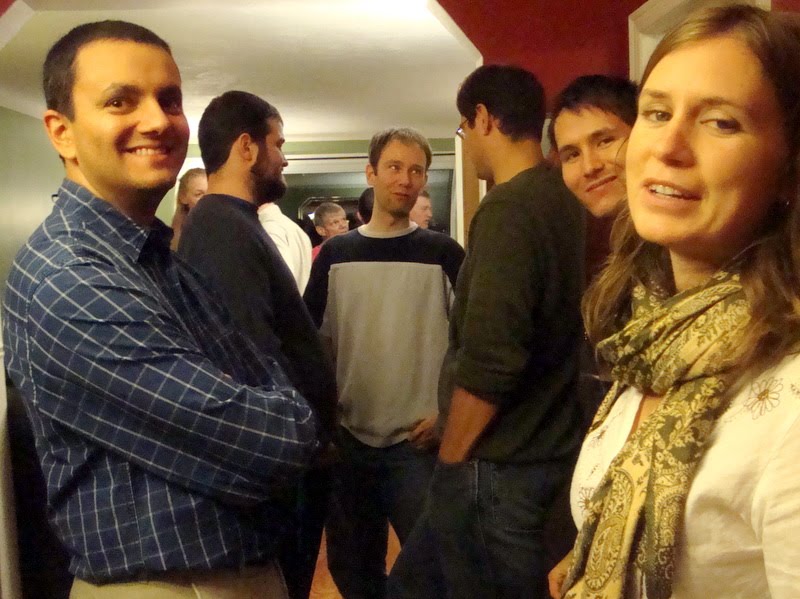
Under the patronage of St. Gianna Beretta Molla, four young women live their Christian faith in community for mutual support and encouragement (three are pictured at left).

They have lots of friends, have a renown for hospitality and enjoy a good time. Last Friday evening, I celebrated Mass in their home for more than thirty young and not-so-young who came for a delightful evening of fellowship.

Herewith some pix following Mass:

Sarah and Naomi dropped in from Alberta, encouraged by Sr. Anna Chan; they were en route to Madonna House in Combermere


Tuesday, September 21, 2010

St. Matthew, Apostle & Evangelist - Hope Cemetery Prayer Service

Ebbo Gospel (Matthew) (Artist unknown) 3'4" x 1'5" Mosaic, Carolingian Renaissance c. 830 AD, France

Today, the Church celebrates the feast of St. Matthew, Apostle and Evangelist.

Though scholars remain undecided about several aspects concerning this longest of the gospels which for centuries held pride of place in the Church’s teaching and life, mainstream scriptural interpreters place this gospel’s composition towards the end of the first century (80–90 AD), possibly in a mixed Jewish-Gentile community such as was found at Antioch in Syria.

Matthew’s is the gospel of the risen, cosmic Christ.

The Messiah, son of Abraham, son of David, Son of Man, Son of God, who fulfills all messianic expectations through the cosmic event of his death and resurrection, is present in the reading or proclamation of the gospel (“for where two or three are gathered in my name, I am there among them” [18.20]).

* * *

O God, who with untold mercy were pleased to choose as an Apostle Saint Matthew, the tax collector, grant that, sustained by his example and intercession, we may merit to hold firm in following you. Through our Lord.

* * * * * *

COMMEMORATION OF THE FAITHFUL DEPARTED AT HOPE CEMETERY

Sunday afternoon was a lovely, bright and sunny day. Traffic was chaotic because of the marathon, observances of the Battle of Britain, construction rerouting around the new Convention Centre on Colonel By, regular Sunday closures and road work just about everywhere.

Still a large throng came to visit the tombs and mausolea and to pray for our beloved dead.

Emotions are mixed as one greets those who have recently lost a love one, but also very consoling as we share our faith and hope in the resurrection.

Herewith some photos (courtesy of Garry Bourgeois):


Monday, September 20, 2010

Benedict XVI Returns to Rome - Memorial of the Korean Martyrs - Commissioning Lectors


End of Pope Benedict XVI's Visit to the United Kingdom...

The Holy Father's pastoral visit to Scotland and England seems to have surpassed expectations and been seen as successful. The focus on Saturday evening and Sunday was on Cardinal Newman's beatification; the application of Newman's writings and spirituality to our day struck me including the following:

One of Cardinal Newman’s best-loved meditations includes the words, “God has created me to do him some definite service. He has committed some work to me which he has not committed to another” (Meditations on Christian Doctrine).

Here we see Newman’s fine Christian realism, the point at which faith and life inevitably intersect. Faith is meant to bear fruit in the transformation of our world through the power of the Holy Spirit at work in the lives and activity of believers.

No one who looks realistically at our world today could think that Christians can afford to go on with business as usual, ignoring the profound crisis of faith which has overtaken our society, or simply trusting that the patrimony of values handed down by the Christian centuries will continue to inspire and shape the future of our society.

We know that in times of crisis and upheaval God has raised up great saints and prophets for the renewal of the Church and Christian society; we trust in his providence and we pray for his continued guidance. But each of us, in accordance with his or her state of life, is called to work for the advancement of God’s Kingdom by imbuing temporal life with the values of the Gospel.

Each of us has a mission, each of us is called to change the world, to work for a culture of life, a culture forged by love and respect for the dignity of each human person.

As our Lord tells us in the Gospel we have just heard, our light must shine in the sight of all, so that, seeing our good works, they may give praise to our heavenly Father (cf. Mt 5:16)….


...some applications to youth

"Here I wish to say a special word to the many young people present. Dear young friends: only Jesus knows what “definite service” he has in mind for you. Be open to his voice resounding in the depths of your heart: even now his heart is speaking to your heart.

Christ has need of families to remind the world of the dignity of human love and the beauty of family life. He needs men and women who devote their lives to the noble task of education, tending the young and forming them in the ways of the Gospel.

He needs those who will consecrate their lives to the pursuit of perfect charity, following him in chastity, poverty and obedience, and serving him in the least of our brothers and sisters.

He needs the powerful love of contemplative religious, who sustain the Church’s witness and activity through their constant prayer.

And he needs priests, good and holy priests, men who are willing to lay down their lives for their sheep. Ask our Lord what he has in mind for you! Ask him for the generosity to say “yes!”

Do not be afraid to give yourself totally to Jesus. He will give you the grace you need to fulfil your vocation.

Let me finish these few words by warmly inviting you to join me next year in Madrid for World Youth Day. It is always a wonderful occasion to grow in love for Christ and to be encouraged in a joyful life of faith along with thousands of other young people. I hope to see many of you there!


* * *

WHAT HAPPENED TO THE WELSH?

Pope Benedict was not able to visit Wales in his four days in the U.K., but he did take part in two gestures indicating his regard for the Welsh, lighting a candle before the statue of Our Lady of Cardigan which went on pilgrimage to Westminster Cathedral. As well, he blessed a new Mosaic of St. David the Patron Saint of Wales:

A popular teacher and preacher, this 6th century Bishop founded monasteries in Britain at a time when paganism was widespread.

Calling St. David a “founder of the Christian culture which lies at the root of modern Europe,” The Holy Father encouraged the faithful of Wales to look to his life for inspiration — particularly to a popular phrase from him.

… his dying words to his monks were, “Be joyful, keep the faith, and do the little things”. It is the little things that reveal our love for the one who loved us first (cf. 1 Jn 4:19) and that bind people into a community of faith, love and service.

Bishop Edwin Regan, the Bishop of Wrexham in Wales, brought greetings to the Pontiff. He presented him a special gift: a replica of the first book printed on Welsh soil — an essay from the 1580s on the love of God. It had been secretly printed in a cave

* * *

The Holy Father lit a candle at the statue of Our Lady of Cardigan, or Our Lady of the Taper, which was at St. Paul’s side chapel in Westminster Cathedral. Our Lady is honoured under that name in Wales.

The statue depicts Mary holding the child Jesus in one arm, and with her other hand she is holding a candle. Local tradition holds that the candle burned for nine years without being consumed. In his greeting to the people of Wales he prayed: “May the light of Christ continue to guide their steps and shape the life and culture of the nation.”

Expressing his sadness that he was unable to visit the people of Wales, Pope Benedict added: I trust that this beautiful statue, which now returns to the National Shrine of Our Lady in Cardigan, will be a lasting reminder of the Pope’s deep love for the Welsh people, and of his constant closeness, both in prayer and in the communion of the Church.

* * * * * *

KOREAN CATHOLIC HEROIC WITNESS

Saint Andrew Kim Tae-gon, Priest, and Paul Chong Ha-sang, Seminarian

O God, who have been pleased to increase your adopted children in the world, and who made the blood of the Martyrs Saint Andrew Kim Tae-gon and his companions a most fruitful seed of Christians, grant that we may be defended by their help and profit always from their example. Through our Lord.

During the persecutions of 1839, 1846, 1866, and 1867, one hundred and three Christians in Korea gave their lives as martyrs. The martyrs included clergy, but were, for the most part, members of the laity.

They consecrated the rich beginnings of the Church in Korea with their blood. Among them were Fr. Andrew Kim of Taegon, the first Korean priest and pastor, and Paul Chong of Hasang, a lay apostle.

St. Andrew Kim Taegon was born into a noble Korean family. He traveled to China to become a Catholic priest and he was ordained in Macao. When he returned to Korea, as the first native priest, he was arrested, tortured, and eventually beheaded.

Paul Chong Hasang was a seminarian, aged 45. As a layman, he was one of the great founders of the Catholic Church in Korea. He was persecuted before he could be ordained.

"We have received baptism, entrance into the Church, and the honor of being called Christians. Yet what good will this do us if we are Christians in name only and not in fact?" (St. Andrew Kim Taegon)

* * *

It is interesting to note that during the Korean War of 1950-53 many priests, nuns, and lay people were killed or expelled.

In today's still divided Korea, the Church flourishes in the South, both in terms of numbers and intellectually, but it remains underground in the North.

"The Korean Church is unique because it was founded entirely by laypeople. This fledgling Church, so young and yet so strong in faith, withstood wave after wave of fierce persecution. Thus, in less than a century, it could boast of 10,000 martyrs.

"The death of these many martyrs became the leaven of the Church and led to today's splendid flowering of the Church in Korea. Even today their undying spirit sustains the Christians of the Church of Silence in the north of this tragically divided land." (Pope John Paul II at the canonization of the Korean Martyrs, May 6, 1984)

* * * * * *

A STEP TOWARD DIACONAL ORDINATION

The diaconal formation resumed this month at the Diocesan Centre. On the opening day of sessions, I presided at Mass during which I conferred the Ministry of Lector on those who will be ordained deacons next June. After Mass, the candidates and their wives posed for a photo under the watchful eyes of the St. Thomas Aquinas mosaic.

Left to right: Lise and Gary Bourgeois, Simonne and Michel Lambert, Blessilda and Stephen Donoghue, John George (Jane missing), Lesley and Ricardo Santiago

Following a period of reflection, the English Sector diaconal community will resume consideration of candidates for diaconate training through a discernment and spiritual preliminary formation program.

For further information, contact Deacon Michael Seath, Director of the Deacon Training Program at (613) 738-5025, ext. 228 (mseath@archottawa.ca).

Sunday, September 19, 2010

The Pope Beatifies Cardinal John Henry Newman - Sunday 25C: TRUE RICHES

Q: Your Holiness, the figure of Cardinal Newman is very significant for you. And for Cardinal Newman you are making the exception of presiding over his beatification. Do you think that his memory might help to overcome the divisions between Anglicans and Catholics? And what are the aspects of his personality that you most wish to stress?

Benedict XVI: On one hand, Newman is, above all, a modern man who lived the whole problem of modernity, who also lived the problem of agnosticism, the problem of the impossibility of knowing God, of believing. A man who throughout his whole life was on a journey, on a journey to allow himself to be transformed by truth in a search of great sincerity and great willingness to know and to find and to accept the path that gives true life.

This interior modernity of his life implies the modernity of his faith. It is not a faith in formulas of past times but a very personal faith, lived, suffered, found in a long journey of renewal and conversion. He is a man of great learning who on one hand participates in our skeptical culture of today, in the question of whether we can be certain in our understanding about the truth of man, and how we can come to convergence in these truths.

A man with great learning and knowledge of the Church Fathers, who studied and renewed the origin and the gift of faith, thus recognizing the essentially interior figure. He was a man of great spirituality and of great humanism, a man of prayer, of a profound relationship with God and a deep relationship also with the people of his time.

Hence, I would say three elements in his life: the modernity of his existence with all the doubts and problems of our existence today; great learning, knowledge of the great treasures of the culture of humanity, and willingness for a permanent search, for permanent renewal; and spirituality, spiritual life with God.

These elements give this man an exceptional greatness in our time and because of this he is a figure of a doctor of the Church for us and for all, and a bridge between Anglicans and Catholics.


* * * * * *

DAY FOUR

The final day of the visit is focused very much on the beatification of Cardinal John Henry Newman, and the Pope will celebrate that beatification in Cofton Park in Birmingham - adjacent, fittingly, to Rednal where Cardinal Newman was buried.

Pope Benedict will conclude the day by meeting with the bishops of England, Scotland and Wales in Oscott College.

* * * * * *

HOMILY IN THE WESTMINSTER CATHEDRAL OF THE PRECIOUS BLOOD


Dear friends, let us return to the contemplation of the great crucifix which rises above us. Our Lord’s hands, extended on the Cross, also invite us to contemplate our participation in his eternal priesthood and thus our responsibility, as members of his body, to bring the reconciling power of his sacrifice to the world in which we live.

The Second Vatican Council spoke eloquently of the indispensable role of the laity in carrying forward the Church’s mission through their efforts to serve as a leaven of the Gospel in society and to work for the advancement of God’s Kingdom in the world (cf. Lumen Gentium, 31; Apostolicam Actuositatem, 7).

The Council’s appeal to the lay faithful to take up their baptismal sharing in Christ’s mission echoed the insights and teachings of John Henry Newman.

May the profound ideas of this great Englishman continue to inspire all Christ’s followers in this land to conform their every thought, word and action to Christ, and to work strenuously to defend those unchanging moral truths which, taken up, illuminated and confirmed by the Gospel, stand at the foundation of a truly humane, just and free society.

How much contemporary society needs this witness! How much we need, in the Church and in society, witnesses of the beauty of holiness, witnesses of the splendour of truth, witnesses of the joy and freedom born of a living relationship with Christ! One of the greatest challenges facing us today is how to speak convincingly of the wisdom and liberating power of God’s word to a world which all too often sees the Gospel as a constriction of human freedom, instead of the truth which liberates our minds and enlightens our efforts to live wisely and well, both as individuals and as members of society.

Let us pray, then, that the Catholics of this land will become ever more conscious of their dignity as a priestly people, called to consecrate the world to God through lives of faith and holiness. And may this increase of apostolic zeal be accompanied by an outpouring of prayer for vocations to the ordained priesthood. For the more the lay apostolate grows, the more urgently the need for priests is felt; and the more the laity’s own sense of vocation is deepened, the more what is proper to the priest stands out.

May many young men in this land find the strength to answer the Master’s call to the ministerial priesthood, devoting their lives, their energy and their talents to God, thus building up his people in unity and fidelity to the Gospel, especially through the celebration of the Eucharistic sacrifice.

* * * * * *

Twenty-Fifth Sunday in Ordinary Time (Year "C") - September 19, 2010 "YOU CANNOT SERVE GOD AND WEALTH" [Texts: Amos 8:4-7; [Psalm 113]; 1 Timothy 2:1-8; Luke 16:1-16]

This Sunday and next the gospels deal with the challenges that wealth presents to one who wants to be Christ's disciple.

Both the story Jesus tells this weekend, of the 'dishonest steward' who merited praise because of his decisiveness, and the parable He will narrate next weekend, of the indecisive 'rich man' who ignored the 'poor Lazarus' at his door, invite a change of one's thinking about the role of money in relation to salvation.

Each parable also offers modern followers of Jesus something to ponder in regard to the proper stewardship of material goods.

The parable of the rogue manager has puzzled interpreters from the beginning. It is not unusual to have disreputable individuals figure in Jesus' parables, but this one is praised, suggesting he is worthy of imitation.

In what precisely was the manager dishonest? Some think it was in what he did when he had his master's creditors write down the amount they owed ("100 jugs of olive oil"..."take your bill and make it 50"; "100 containers of wheat"..."make it 80"). But the master had found fault with him before he settled on this course of action. The dishonesty, or perhaps we should say, his incompetence, had led to dismissal. So reducing the debts, as he did, may have been opportunistic, but it was probably not unjust to his master.

It is likely that the parable takes for granted an economic system in which the manager enjoyed quite a bit of latitude when letting out the goods entrusted to him to earn interest. The commission due on these transactions included a percentage for himself as well as for the owner of the goods. The master and the manager would share the commission earned on the materials traded.

Once he got his notice of termination, the manager acted shrewdly (in the economic circumstances of his day), by cancelling his cut of the interest due. He reckoned that this would be advantageous to him since his employment was ended.

Through a soliloquy we learn that the manager thought himself too weak to be a labourer and had too much self-respect to start begging. So the steward sensibly decided to create goodwill among people who, later on, would be able to offer him help or receive him into their homes. It was this capacity for quick, shrewd and decisive action--that would benefit him in the end--which merited his master's praise.

Jesus said that those who belong to God's Kingdom ('the children of light') ought to learn from those wise in the ways of the world. 'Make friends for yourselves", He says, 'by means of dishonest wealth, so that when it is gone, they may welcome you into the eternal homes'. Disciples should be ready to give away their wealth now so that when God's great end-time reversal takes place and the poor have privileged places (we will hear more of this in next week's gospel), the marginal and outcast may share with them God's hospitality.

Jesus called 'Mammon' (money or wealth personified) 'unrighteous'. Neither the New Revised Standard Version's 'dishonest' or the New International Version's 'worldly' get it exactly right.

Money is not 'unrighteous' in itself, but in the attitudes that its pursuit engenders. For if capital were inherently wicked, all use of it would be evil. In 1 Timothy 6:10, Paul says that it is the love of money that is the root of all evil. Pursuing money can have evil effects by making people selfish, causing them to use others to their advantage or as objects.

The pursuit of wealth tends to attach people to the things of this world. Sought as an end in itself, 'Mammon' quickly becomes a tyrannical master, a rival to God. Thus, Jesus concludes, 'No slave can serve two masters...you cannot serve God and money'.

Possessions, then, are a trust. How one uses them tests character, principles and capacity as a steward. One can be faithful or dishonest in little things and great. Generally one's exercise of responsibility in minor matters foretells what one would do in matters of great moment. If one is faithful in little things--like the use of money--God will entrust to such disciples 'true riches', making them stewards in God's Kingdom.

Saturday, September 18, 2010

The Pope in London - Visit of Archduke Rudolf of Austria, Friends and Supporters of the Canonization of the Empress Zita


DAY THREE

On the third day of the visit, Pope Benedict will celebrate Mass in Westminster Cathedral where he will also greet the people of Wales.

Later in the day he will visit a home for older people and then be present at an open-air Vigil of prayer in London's Hyde Park.

* * *

"THAT THEY ALL MAY BE ONE" (John 17:21)

Yesterday, Pope Benedict XVI and the Archbishop of Canterbury Rowan Williams exchange a fraternal embrace

In a world marked by growing interdependence and solidarity, we are challenged to proclaim with renewed conviction the reality of our reconciliation and liberation in Christ, and to propose the truth of the Gospel as the key to an authentic and integral human development. In a society which has become increasingly indifferent or even hostile to the Christian message, we are all the more compelled to give a joyful and convincing account of the hope that is within us (cf. 1 Pet 3:15), and to present the Risen Lord as the response to the deepest questions and spiritual aspirations of the men and women of our time.--Pope Benedict XVI in Westminster Abbey, September 17, 20101

* * * * * *

SEEKING THE BEATIFICATION OF AN EMPRESS AND QUEEN

This week, I was visited by family and devotees seeking the beatifiction of Zita, Empress of Austria, Apostolic Queen of Hungary, Wife and Mother. It is a fascinating story of heroic virtue available in many languages on the web site of the association (www.beatification-imperatrice-zita.org), which has a Canadian chapter based in Boucherville, QC.

The shortened c.v. omits that the Empress lived in Ottawa at Rideau Hall at the outbreak of World War II:

Princess Zita of Bourbon-Parma was born on May 9, 1892, near Lucca, Italy. On October 21, 1911, she married Archduke Karl of Austria, a great-nephew of Franz-Josef, who became Emperor Karl I of Austria and King Karl IV of Hungary in 1916.

As Empress of Austria and Queen of Hungary, Zita assisted her husband during their two year reign through her efforts for peace and social justice. This united couple, brought closer together by their deep Christian faith, had eight children.

Exiled to Switzerland at the end of the First World War, the imperial family was later exiled to Madeira, where Karl died on April 1, 1922. Widowed, without any resources, devoting herself to her family and others, Empress Zita first lived in Spain and Belgium, then in Quebec and the United States during World War II, and finally returning to Europe after the war.

She returned her soul to God on March 14, 1989, and was buried in Vienna on the following April 1. Karl of Austria was beatified by John Paul II in 2004. In 2008, the Congregation for the Causes of Saints authorized the opening of the cause of beatification in the Diocese of Le Mans for the Servant of God Zita of Bourbon-Parma.

* * *

Le 14 septembre 2010, ja'i eu la visite de certains membres de l'Association pour la béatification et canonisation de Zita, impératrice d'Autriche et reine de Hongrie.

De g. à d. : Archiduc Michaël d'Autriche, Gilles Larose, Benoît Bleau, Marie-Rose Bleau [Monseigneur Terrence Prendergast], Son Altesse Impériale et Royale l'Archiduc Rudolf d'Autriche, Denise Bleau, Jean-Claude Bleau, Président, Guy Trad

Friday, September 17, 2010

Papal Visit to the UK: Day Two - Memorial - St. Robert Bellarmine

DAY TWO On the second day the Holy Father is going to St Mary's University College, Twickenham, where he will pray with representatives of religious congregations - particularly those who have a charism for education.

He will meet 3,000 young people to celebrate Catholic education and, later, the leaders of other religions.

The Pope will also meet with the Archbishop of Canterbury and, as part of the State visit, address British society.

* * *

"THE CHURCH IS AT THE SERVICE OF ANOTHER: CHRIST!"

For me the money quote of the Pope's Trip to the U.K. began on the flight over, in reply to one of five questions the journalists put to the Holy Father!

Have a look:

Q. - The UK, like many other Western countries - there is an issue that you have already touched on in the first answer –it is considered a secular country. There is a strong atheist movement, even for cultural reasons. However, there are also signs that religious faith, particularly in Jesus Christ, is still alive on a personal level. What can this mean for Catholics and Anglicans? Can anything be done to make the Church as an institution, more credible and attractive to everyone?

A. - I would say that a Church that seeks to be particularly attractive is already on the wrong path, because the Church does not work for her own ends, she does not work to increase numbers and thus power.

The Church is at the service of another: she serves, not for herself, not to be a strong body, rather she serves to make the proclamation of Jesus Christ accessible, the great truths and great forces of love, reconciling love that appeared in this figure and that always comes from the presence of Jesus Christ.

In this regard, the Church does not seek to be attractive in and of herself, but must be transparent for Jesus Christ and to the extent that she is not out for herself, as a strong and powerful body in the world, that wants power, but is simply the voice of another, she becomes truly transparent for the great figure of Christ and the great truth that he has brought to humanity.

The power of love, in this moment one listens, one accepts. The Church should not consider herself, but help to consider the other and she herself must see and speak of the other. In this sense, I think, both Anglicans and Catholics have the same simple task, the same direction to take.

If both Anglicans and Catholics see that the other is not out for themselves but are tools of Christ, children of the Bridegroom, as Saint John says, if both carry out the priorities of Christ and not their own, they will come together, because at that time the priority of Christ unites them and they are no longer competitors seeking the greatest numbers, but are united in our commitment to the truth of Christ who comes into this world and so they find each other in a genuine and fruitful ecumenism.

--courtesy Vatican Radio (www.radiovaticana.org).

* * * * * *

ST. ROBERT BELLARMINE, DOCTOR OF THE CHURCH

Today's liturgical memorial is of a wonderful teacher of the faith, unafraid to enter the challenging questions of his day:

Robert Bellarmine (1542-1621) was a scholar, theologian and intrepid defender of the Faith during the controversies of the Reformation. As a cardinal he served three popes who counted on his wisdom and scholarly advice.

Roberto Bellarmino was born in central Italy, in the small hill city of Montepulciano, and was the nephew, on his mother's side, of Pope Marcellus II. His father initially opposed Bellarmine's desire to become a Jesuit and requested that he wait a year to test his vocation. Father General James Laínez decided to count that year as the young man's novitiate and accepted his vows as soon as he arrived in Rome.

After studying philosophy at the Roman College, he studied theology first at the University of Padua and then at Louvain. He was ordained in 1570 in the same year that the Jesuits opened their own theologate in Louvain where he was appointed the first Jesuit professor of theology. During his seven years there he became familiar with the writings of the Reformers, especially Martin Luther and John Calvin, whose objections against the Roman Church he answered in his courses.

The Jesuit theologian returned to the Roman College in 1576 to take the chair of "controversial theology" which meant specializing in those theological disputes that divided the Christian Church. The success of his lectures during his 11 years there led the pope to name him to papal commissions on revising the Vulgate (Latin) Bible and preparing a new edition of the Septuagint (Greek) Bible.

In 1586 he published the first of three volumes of his Controversies, his most important work. In 1598 he published his Catechism, which became widely used and was translated into 62 languages. As he devoted himself to writing, Father Bellarmine stopped teaching but continued spiritual direction of Jesuit students, including the young nobleman, Aloysius Gonzaga. In 1592 he was appointed rector of the college, with responsibility for 220 Jesuits; then in 1594 he was appointed provincial of the Naples province.

Bellarmine was only provincial for two years before Pope Clement VIII asked him to become his theological adviser. Despite the Jesuit's own desires, the pope named him a cardinal on March 3, 1599. Being a cardinal meant that he had to be surrounded by servants and gentlemen-in-waiting, but he continued to live simply and distribute to the poor money he did not spend on himself. To Cardinal Bellarmine's surprise, in 1602 the Holy Father named him Archbishop of Capua, a diocese north of Naples.

When Paul V was elected on May 16, 1605, the new pope asked Cardinal Bellarmine to remain in Rome, where he was named to several Vatican congregations

Cardinal Bellarmine always maintained a Jesuit spiritual life, and used the annual retreat, which he extended to 30-days per year, as an opportunity to write books on spirituality. As he progressed into his 70s, he asked the Holy Father for permission to retire and return to live in the Jesuit novitiate of Sant'Andrea in Rome. Both Paul V and his successor, Gregory XV, refused to allow Bellarmine to leave their service because they so valued his presence.

Eventually Pope Gregory relented, and the Jesuit cardinal moved into the novitiate only days before contracting a fever from which he never recovered. The simple funeral he had requested became, by order of the pope, something much more elaborate as testimony to someone whose service to the Church had been outstanding. His body was transferred in 1923 to the church of St. Ignatius.

* * *

O God, who adorned the Bishop Saint Robert Bellarmine with wonderful learning and virtue to vindicate the faith of the Church, grant, through his intercession, that in the integrity of that same faith, your people may always find joy. Through our Lord.