Tuesday, May 25, 2010

Pope St. Gregory VII - Images from the Youth Summit

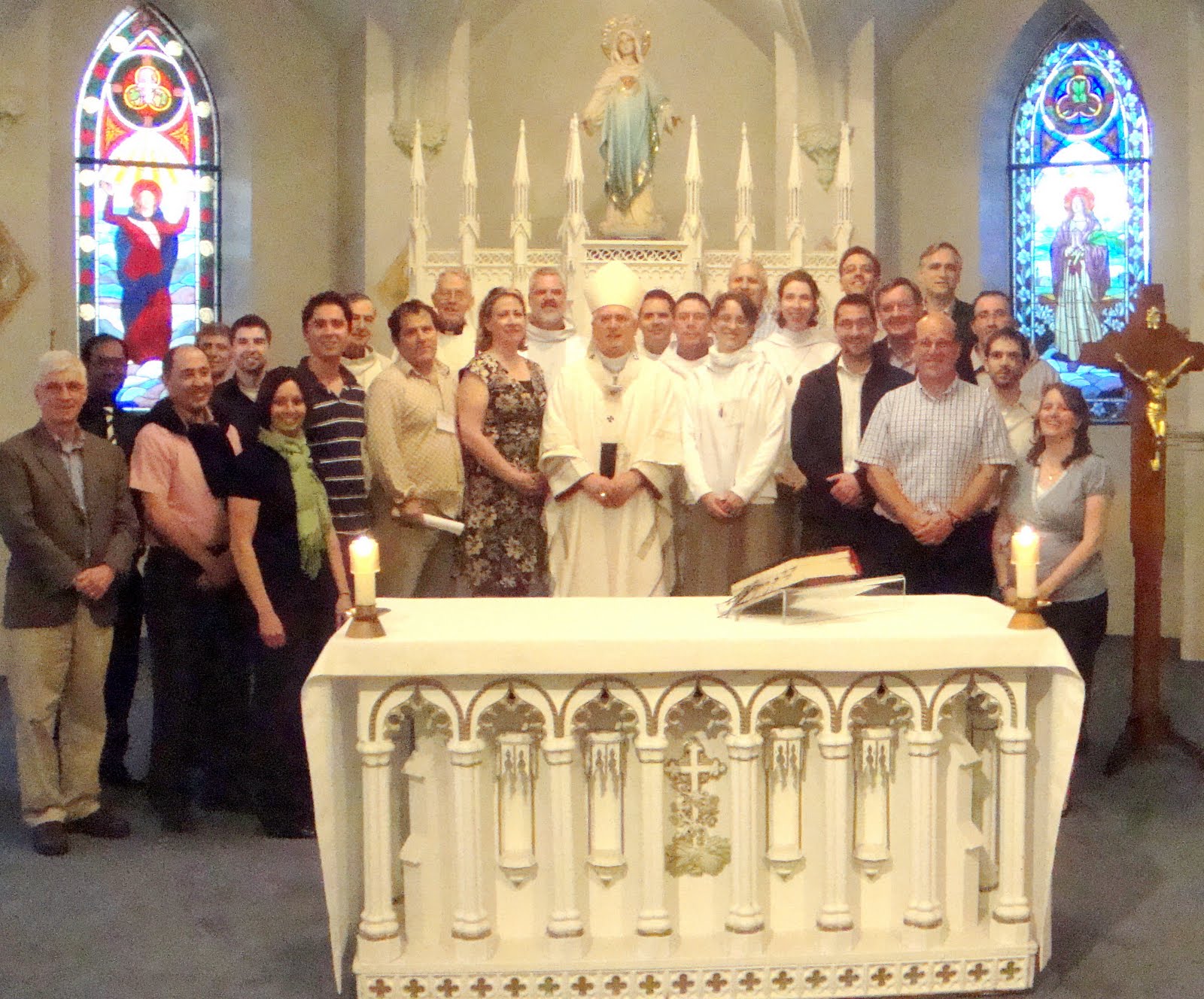
Today the liturgy allows three optional memorials of the Venerable [Saint] Bede, St. Mary Magdalene de Pazzi or the saint featured St. Gregory VII:

St Gregory VII (1028-85) Cluniac monk, reforming pope

Pope from 1073 to 1085, Gregory "was probably the most energetic and determined man ever to occupy the See of Peter and was driven by an almost mystically exalted vision of the awesome responsibility and dignity of the papal office" (Eamonn Duffy, Saints and Sinners: A History of the Popes, p. 121).

Patrick Duffy summarizes his life and significance [cf. www.catholicireland.net].

A disciple of Pope Gregory VI - Born at Sovana, a small town in southern Tuscany, the son of a blacksmith, and christened Hildebrand, he was educated in Rome by the archpriest John Gratian, who in 1045 became Pope Gregory VI.

However, because of a financial deal involved in getting rid of his corrupt predecessor, Gregory was deposed in 1046 by the reforming German king and Holy Roman Emperor Henry III and went into retirement in the Benedictine monastery of Cluny, France. Hildebrand went with his master into exile at Cluny and spent three years there as a monk.

Ambassador of four popes - However, Hildebrand returned to Rome in 1049 to serve the newly elected Pope St Leo IX as papal treasurer. He became a deacon and then prior of the monastery of St Paul's Outside the Walls and was a major influence on the next four popes, all of whom were reformers. He was also successful in various ambassadorial roles.

On the death of Pope Alexander II (1061-73, he was elected pope after popular acclaim by the clergy and people of Rome. He still had to be ordained priest and bishop before he could act as pope.

Conflict with King Henry IV of Germany - Gregory VII immediately set about cleaning up the abuses of simony, clerical concubinage and lay investiture. He demanded that bishops take an oath of obedience to him and threatened those who wouldn't carry out papal decrees. Over the issue of lay investiture he faced opposition from King Philip I of France, William the Conqueror of England and the young King Henry IV of Germany.

Henry, whose father had appointed bishops and popes at will, resented the brusqueness of this new pontiff and gathered "his" bishops at Worms and insisted Gregory be deposed. But Gregory then excommunicated Henry and all the bishops collaborating with him and absolved his subjects from allegiance. Ecclesiastical support for Henry cracked and in 1077 he had to travel to the house of Matilda of Canossa in Italy where Henry was staying to beg the Pope's pardon and absolution. Gregory left Henry standing in humiliation for three days in the snow before eventually pardoning him.

Pyrrhic victory and death - But Gregory's victory was short lived. Henry rallied his forces and in 1080 invaded Italy, captured Rome, declared Gregory deposed. He installed an antipope Guibert of Ravenna as Clement III. Gregory took refuge in Castel Sant'Angelo, invited in the Normans under Robert Guiscard to rescue him. However, the Normans behaved so badly in Rome that the Romans turned on Gregory and forced him to retire first to Monte Cassino and then to Salerno south of Naples where he died.

His last words were famously an adaptation of Psalm 44 (45) verse 7: "I have loved justice and hated iniquity; therefore I die in exile".

Papal claims - Gregory's pontificate represents a strong staking out of the papal claim of power over the secular world and though he achieved little, the spirit of papal reform continued and the papacy never receded from its claims to freedom from secular and political control in spiritual matters.

From then on too the pope was presented not just as the vicar of St Peter, but as "the vicar of Christ himself" (Innocent III 1198-1216).

His influence - Gregory's beatification (1585) and canonization (1605) took place at a time when the papacy was in conflict with secular powers - Queen Elizabeth I and James I in England. His feast was extended to the universal Church in 1728, causing some fury among proponents of Gallicanism in France.

He was later seen as a precursor of Vatican I with its definition of papal infallibility as a doctrine. One could perhaps be forgiven for detecting a hint of spin or ideology in his promotion, but the tyrannies of the 20th century bear out the value of his insistence on the freedom of the Church in speaking out on spiritual matters.

* * * * * *

Some scenes from Montee Jeunesse

Young and not so young Catholics express their support for Cardinal Marc Ouellet at Opening Mass at Paroisse Sainte-Famille on Saturday morning

“We come here first to meet Jesus in the Holy Mystery of the Eucharist,” he said, noting how the Youth Summits represent a Eucharistic movement.

“We want to meet Jesus and we want to bear witness that He is among us and gives us Life.”

One text concerned Paul, who was imprisoned. “Paul is a prisoner, but he is free to evangelize. You can be in prison and evangelize. You can be completely cornered. He had no fear.”

He described Jesus, nailed to the Cross, as the ultimate prisoner.

“The one nailed on the Cross, he is prisoner but he is freeing the whole of humanity; he is giving freedom and real life,” he said. “This is the way of the Gospel.”

“We look at Jesus with the eyes of the Spirit,” he said. “Only the Spirit can give us the grace to say Jesus is my Savior.”

The theme of this year’s summit is “sent,” having to do with mission or vocation. Ouellet said that everyone has a gift or vocation. That brought him to the other text which had to do with the question of what might happen to John and Jesus’ answer, what does that have to do with you.

“Nobody is left out,” Ouellet said. “We all have a personal vocation to be with Jesus.”

“Some of us are called to be more publicly exposed,” he said, describing Peter as being called to be in front of the flock and to speak out for the flock.

“Others are behind. John is behind. Peter is the symbol of ministry; John is the symbol of love, pure love, the loving response to the love of Jesus.”

(Thanks to Deborah Gyapong for the photo and this blog she posted at www.theanglocatholic.com)

* * * * * *

Except when Mass was being offered upstairs in the cathedral basilica, Eucharistic adoration took place 24/7 in the lower-level Archbishops' Chapel during the Montee Jeunesse: here a group prays silently on Sunday afternoon

* * * * * *


Matt Maher and his band pose with the Keith Doucette family (like Maher, Doucette has Newfoundland roots) [photo courtesy K. Doucette]

Monday, May 24, 2010

WOW, what a weekend!! Montée Jeunesse moves to Montréal in 2012

Today's entry is a bit later than usual and will be rather shorter, as things return to normal now that the Youth Summit 2010 has wrapped up.

The torch has been thrown to the Archdiocese of Montréal for May 18-21, 2012. Indeed, the decision was taken last fall that whenever an international World Youth Day gathering takes place, our focus would be on that; thus Madrid's WYD XXVI will take our undivided attention for youth ministry in 2011.

On Saturday, besides the activities of MJ, I was part of the re-creation of Bishop Guigues' visit to Paroisse St. Joseph in Orléans in 1860: a boat trip on the Ottawa River from the Ottawa Boating Club dock to the landing near Villa St-Louis where I was met by the pastor Mgr Peter Schonenbach, les Soeurs de la Charité, local citizens and an RCMP mounted escort, then riding a landau to a marshalling yard near Place d'Orléans for a parade with marching band and floats to St. Joseph's Church (with many wearing period clothing).


This day's sesquicentennial festivities were closed with the Mass on the Vigil of Pentecost and a reception in the parish hall.

Mgr Peter Schonenbach, Abbé Daniel Berniquez, André Dufault, diacre permanent

Abbé Berniquez, who accompanied me to the parish, then drove me to the residence where we changed into alb, stole and cope for the procession from St. Joseph's cathedral in Gatineau, across the Interprovincial Bridge to Parliament Hill and then eucharistic adoration and Taizé Prayer, confessions in the basilica and on the landing outside.

Yesterday, I had two celebrations with Confirmations of adults and adolescents at noon in English and at the 5:15 francophone Mass: some 30+ at each occasion.


Then the Christian concert in one of the halls at Lansdowne Park featuring Matt Maher (ex-Newfoundlander now living in Arizona), the French-Canadian cultural band Chakidor and the Chorale Gospel de l'Outaouais.

Matt Maher and I chat after the concert as he autographs albums, etc.

This morning, Mgr Paul-André Durocher gave a moving bible study to encourage us to let ourselves carry on the mission of Jesus in reaching out to others in witness and service, followed by the closing Eucharistic litury, the blessing of all by the Papal Nuncio, Archbishop Pedro Lopez Quintana and the handing over of the Ark of the New Covenant to Mgr André Gazaille and the Montréal delegation.

Everyone I spoke to went away boosted in their faith and commitment to the gospel. I was thrilled by how everything turned out so well, grateful for the many blessings we received through Montée Jeunesse and the many graces we witnessed being given by the Lord to others.

Further photos will be posted later in the week. Meantime, these photos are a foretaste of those to come.

Chorale Gospel de l'Outaouais

Sunday, May 23, 2010

PENTECOST: birthday of the Church - Eucharistic Procession Gatineau Cathedral to Ottawa's via Parliament Hill

Solemnity of Pentecost (Year "C") - May 23, 2010 "SEND OUT YOUR SPIRIT, RENEW THE FACE OF THE EARTH" [Texts: Acts 2:1-11 [Psalm 104]; Romans 8:8-17; John 19:15-16,23b-26]

W. O. Mitchell's novel, Who Has Seen the Wind recounts several years in the life of a boy growing up on the prairies. The hero Brian O'Connal shares the limelight with the ever-present wind. The interaction between Brian and the wind begins one day as he wanders out onto the prairie and savours the life surrounding him:

'All about him was the wind now, a pervasive sighing through great emptiness, unhampered by the buildings of the town, warm and living against his face and in his hair'.

By contrast with people of the village who come and go, the wind is everlasting--like God--a fact the novel's author points out:

'People were forever born; people forever died, and never were again. Fathers died and sons were born; the prairie was forever, with its wind whispering through the long, dead grasses, through the long and endless silence.'

This parallels the theme of today's psalm that when God takes back the spirit, people die. 'When You send forth your Spirit, they are created; and you renew the face of the earth'.

God's renewal of the earth, however, can appear powerful, at times frightening, like the dynamic description of Pentecost which Luke gives in today's passage from Acts.

Mitchell grasps this aspect of the wind as well: 'The wind turns in silent frenzy upon itself, whirling into a smoking funnel, breathing up topsoil and tumbleweed skeletons to carry them on its spinning way over the prairie, out and out to the far line of the sky.'

To those familiar with the Old Testament, Luke's account of Pentecost Day would evoke the giving of the Torah to Moses on Mount Sinai. It might also suggest a reversal of the Tower of Babel story (Genesis 11:1-9).

Later, when Peter explained what was going on, he said that the prophecy of Joel ('your sons and your daughters shall prophesy, and your young men shall see visions, and your old men shall dream dreams' [2:28-32]) had been fulfilled in the outpouring of the Holy Spirit the bystanders had witnessed (Acts 2:14-36).

The "Feast of Weeks" celebrated on the fiftieth day (Greek Pentekostes) of the spring harvest, marked the end of the celebration of God's blessings. Israel gave thanks not only for the agrarian bounty but also for the greater bounty of God's love in choosing a covenant people. God's election of Israel at Sinai came to be linked with Pentecost, just as the Exodus had been with Passover.

So, at Pentecost there was praise for God's self-revelation on Sinai in 'fire' and in 'wind' and, according to first century rabbinic writings, in 'tongues.' The Pentecost day following Jesus' resurrection and ascension, then, is described by Luke as God's newest self-manifestation. Through the Holy Spirit who is to carry the power of Jesus' ministry to the ends of the world and to all peoples on the face of the earth, God becomes present in this world in a marvellously new way.

The divisions and misunderstandings that occur because people speak different languages is an aspect of the world's sinful condition that Jesus overcame through His paschal mystery. Luke shows that this reconciliation has truly come about when he tells how 'Jews and proselytes' (converts to the Jewish faith who were not yet full members of the people of God) from the whole known world grasped and expressed in their individual dialects that Jesus' disciples were telling 'God's deeds of power'.

In a catalogue of places sweeping from east to west (from Parthia to Rome), Luke proclaimed that the Spirit of God was moving over the world, unifying one and all in praise of God. Pentecost appears, then, as a new beginning for humanity's relationship with God. And, as the rest of the Acts of the Apostles shows, at Pentecost the marvels had only just begun.

Encouraged by the Spirit who, as 'Advocate', teaches disciples 'everything', reminds them of 'all that I have said to you' (gospel) and causes them to cry out 'Abba! Father!' to God (second reading), members of the Church today pray for a renewal of the event of Pentecost:

'Come, Holy Spirit, fill the hearts of your faithful; and kindle in them the fire of your love' (Alleluia verse).

* * * * * *

MONTEE JEUNESSE IN HIGH GEAR

Yesterday, the young evangelists of Montee Jeunesse/ Youth Summit held a Eucharistic Procession from Gatineau's St. Joseph's Cathedral, across the Alexandra Interprovincial Bridge to Parliament Hill and back along Wellington and MacKenzie to the Ottawa Cathedral of Our Lady. It was a wonderful experience and drew noticeable attention from passersby.

The rain held off and spirits were high, just part of an extraordinary day that began with Mass at Eglise Sainte-Famille presided by Cardinal Ouellet during which he gave a powerful homily.

Workshops at Immaculata High School in the morning and at St. Paul University in the afternoon prepared for the Procession and last evening, an evening of prayer, listening to an exciting woman evangelist from New Jersey, Caroline Gambale Dirkes and some street evangelizing in the Byward Market rounded out a full day.

Some pix of the procession, courtesy of Deborah Gyapong CCN:


Saturday, May 22, 2010

St. Rita of Cascia - Photos from Visit to St. Leonard's Parish, Manotick

My home parish in Montreal was named in honour of ST. RITA OF CASCIA so her feast on May 22 has long been part of my devotional life. Rita's feast was dropped in the reform of the post-conciliar liturgical renewal, but Pope John Paul II returned him to the calendar as an optional memorial.

St. Rita of Cascia (born: 1386; died: May 22, 1457; canonized: May 24, 1900, by Pope Leo XIII; patron saint of impossible cases [along with St. Jude]).

Despite her marriage being arranged against her wishes at the tender age of 12, Rita remained loyal to her spouse for the entire 18 years of their marriage. Rita was also a devoted mother of two boys. Rita's religious and spiritual convictions so frustrated and angered her husband that he often flew off in a fit of rage, beating and abusing her.

Sixteen years into their marriage, her consistency and persistence finally had their toll - she converted her husband her her way of life; but two years later he was murdered, in what was believed to be a politically motivated assassination. Knowing this, Rita's two boys immediately began to scheme to avenge their father's murder.

Rita exhausted all efforts to convince her boys not to go forward with their plans, but she did not succeed. Fearing for her boys' souls, as a last resort, she prayed for their death before they could carry out their plans. Her prayers were answered.

After losing her entire family, Rita asked to join the local convent in Cascia but she was turned down, as widows were not allowed to enter. Unswayed by her failed attempt, her prayers were again answered, this time in grand fashion. Saints Augustine of Hippo, John the Baptist and Nicholas of Tolentino accompanied her on a journey to the Augustinian Convent Santa Maria Maddalena. When the party arrived, they found, as was the practice for the convent, that the entry way securely locked.

Proving no challenge for this saintly crew, Rita was found the next morning praying in the convent's chapel. Realizing that greater powers than just Rita were at work here, the convent waived the non-admittance of widows and allowed Rita to join the convent.

During the remaining years of her life, this future saint prayed to join with Jesus in His suffering and was given the stigmata gift of a thorn in the forehead. Although the thorn itself was not visible to anyone but Rita, the wound certainly was. This wound remained with her for the rest of her life, festering and exuding a horrible smell for some 15 years. The stench was so extreme that she became a recluse within the convent.

At the time of her nearing death, it was reported by several witnesses that the smell turned from revolting to a sweet, pleasant odor. And at the moment of her death, a bright light, the source of which was the wound in her forehead, filled the room.

"Bestow on us, we pray, O Lord, the wisdom and strength of the Cross, with which you were pleased to endow St. Rita, so that, suffering in every tribulation with Christ, we may participate ever more deeply in his Paschal Mystery. Who lives and reigns with you."

* * * * * *

Belated Report on VISIT TO ST. LEONARD'S PARISH, MANOTICK


In reviewing my reporting on visits and activities, it became clear that the visit to St. Leonard's Parish, Manotick (April 22, 24-25) had not been covered, for which my apologies to pastor Father Daniel Hawkins, MSF and his parishioners.

That period coincided with my trip to the first (francophone) Wedding Anniversary Mass and my travel to Turin and Rome.

On April 22, Father Dan Hawkins Father Muldoon and me at St. Francis Xavier High School and for the visitation activities the rest of that day: 9:00 am Visit to St. Francis Xavier High School, Principal- Peter Atkinson; 10:00 am Visit to St. Jerome’s Elementary School, Principal- Gerry Gilmore; 11:00 am Visit to St. Leonard’s Elementary School, Principal- Kimberly Giles; 12:00 pm Orchard View Seniors Home for an informal luncheon with the owner and residents, Contact - Agatha Thissen; 1:45 pm Carleton Lodge Seniors Home, Contact- Barry Gauthier.

The other main event took place on Saturday, April 24th a "Meet the Volunteer Leaders" session (members of the Pastoral and Finance Councils, as well as leaders of K of C, CWL, Outreach and Pastoral Care Teams: 6:30 pm Presentation on Parish
7:00 pm to 8:00 pm Discussion with Archbishop, feedback on the questions that I asked them to consider was presented for discussion. In particular, many parishioners would like to know what that the Diocese’s plans are for Riverside South and what impact that will have on the future of St. Leonard’s.

Here are some photos of the day and of the meeting with committee representatives at a Saturday evening supper in the parish hall.

St. Francis Xavier students explain the motivation and outcomes of the various committees, bodies in this brand new high school

Presentation of a gift to me after the exchanges

St. JEROME'S ELEMENTARY SCHOOL


St. LEONARD'S SCHOOL


After lunch at Orchard View

Carleton Lodge Exchange


Meeting with Parish Reps


Friday, May 21, 2010

St. Eugène de Mazenod & Mgr Joseph-Eugène-Bruno Guigues - MJ's DISCIPLES - Death of a Canadian Jesuit in Darjeeling

St. Eugène de Mazenod and Bishop Guigues

In showing visitors the portraits of the bishops and archbishops of Ottawa depicted in my residence, I often point out the our first bishop was a colleague of, and sent to us by, a saint: today's memorial, the founder of the Oblates of Mary Immaculate, great missionaries here in Canada and around the world.

St. Eugène

In 1815, St. Eugène de Mazenod founded the Congregation of the Oblates of Mary Immaculate to evangelize the poorest populations of Provence that were being neglected. He then sent his missionaries to proclaim the Gospel in America, South Africa and Asia.

Later on, he was appointed Vicar General of Marseilles and, in 1836, Bishop of this same diocese. Until his death on May 21, 1861, he was at the service of his people with an extraordinary pastoral charity, nourished by an intense interior life. In his city, rapidly developing at the time, he created numerous parishes, built new churches and installed new Religious Institutes.

St. Eugene De Mazenod, refused to follow the established modes expected of someone born into nobility. From an early age, Eugene was troubled by the living conditions of the poor and their degraded status in society. When he became a priest, Eugene was not satisfied to accept the traditional role of a pastor serving a large, affluent parish. Instead, he sought out the poor laborers and preached the message of God’s love — a message they had not heard before.

Born in France in 1782, Eugene lived amid turmoil in his country and in his family. Although he grew up with the privileges and luxuries of wealth, his family life was far from ideal. His parents came from very different backgrounds and they eventually divorced, a rarity for Catholics in the 18th century.

As the French Revolution grew, Eugene’s family was forced into exile, and at different times, he was separated from his mother or father for years at a time.

After years of struggling to find his place in life, Eugene experienced a conversion at the age of 25 and entered the seminary. He was ordained a priest in 1811. In 1816, Eugene invited others to join in his ministry to the poor and founded the Missionary Oblates of Mary Immaculate. Since that time, thousands of Oblate priests and brothers have dedicated their lives to serving those most in need. He died on May 21, 1861.

On December 3, 1995, Pope John Paul II canonized Eugene De Mazenod a saint and recognized his example of untiring dedication to the poor. (— Excerpted from Missionary Oblates of Mary Immaculate Website)

Last year, in recognition of the impact of the OMIs as missionaries the world over, the Bishops of Canada recommended to the Congregation of Divine Worship the extension of the feast of St. Eugène to the church universal.

* * * * * *

Mgr Guigues

Joseph-Eugène-Bruno Guigues (1805-1874) fut le premier évêque catholique d'Ottawa.

Né à Gap (France) le 28 août 1805, fit profession d'Oblat de Marie Immaculée entre les mains de Mgr Charles-Eugène de Mazenod, le 4 octobre 1824, à Aix, en Provence. Il fut ordonné à Aix par Mgr Fortuné de Mazenod, évêque de Marseille, le 26 mai 1828. De ce jour jusqu'à l'année 1844, il donna des missions dans les diocèses d'Aix, de Marseille, de Tréguier, de Gap, de Grenoble et de Valence. Arrivé au Canada le 18 août 1844, il fut supérieur et provincial des R. P. Oblats, à Longueuil.

Nommé par Pie IX évêque de Bytown (Ottawa), il fut consacré dans sa cathédrale, le 30juillet 1848 par Mgr Gaulin. Mgr Guigues admit, dans son diocèse, les sœurs grises de la Croix, les sœurs de la congrégation de Notre-Dame de Montréal et les sœurs de la Charité du Refuge. Il se rendit à Rome en 1850 et en 1867 pour les grandes fêtes du 18ème centenaire du martyre des apôtres St-Pierre et St-Paul, et en 1869, au concile du Vatican. Décédé le 8 février 1874, il fut inhumé le 12, dans sa cathédrale.

* * * * * *

Saint Christopher Magallanes was joined in martyrdom by twenty-one diocesan priests and three devout laymen, all members of the Cristeros movement, who rose up in rebellion against the anti-Catholic Mexican government during the 1920s. Having erected a seminary at Totatiche, he secretly spread the Gospel and ministered to the people.

Captured by government authorities, he was heard to shout from his jail cell: "I am innocent and I die innocent. I forgive with all my heart those responsible for my death, and I ask God that the shedding of my blood serve the peace of our divided Mexico."

This optional memorial for May 21 will not generally be observed in Canada because of the feast of St. Eugène.


* * * * * *


LEADERSHIP TRAINING FOR THE MONTEE JEUNESSE/YOUTH SUMMIT

As the Youth Summit approaches, the immediate preparations kick into high gear. But there are also spiritual dimensions to be realized by the thirty youth who came a week early to train as DISCIPLES, leaders for the big weekend coming up.

They have been living at Algonquin College and holding sessions at St. John the Apostle church on Baseline Road, hosted by the parishioners and their pastor, Father Thomas Riopelle.

Each day begins with Eucharistic adoration, followed by devotions personal and communal (recited rosary) and an opportunity for the sacrament of reconciliation.


Daily Mass is celebrated at 9AM and I had the joyful privilege of presiding yesterday morning, with Fathers Dominique Perron, FMJ and Jonathan Blake concelebrating.


* * * * * *

FATHER EDGAR BURNS, SJ [R.I.P.]

Canadian Jesuit Edgar Burns (born April 25, 1925; ordained March 19, 1958) passed away on May 17 in Darjeeling, India where he had served over fifty years. The description of his death shows the difference in culture from our own pratices. A priest who was with Father Burns gave a wonderful write-up of his last hours:

Love and Greetings from Fr. Kennedy,

On Thursday, May 17, 2010 at 7.30 pm Fr. Burns passed away. The flame that burnt with love joined the eternal flame of everlasting love. The river that sustained the lives of thousands of people in Darjeeling collected itself and joined the ocean of life. “By dying we are born to eternal life”.

As usual I was with Fr. Burns in his room during the tea time from 4 pm to 5 pm on May 17th. We had a wonderful conversation. During the conversation he asked me how old I am. I said I am 43. Then he went on to say “you are young, you have got into the work of Hayden Hall, you are doing very well, continue to do the work…”

Very little did I know that he was blessing me, as though he knew very well that his hour had come and he must depart from the world.

I have been with Fr. Burns for the past 11 months as the Director of Hayden Hall. I have come to know him … there are times I had gone to give retreats … when I came back to Hayden Hall…… he would say “ I missed you”… I recall and cherish those moments at this time as I miss him a lot.

As usual Ms. Dunne comes in the evenings to Fr. Burn's room, goes through the check list of medicines he has taken or not taken, then guides him through some simple physical exercises. It is at this time, the Time had come for him. At 7.30 pm, I was in my room which is next to Fr. Burns' room, I heard a knock on my door and Ms. Dunne was calling me out… I rushed to Fr. Burns' room, he was collapsing; Ms Dunne, the room boy Mr. Sundeep and I shifted him from his chair to his bed. By then Dr. Plaban Das had arrived. He checked Fr. Burns and pronounced “Fr. Burns had cardiac arrest and I am unable to revive him”. Then I give my blessings and prayed for him.

I first informed the sad news to Fr. Peter Pappu, the provincial of Darjeeling, the local Jesuit communities and the HH (Hayden Hall) staff members. Fr. Kinley, Rector of St. Joseph’s School and his community is the first one to arrive in HH they all prayed over Fr. Burns. Then came the Sisters of St. Joseph’s of Cluny. The bishop of Darjeeling Fr. Stephen Lepcha was there to console us and to pray for Fr. Burns. The HH staff rushed in with tears in their eyes.

Ms. Shanti, the cook for Fr. Burns and me kept on crying and weeping. She looked after Fr. Burns with love and care. That same night around 11 pm I had small meeting with couple of staff members namely with Mr. Khgan and Mr. Gopal to plan out and organize the coming days. The staff members took turns to keep vigil at Fr. Burns' body.

Ms. Dunne began to inform Fr. Burns' relatives and friends. Ms. Edith, professionally a nurse and a social worker was here much ahead of everyone. She cleaned the body with warm water, anointed the body with oil, dressed it with very new cassock which I had and we put on him the Mass vestments. The body of Fr. Burns looked very fresh as though he is just sleeping and it remained in that state till we placed the lid over the coffin. Thanks to Ms. Edith.

On May 18, 2010 at 10 am we shifted the body to the big hall in HH itself for the public to pay their last respects. Fr. Peter Pappu was here in HH in the morning. People from all walks of life came in hundreds. The HH staff members had arranged tea and biscuits for all. Ms. Dunne and I planned for the following Day.

On May 19, 2010 at 9.30 am we had a short prayer service in HH, I blessed body and placed it in a decorated pick-up van arranged by St. Joseph’s College community for the funeral procession. I never witnessed a funeral procession such as this for any priest in my life. The entire town came to a stand-still, shops were closed, roads were cleared, vehicular traffic was held up, the people were lined up on either side of the road with Khadas (a scarf traditionally used in all the religious and civil functions to put on the person around the neck to welcome and give farewell…etc). It was so wonderful to see, it is a witness to the life Fr. Burns lived and the Life he would embrace.

By the time the procession reached the school the number of people swelled up to thousands. Thanks to the old students of Fr. Burns who were very much involved in arranging the procession.

The Mass began at 11.30 am at St. Joseph’s School gymnasium hall. It accommodated more than 1000 people. The hall was overflowing with people so many outside the hall. Fr. Stephen Lepcha, the Bishop of Darjeeling diocese, Fr. Clement, the Bishop of Jailpaiguri diocese, Fr. Thomas, the Bishop of Bagdoghara diocese were presiding over the Mass. Nearly 60 priests were there for the Mass. Hundreds of religious sisters belonging to various congregations were gathered there. Above all Fr. Burns' people, whom he loved and helped were there with tears in their eyes. He was their Hero, a Home to the homeless and a Light House to so many who were confused in sea of life. Fr. Van gave the homily; it was personal therefore at times emotional. It was well received. At 3.30 pm the entire ceremony including the burial was over. The burial ceremony was conducted by Fr. Papadil.

Mid-April Fr. Burns was in the hospital when Ms Rosana Pellizzari and her Husband Mr. Sil visited us in HH. Their visit was a real healing to Fr. Burns. We brought him back to Hayden Hall and celebrated his 85th Birthday, meticulously planned and arranged by Ms. Rosana. The Jesuits too in good number joined the celebration. I recall how happy he was just a few weeks ago in the presence of Rosana and Mr. Sil. Thank you so much you have made a difference in the last days of his life. I must say he remained happy till the last moment of his life.

On this occasion, I like to thank the parents of Fr. Burns, his brothers and sisters and his relatives for giving us the gift of Fr. Burns. I continue to remember you in my prayers, most of whom I have met while you were in India. I request you to pass on the message to the friends, well wishers of Fr. Burns and all those who support his work in HH.

I love you and pray for you.

Fr. Kennedy

Thursday, May 20, 2010

St. Bernardine of Siena - Evangelizing Movements in the Church

MAKING THE NAME OF JESUS KNOWN

The liturgy allows the optional memorial today of St. Bernardine of Siena, whose tomb I visited several years ago when I made a journey to L'Aquila, the city struck by a great earthquake last year.

The letters favoured by Bernardine's preaching, IHS (the first two and last letters of the Greek name for Jesus, though often reinterpreted as Latin [Iesus Hominum Salvator: Jesus, Savior of Men] or English [I Have Suffered; In His Service, etc] are often surmounted by a cross, sometimes with the three nails underneath.

When superimposed on a blazing sun, they reflect the Paschal Mystery: the Passion of the Cross and nails taken up into the glory of the resurrection. This is how they are often depicted on iconography of the Society of Jesus, which is why you will find them on the right hand side of my coat of arms (to the top and right of this post).

Making Jesus known has taken many forms over the centuries. New evangelizing movements, which are meeting at the Diocesan Centre these days, at the invitation of CCO in the context of Montee Jeunesse/Youth Summit. I met briefly with these new movements (Face-to-Face Ministries, Ministry of the Redeemer, Emmanuel Community, Renewal Ministries, Famille Marie-Jeunesse, etc) yesterday, then presided at a concelebrated Eucharist in the Archbishop's Chapel and shared a meal with them. What energy, what joy, what zeal! Let us hope and pray that it will flourish and spread.


* * * * * *

St. Bernardine of Siena was said to be the greatest preacher of his time, journeying across Italy, calming strife-torn cities, attacking the paganism he found rampant, attracting crowds of 30,000, following St. Francis’s admonition to preach about “vice and virtue, punishment and glory.”

Compared with St. Paul by the pope, Bernardine had a keen intuition of the needs of the time, along with solid holiness and boundless energy and joy. He accomplished all this despite having a very weak and hoarse voice, miraculously improved later because of his devotion to Mary.

When he was 20, the plague was at its height in his hometown, Siena. Sometimes as many as 20 people died in one day at the hospital. Bernardine offered to run the hospital and, with the help of other young men, nursed patients there for four months. He escaped the plague but was so exhausted that a fever confined him for several months. He spent another year caring for a beloved aunt (her parents had died when he was a child) and at her death began to fast and pray to know God’s will for him.

At 22, he entered the Franciscan Order and was ordained two years later. For almost a dozen years he lived in solitude and prayer, but his gifts ultimately caused him to be sent to preach. He always traveled on foot, sometimes speaking for hours in one place, then doing the same in another town.

Especially known for his devotion to the Holy Name of Jesus, Bernardine devised a symbol—IHS, the first three letters of the name of Jesus in Greek, in Gothic letters on a blazing sun. This was to displace the superstitious symbols of the day, as well as the insignia of factions (for example, Guelphs and Ghibellines).

The devotion spread, and the symbol began to appear in churches, homes and public buildings. Opposition arose from those who thought it a dangerous innovation. Three attempts were made to have the pope take action against him, but Bernardine’s holiness, orthodoxy and intelligence were evidence of his faithfulness.

General of a branch of the Franciscan Order, the Friars of the Strict Observance, he strongly emphasized scholarship and further study of theology and canon law. When he started there were 300 friars in the community; when he died there were 4,000. He returned to preaching the last two years of his life, dying while traveling.

He is the patron saint of: advertizing, compulsive gambling, public relations, Italy.

* * * * * *

Behind the Scenes of Montee Jeunesse/Youth Summit

The lead volunteers pause for a photo amid the last minute crunch

Wednesday, May 19, 2010

St.Yves - Shepherds of Good Hope Hunger Meal - French Catholic School Board honours clergy

Today, I noticed in my French breviary, that the Church in France celebrates St. Yves (English St. Ives), defender of the poor. Knowing little about him, here is what I found on the web:

Saint Yves défendant les pauvres. Isaac Moillon. Collégiale Notre-Dame. Beaune. Bourgogne. XVIIe.

St. Ives, born at Kermartin, near Tréguier, Brittany, 17 October, 1253; died at Louannee, 19 May, 1303, was the son of Helori, lord of Kermartin, and Azo du Kenquis. In 1267 Ives was sent to the University of Paris, where he graduated in civil law. He went to Orléans in 1277 to study canon law.

On his return to Brittany having received minor orders he was appointed "official", or ecclesiastical judge, of the archdeanery of Rennes (1280); meanwhile he studied Scripture, and there are strong reasons for holding that he joined the Franciscan Tertiaries sometime later at Guingamp.

Soon he was invited by the Bishop of Tréguier to become his "official", and accepted the offer (1284). He displayed great zeal and rectitude in the discharge of his duty and did not hesitate to resist the unjust taxation of the king, which he considered an encroachment on the rights of the Church; by his charity he gained the title of advocate and patron of the poor.

Having been ordained he was appointed to the parish of Tredrez in 1285 and eight years later to Louannee, where he died. He was buried in Tréguier, and was canonized in 1347 by Clement VI, his feast being kept on 19 May. He is the patron of lawyers, though not, it is said, their model, for — "Sanctus Ivo erat Brito, Advocatus et non latro, Res miranda populo."

* * * * * *

Yesterday was a very busy day with the regular Tuesday staff meetings, a brief address at the Shepherds of Good Hope fundraising meal at which Rabbi Reuben Bulka and I spoke on social justice in our respective faith communities.

In the afternoon, I attended a farewell for Mr. Jamie McCracken as head of the Ottawa Catholic School Board (no photos from it, so there is one from the hunger meal.

Messrs. Gordon Butler, Chair Ottawa Catholic School Board Trustees, Jamie McCracken, Michael Allen, CEO of United Way of Ottawa

Finally, I attended a clergy recognition dinner held by the Conseil district catholique de l'Est ontarien at the Casselview Golf and Country Club in Casselman in honour of the Year of the Priest. Some photos.

Shepherds of Good Hope Hunger Meal


Shepherds of Good Hope High School Volunteer of the Year Award Winner Christine Mathew and her parents

Dîner pour célébrer l’Année du Prêtre