Thursday, October 31, 2013
To Honour a Saintly Brother
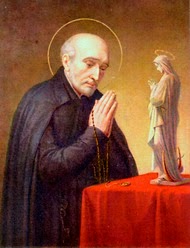
While much attention is given to Hallowe'en today, in the Jesuit Order we honour the feast of St. Alphonsus Rodriguez who foreshadowed the life of our St. Andre Bessette in his role as door-keeper. He had a marvellous influence on many who came and went at the Jesuit College, including on St. Peter Claver, whom he helped discern a call to serve the slaves in Colombia. Here is the Jesuit poet Gerard Manley Hopkins's tribute to him:
In Honour of St. Alphonsus Rodriguez, Lay Brother of the Society of Jesus
by Gerard Manley Hopkins
Honour is flashed off exploit, so we say;
And those strokes once that gashed flesh or galled shield
Should tongue that time now, trumpet now that field,
And, on the fighter, forge his glorious day.
On Christ they do and on the martyr may;
But be the war within, the brand we wield
Unseen, the heroic breast not outward-steeled,
Earth hears no hurtle then from fiercest fray.
Yet God (that hews mountain and continent,
Earth, all, out; who, with trickling increment,
Veins violets and tall trees makes more and more)
Could crowd career with conquest while there went
Those years and years by of world without event
That in Majorca Alfonso watched the door.
Monday, October 28, 2013
Bp Richard Gagnon Transferred - Becomes Archbishop of Winnipeg
Today it was announced in Rome that His Holiness Pope Francis has accepted the resignation of the Most Reverend James Weisgerber as Archbishop of Winnipeg, according to canon 401 §1, and appointed the Most Reverend Richard Gagnon, currently Bishop of Victoria in British Columbia, as Archbishop of Winnipeg. The Holy Father has appointed Most Reverend James Weisgerber as Apostolic Administrator of Winnipeg until the new Archbishop takes canonical possession of the Archdiocese.
Congratulations, Your Excellency! Ad multos annos!
Wednesday, October 23, 2013
Pastoral Visit to Rockland Parish
Visite pastorale à la paroisse “Très-sainte-Trinité”— Rockland, ON
28e dimanche du temps ordinaire—Année “C”—12-13 octobre 2013
VOIR CE QUE DIEU ACCOMPLIT ET RENDRE GRÂCE
[Textes: 2 Rois 5, 14-17; [Psaume 98]; 2 Timothée 2, 8-13; Luc 17, 11-19]
La semaine dernière, j’ai eu le bonheur de rendre visite aux élèves des écoles Sainte-Trinité et L’Escale. J’ai réalisé combien ces élèves étaient chanceux de pouvoir étudier dans des écoles catholiques de langue française.
Notre tâche à nous tous est de les aider à accueillir la foi qui leur est proposée – voilà le défi de la ‘nouvelle évangélisation’ : chacun de nous a à faire sa propre conversion, son propre cheminement comme nous le rappelle le pape François.
Le Saint-Père nous met au défi de voir notre foi autrement que comme le glaçage sur un gâteau ou une espèce de parfum. La foi doit faire partie de notre identité, de qui nous sommes en tant qu’être humain, en tant que personnes qui ont la foi.
Au cours de cette visite, j’ai également eu l’occasion de discuter avec quelques représentants de votre paroisse. Nous avons échangé sur les forces et les défis qui se présentent, sur les préoccupations qui vous habitent, et les nombreux bienfaits que nous partageons ensemble.
J’ai voulu me mettre à l’écoute de leurs observations et bien saisir la richesse de leur pensée. Ils ont parlé avec leur cœur et avec beaucoup de gratitude de leur pasteur qui les a accompagnés et guidés sur le chemin de la foi ces neuf dernières années. Ils ont parlé de leur espoir de voir la paroisse continuer de fleurir dans l’avenir, tout particulièrement durant les mois qui viennent alors que vous vous préparez à célébrer votre 125e anniversaire.
Plusieurs personnes ont dit trouver force et courage, soutien et joie dans cette communauté chrétienne. Vous avez de quoi être reconnaissants en effet! Continuez de vous soutenir les uns les autres dans un amour fraternel alors que vous cheminez ensemble dans la foi, l’espérance et charité.
En cette fin de semaine de l’Action de grâce, la Parole de Dieu mets sous nos yeux une personne reconnaissante.
Ça nous interpelle… sommes-nous des personnes reconnaissantes, capables de dire merci ?
La quatrième préface commune nous invite à rendre grâce à Dieu pour le salut qu’il nous offre: « Tu n’as pas besoin de notre louange, et pourtant c’est toi qui nous inspires de te rendre grâce : nos chants n’ajoutent rien à ce que tu es, mais ils nous rapprochent de toi ».
Le passage de l’Évangile que nous venons d’entendre peut nous amener à nous demander pourquoi certaines personnes semblent incapables de dire merci. Est-ce parce qu’elles ne pensent qu’à elles-mêmes ou parce qu’elles croient qu’elles méritent toujours davantage que ce qu’elles ont reçu?
Ce n’est pas à nous d’en juger. Nous n’avons aucune idée pourquoi des personnes qui ont pourtant reçu une multitude de bienfaits demeurent incapables de s’arrêter et dire merci pour tout ce qu’elles ont reçu. Il s’agit-là d’un des mystères du cœur humain.
Lorsque Jésus pris la parole dans une synagogue à Nazareth pour nous présenter le sens de sa mission (Luc 4, 16-30), il cita la guérison de Naaman le Syrien (2 Rois 5, 8-19) pour expliquer qu’il s’agissait-là d’un précédent dans l’histoire du salut et que, comme ce fut le cas pour le prophète Élisée, Dieu l’a envoyé apporter le salut aux personnes rejetées.
Si Jésus porte une attention particulière aux personnes rejetées, aux exclus, c’est peut-être parce qu’ils sont plus ouverts que les autres à accueillir et à reconnaître l’œuvre de Dieu dans leur vie. Après avoir été guéri, Naaman reconnu que l’action de Dieu l’avait sauvé de sa misère et il s’exclama ‘‘Je le sais désormais : il n’y a pas d’autre Dieu, sur toute la terre, que celui d’Israël’’.
Les dix lépreux rencontrèrent Jésus à la limite, à l’entrée, du village où il se rendait. Ils se tinrent à distance comme il avait été dans les Écritures [Nombres 5, 2-3 et dans le Lévitique 13, 45-46].
D’une seule voix, ils crièrent à Jésus – espérant peut-être qu’il leur ferait l’aumône – ‘’Jésus, maître, prends pitié de nous’’.
Luc rapporte que Jésus commanda aux lépreux d’aller se montrer aux prêtres – à ceux-là mêmes qui avaient l’autorité pour déclarer qu’ils ne présentaient plus un risque pour la santé des autres et qu’ils pouvaient être réintégrés dans la société.
Grâce à Jésus, la parole de Dieu guérit les dix lépreux mais cette guérison ne s’est pas produite instantanément. Elle se réalisa alors qu’ils étaient en chemin pour aller se montrer aux prêtres. Luc nous raconte qu’à un moment donné un des lépreux s’aperçu qu’il avait été guéri et il ‘ revint sur ses pas, en glorifiant Dieu à pleine voix’.
Ce que ce lépreux a réalisé ce n’est pas seulement qu’il était guéri, mais surtout qu’il avait été guéri par Dieu agissant en Jésus.
Tout ce que ce lépreux ressentait dans son cœur se manifesta dans ce geste : ‘Il se jeta la face contre terre aux pieds de Jésus en lui rendant grâce’. Sa gratitude était sans limites!
Jésus demanda alors : ‘‘Et les neufs autres, où sont-ils?’’ Seul cet étranger, ce Samaritain est revenu lui dire merci. Il fut le seul à reconnaître l’action de Dieu. Jésus reconnu en son geste un acte de foi : ‘Va : ta foi t’a sauvé’.
Il y a quelques années, un sondage fait auprès de riches américains révéla que la moitié des personnes reconnues par leurs paires comme ayant particulièrement bien réussi, n’étaient pas heureuses.
Cela nous enseigne peut-être que pour connaître le bonheur il est nécessaire de ‘voir’– un peu comme ce lépreux venu de la Samarie – que c’est la main de Dieu qui distribue ses bienfaits dans nos vies (même si nous avons parfois le sentiment d’avoir ‘réussi’ à force de travailler fort) et de développer en nous le goût de répondre à Dieu avec gratitude. N’est-ce pas là ce que nous enseigne Jésus en qui nous mettons notre foi?
En ces jours où nous fêtons l’Action de grâce, demandons-nous si nous sommes suffisamment reconnaissants pour tous ces dons que nous avons reçu de ce Dieu d’amour que nous connaissons en la personne de Jésus-Christ : santé, bien-être, famille, travail, collègues, amis, notre paroisse et notre pays.
Et que dire de tous ces bienfaits que nous avons reçus de Dieu : nous avons été créés à l’image et à la ressemblance de Dieu; le Christ est venu nous sauver; et que dire de toutes ces grâces auxquelles nous avons accès chaque jour de par notre vie en Église.
Saint Paul se montra reconnaissant envers le Seigneur pour tous ses bienfaits, alors même qu’il fut emprisonné pour avoir proclamé l’Évangile. Paul reconnu qu’il pourrait lui arriver d’être infidèle mais savait que ce ne sera jamais le cas pour le Christ Jésus (Si nous sommes infidèles, lui, il restera fidèle, car il ne peut se renier lui-même)
C’est cette confiance en Jésus qui nous permet d’aller de l’avant sans crainte pour l’avenir. Aller de l’avant dans la joie, le cœur remplis de gratitude!
Wednesday, October 16, 2013
Grace for Archbishop's Dinner on Feast of St Marguerite d'Youville
Introduction au bénédicité – Souper de l’Archevêque
Le 16 octobre 2013
Nous célébrons aujourd’hui la fête de sainte Marguerite d’Youville, la première personne née au Canada à avoir été canonisée. C’est elle qui a fondé la communauté des Sœurs de la Charité de Montréal, les ‘Sœurs Grises’. Devenue veuve peu de temps après son mariage, elle élève ses deux enfants et dirige une petite entreprise familiale. Les nombreuses épreuves de sa vie l’ont amenée à développer une profonde spiritualité qui s’est manifestée dans sa compassion envers les démunis. Avec quatre amies et compagnes, elle prononce le 31 décembre 1737 des vœux privés avec l’intention de se consacrer pour toujours aux pauvres.
On les appela les ‘Sœurs Grises’ à cause de leur lien avec les Youville connus pour leur trafic de l’eau-de-vie. En 1747, les Sulpiciens leurs confient l’administration de l’Hôpital Général de Montréal qui était dans un état financier lamentable. En 1755, Marguerite d’Youville et ses consoeurs deviennent officiellement les Sœurs de la Charité, que l’on appelle communément les ‘Sœurs Grises’.
Today is the feast of Saint Marguerite d’Youville, the first Canadian-born saint and founder of the Grey Sisters. Widowed shortly after her marriage, she reared her two children and carried on the family business. Following a religious conversion, she and four other women formed a lay group dedicated to charity and took simple vows.
Many Montrealers attested to her prophetic gifts and miraculous healing powers. Her spirituality and sacrificial life were officially recognized by Rome. She was the first Canadian-born person to be beatified and was canonized in 1990.
In Ottawa, we are privileged that one of the gifted Grey Nuns Elisabeth Bruyère came here from Montreal and put into motion the foundation of our Sisters of Charity, whose service was to the poor by every work of charity: Ottawa’s first hospital and orphanage, and schooling of many kinds and levels. They continue to serve here and abroad and are a rich part of our history of social engagement.
À Ottawa, nous avons été vraiment privilégiés puisque Sœur Élisabeth Bruyère accepte de venir fonder une mission à Bytown (maintenant Ottawa). Les Sœurs de la Charité d’Ottawa continuent de servir le peuple de Dieu ici et ailleurs. Les ‘Sœurs Grises’ ont écrit plusieurs des plus belles pages de notre histoire; leur dévouement envers les pauvres et démunis leurs ont mérité l’admiration de tous.
La veille de Noël 1872, Mère Bruyère écrivait ceci : ‘ si vous êtes bonnes, si vous êtes ferventes…vous serez proches du Cœur de notre divin Sauveur qui désire que toutes ses épouses soient saintes’.
Dans cet esprit, souvenons-nous de sainte Marguerite d’Youville et de Mère Bruyère alors que nous demandons à Dieu de bénir ce repas.
As we us recall both Saint Marguerite d’Youville and Mother Bruyère, we ask God’s blessing on our table:
Dieu de miséricorde, toi qui a appelé sainte Marguerite d’Youville et Mère Élisabeth Bruyère à te suivre sur le chemin de la Croix et à mettre leur grand amour au service des personnes dans le besoin, en leur temps, nous te prions de nous aider à avoir un cœur ardent comme elles. Aide-nous à avoir un cœur remplis de compassion comme le tien. Donne-nous la force de persévérer sur le chemin de l’amour jusqu’au jour où tu nous appelleras à partager le bonheur éternel avec tous tes saints et saintes. Bénis cette nourriture, ainsi que tous nos liens fraternels. Aide-nous à partager ce que nous avons reçu de toi et à aider nos frères et sœurs dans le besoin.
Bless us, O Lord, and these thy gifts, which we are about to receive from thy bounty. Through Christ, Our Lord. Amen.
Bon appetit!
Tuesday, October 15, 2013
A New Bishop Appointed for the Diocese of MacKenzie-Fort Smith
Today, His Holiness Pope Francis appointed Msgr. Mark A. Hagemoen, P.H., currently President of Corpus Christi and St. Mark’s Colleges in Vancouver, as Bishop of Mackenzie-Fort Smith.
Congratulations, Your Excellency! Best wishes for a long and fruitful ministry in Canada's north.
Friday, October 11, 2013
La fin de semaine d'Action de grace The Thanksgiving Weekend 2013
The liturgy of this Sunday and our Canadian Thanksgiving Day come together again this year. The photos are seasonal shots from the Byward Market and our delightful fall season these recent couple of weeks:
Twenty-Eighth Sunday in Ordinary Time (Year “C”) - October 13, 2013
A SAMARITAN TEACHES GRATITUDE
[Texts: 2 Kings 5.14-17; [Psalm 98]; 2 Timothy 2.8-13; Luke 17.11-19]
Tracing their lineage to the old Northern Kingdom, Samaritans were reckoned by Jews to be neither Jews nor Gentiles. They were treated with suspicion, hostility. But such “marginal” types were the very people Jesus came to seek out and to save.
Outsiders, whether Samaritans or lepers, are the special focus of Jesus' ministry, possibly because they are open to seeing God at work in a way that ordinary believers are not. Following his healing, Naaman recognized the special status of Israel's saving Lord and declared, “Now I know that there is no God in all the earth except in Israel”.
More than the others, Luke's gospel features Samaritans. At the outset of Jesus' journey, readers learn of a Samaritan village that refused to give Him hospitality because “His face was set toward Jerusalem” (9.51-56).
Samaritans responded well to the preaching of the gospel (cf. Acts 1.8; 8.1-25) and became models of behaviour, as in the parable of the “Good Samaritan” and in today's gospel that introduces the “Grateful Samaritan”, a leper who returned to give thanks to Jesus for his cleansing.
For those steeped in the Bible, the narrative of a leper's healing would naturally evoke memories of the leper cured by the prophet Elisha (2 Kings 5.1-27). Jesus cited Naaman's healing to the citizens of His hometown as justification for going beyond those who think they have claims on his ministry by kinship or personal acquaintance, to serve outsiders instead: “There were many lepers in Israel in the time of Elisha, and none of them was cleansed except Naaman, the Syrian” (Luke 4.27).
The liturgical selection is a truncated account of Naaman's physical healing and subsequent coming to faith. It omits Naaman's initial reluctance to trust the word of Elisha's servant (2 Kings 5.9-13). It focuses, rather, on the healing itself, Naaman's profession of faith, Elisha's selflessness in refusing recompense and the decision by the converted pagan Naaman to worship only the God of Israel.
Possessed of a rather simplistic faith, Naaman thought he could only adore the God of Israel on Israelite soil, and so begged two mule-loads of earth to take back to Syria, on which he would offer God burnt offerings and holocausts.
Biblical tradition struggles to explain the link between illnesses of the body and sins which afflict the soul. One must not be lead to think that someone suffering from an illness—leprosy, for example—is being punished by God for the commission of one or another sin. Rather, sickness reflects the normal state of humanity, which is wounded and incomplete. Physical illnesses and moral disorders are the ordinary lot of mortals, human beings who are fragile and sinful.
This explains why all healings brought about through the invocation of God's name are signs of the divine purpose which intends to put an end to the travails that weigh upon God's children. God does not want the death of sinners, but that they be converted and live (cf. Ezekiel 18.23). The healing granted to a particular person becomes, then, a pledge of the hope of salvation all people should entertain in their hearts.
Biblical accounts of healings usually feature ritual gestures that spell out this link with God's purpose. Such would underlie Jesus' instruction to the ten lepers, “Go and show yourselves to the priests”. This command speaks of the healing of the soul that God desires and that is symbolized by physical healings. Along with physical restoration to health, one must envisage liturgies of pardon, celebratory rites of redemption granted.
The Naaman story reveals a double healing: the restoration of his flesh to be “like that of a young boy” and the opening of his heart to discover the true God. So, too, does the story of the ten lepers. All receive physical healing, but nine are satisfied with staying on the physical level alone.
One, a Samaritan heretic, is shown to be touched by the grace of thanksgiving, gratitude. His faith has doubly saved him. He rendered thanks to God—as Christians do at the Eucharist—for healing both physical and spiritual.
Paul's gratitude to God extended even to the circumstances of his imprisonment for the gospel. Paul knew he might prove unfaithful, but not Christ: “He remains faithful—for He cannot deny Himself”.
Sunday, September 29, 2013
A Visit to Holy Redeemer, Kanata - Jerome, Translator Extraordinaire
Holy Redeemer Church—Kanata, Ontario
MASS WITH WOMEN WHO COMMIT THEMSELVES
TO THE SPIRITUAL MOTHERHOOD OF PRIESTS
Twenty-Sixth Sunday in Ordinary Time (Year “C”)—September 28, 2013
SHARING WEALTH WITH GOD'S POOR
[Texts: Amos 6:1, 4-7; [Psalm 146]; 1 Timothy 6:11-16; Luke 16:19-31]
Today's Old Testament reading and gospel present biting criticisms of luxurious living. Each faults those who possess an abundance of goods for their failure to show compassion. The psalm describes God as the champion of the dispossessed of every kind. Finally, the epistle calls to mind the commitment of the baptized to live their faith.
The prophet Amos denounced what today we would call conspicuous consumption. The seer's stinging criticism noted signs of opulence, people lying on “beds of ivory” and “lounging on couches”. He observed excess as they drank wine by the bowlful rather than from a goblet in moderation.
Amos preached his message in the second quarter of the eighth century B.C. It was a time of apparent peace that seemed to promise increasing prosperity. The Northern Kingdom dreamed of grandeurs to come (Amos 6.13-14).
Especially among the residents of Samaria—to whom the words we hear today were addressed—luxury and a certain snobbishness held sway. Beneath the superficial calm, however, a social cancer lay lurking.
Into this dream world Amos came preaching a social gospel rooted in radical faith in God alone. To those who lacked a social conscience Amos promised the first place in the coming deportation.
Faithful Samaritans ought to have cared for the poor with whom they were bound in a common faith. Instead, they cared not at all for the “ruin of Joseph”, their community of faith and culture. Their indifference would be met with a divinely-imposed recompense.
The positive side of Amos' proclamation foreshadowed that of the gospel of Jesus. He inquired of his hearers what things they possessed that they had not received from God, wondering how they could boast of them as if they were their own (cf. 1 Corinthians 4.7).
By stressing God's identification with the lot of the poor, Amos anticipated what Jesus would say, “what you did to one of these, the least of my sisters and brothers, you did to me” (Matthew 25.40).
An aspect of the teaching of Jesus regularly emphasized in Luke's Gospel is the prudent use of material possessions. Throughout Luke's narrative of Jesus' journey to Jerusalem (Luke 9.51-19.27), He offered instruction to various groups. In this case, Jesus spoke to the Pharisees who were said to be “lovers of money” (16.14) and illustrated His saying that “what is prized by human beings is an abomination in the sight of God” (16.15).
Jesus' teaching in this parable, the only one in which a character is given a proper name (Lazarus), illustrates the “everlasting dwellings” spoken of in the Parable of the Dishonest Steward (16.9). Likewise, it emphasizes the reversal of situations taught earlier about the rich and poor (6.20, 24)
The parable has two parts: in the first, Jesus taught that in the after-life there is a counterbalancing of the situation that held sway in this life; in the second, Jesus argued that even a messenger from the dead cannot effect repentance among rich people whose hearts have been hardened against the poor.
There’s a problem we have to face as we read these reflections and that is the question of God’s initiative in drawing us to himself and our response.
In his recent interview, Francis noted that men and women religious are called like Amos to be prophets. They are to show how Jesus lived on earth and proclaim how the kingdom of God will be in its perfection.
Pope Francis said, “A religious must never give up prophecy…The charism of men and women religious is like yeast: prophecy announces the spirit of the Gospel.” And yes, prophets make us uneasy.
In images, Francis returned to the patristic concept of the Church as a hospital for sinners.
“I see clearly,” he says, “that the thing the church needs most today is the ability to heal wounds and to warm the hearts of the faithful…The most important thing is the first proclamation: Jesus Christ has saved you. And the ministers of the church must be ministers of mercy above all.”
Each of us, you see, is called to share in the new evangelization, providing that you yourself are evangelized. Pope Francis has indicated that he wants to move the church away from ideological fixations of a moralizing sort and toward proclaiming the gospel. The order of church life must be inviting people to know God in Christ first. Then comes the moral order, as a response to one’s coming to know God’s mercy, forgiveness, and joy. Often the order gets reversed and that’s where trouble ensues. This is where the issues of abortion, contraception, active homosexuality, and other life issues come in. Virtuous behaviour in these areas is a response to God’s grace, not a pre-condition to belonging to the community of God’s Kingdom and the Church.
Most people need a close walk with the Lord to understand why the Church says no to abortion, gay marriage, and contraception. Without Jesus deeply in your life, it is hard to understand these prohibitions. But how do people get to know Jesus? People get to know him by God’s people—you—evangelizing and telling them about your Lord and Saviour. By you telling a person you know what Jesus has done for us and for you in particular. You must tell that person how Jesus has saved you, loved you, and healed you. Then you must let the Holy Spirit take over as you pray for that person.
I pray that all of us here today, especially those who have taken part in this program supporting women dedicated to the spiritual motherhood of priests may share the faith and serve the poor, enter fully into these sacred mysteries that we are celebrating at this Lord’s Day Mass. On this Saturday, which honours Our Blessed Mother, let us ask Mary’s aid in being drawn to her Son so that we, in our turn, may draw others to him.
Photo credit: David Chan
* * * * *
ST. JEROME: SCRIPTURE EXPERT,
DOCTOR OF THE CHURCH
September 30 features the annual memorial of Saint Jerome, inspiration and patron of those engaged in scriptural translations and the teaching of Sacred Scripture.
Leonardo da Vinci’s, St. Jerome in the Wilderness (c. 1480) in Rome’s Vatican Museums.
* * *
A Prayer of Saint Jerome for Christ's Mercy
O Lord, show Your mercy to me and gladden my heart. I am like the man on the way to Jericho who was overtaken by robbers, wounded and left for dead. O Good Samaritan, come to my aid. I am like the sheep that went astray. O Good Shepherd, seek me out and bring me home in accord with Your will. Let me dwell in Your house all the days of my life and praise You for ever and ever with those who are there. Amen.
Subscribe to:
Posts (Atom)