Wednesday, January 16, 2013

CNEWA launches Rome event for Eastern Catholic Churches


CNEWA Canada Executive Director Carl Hetu and I, as president of CNEWA Canada, are in Rome to take part in the pilgrimage-familiarization experience described below by Vatican Radio.

* * * * * *
Rome: Vatican Radio - Many Catholics today are surprised when they hear that their Church is made up of a myriad of ancient rites and not just the Latin one. Many of these 22 rites stem directly from the lands where Jesus lived.

The Catholic Near East Welfare Association (CNEWA) is trying to raise awareness among the faithful that the Church’s rich tapestry of eastern traditions is an historically important source of strength for the Universal Church. But, these ancient churches need our help.

That’s why the President of CNEWA, Monsignor John Kozar is co-hosting with the Pontifical Congregation for Eastern Churches a special event and pilgrimage in Rome this week. He and Cardinal Leonardo Sandri, Prefect of the Congregation, are hoping to introduce Italians, mostly Catholics, to the reality of the eastern rite churches.

They’re doing so with the help of the Kights of the Holy Sepulchre who have a long tradition of cooperation with the churches in the Holy Land. The Knights will be hosting a get-to-know each other event Wednesday January 16th in their Grand Hall here in Rome.

“All of this is at the fullest level of cooperation with the Congregation for Eastern Churches which really excites me because we have a great partnership,” Msgr Kozar says. “I’d like to say it in these terms: together, the Holy Father invites us, of course the congregation is his main outreach in service to the eastern churches – but, he invites us in partnership with them to extend the reach.”

Prominent Italians from the political, civic and social spheres are expected to attend next Wednesday’s event. The directors of CNEWA offices in Amman, Beirut and Jerusalem will also mingle with guests and share their experiences working among the poor, and especially among the hundreds of thousands of refugees flooding over Syria’s borders.


A suffering Eastern Church

“We want to open a little door,” explains Msgr Kozar, “to share with Italians (this little known segment of the Universal Church). You know, there’s a great family at work and we’d like you to learn a little bit about this eastern Catholic family. It’s part of the universal Catholic family. And we’re given a special privilege of serving them because although they’re very historic and they’re in the original lands of Jesus, they suffer greatly because in those lands they lack a lot of things.”

“We want to share (with Italians) both the great good news of this heritage…but at the same time these tremendous needs and how we’re very honoured to respond. And just maybe, they might want to become part of the CNEWA family too, to help us reach out.”

Speaking of the refugee crisis from the conflict in Syria, Msgr Kozar explains that his organization is focusing primarily on the displaced in Syria. The association’s funds are insufficient to offer major help, but CNEWA is able to provide some of the basics like clothing, bedding and food to some 500 – 1000 families, he says.

All is delivered by “our hands-on agents, part of our family,” says Kozar who assures donors in this way “that it’s not going to the wrong places or it’s not being used for something else.”


Besides its offices in the Middle East and Egypt, CNEWA is present in India and Eastern Europe with healthcare and schools "as a sign of solidarity with the local population." Msgr Kozar says that’s a significant part of CNEWA’s mission: “our presence.”

“We can’t pretend to match what huge government aid agencies can and should do,” he says. “ We help with humanitarian aid of course…health care aid, but I think we’re best at maintaining the presence, the face of Christ: priests, sisters, lay people, catechists, formators…even though our numbers are very small, we try to keep an abiding presence.”

To learn more about CNEWA Canada or to make a donation to help suffering Christians in the Middle East and among the Oriental Churches of India and Eastern Europe: www.cnewa.ca.

Pour en savoir plus sur les eglises orientales et les chretiens/chretiennes dans le besoin, ou pour faire un don: www.cnewa.ca.

Tuesday, January 15, 2013

The Joyous Wedding Feast of Cana


Second Sunday in Ordinary Time (Year "C") January, 20, 2013

AFFIRMING THE BLESSINGS OF MARRIAGE IN OUR DAY

[Texts: Isaiah 62.1-5 [Psalm 96]; 1 Corinthians 12.4-11; John 2.1-12]


A dozen years ago, religious leaders from four American church bodies pledged themselves to affirm God's first institution—marriage (cf. Origins 30:24, November 23, 2000, p. 388). Catholic, Baptist, Evangelical and National Council of Churches representatives declared God established the married state as ‘a holy union of one man and one woman in which they commit, with God's help, to build a loving, life-giving, faithful relationship that will last for a lifetime’.

‘Marriage’, they said, ‘is God's gift, a living image of the union between Christ and his church’. As such, marriage—when lived according to God's plan—‘brings spiritual, physical, emotional, economic and social benefits not only to a couple and family but also to the church and the wider culture. Couples, churches and the whole of society have a stake in the well-being on marriages’.

The church spokesmen see threats to the good of society in factors militating against successful marriages: ‘a high divorce rate, a rise in cohabitation, a decline in the marriage rate and a diminishing interest in and readiness for marrying, especially among young people’. They could not have imagined then the additional challenge coming from the pressure from same-sex unions, let alone from countries or states that permit same-sex ‘marriages’!

Since three-quarters of marriages are performed by clergy, they called on churches to do everything possible to foster sound marriages: ‘prayer and spiritual support for stronger marriages; encouragement for people to marry; education for young people about the meaning and responsibility of marriage; preparation for those engaged to be married; pastoral care—including qualified mentor couples—for couples at all stages of their relationship; help for couples experiencing marital difficulty and disruption; influence within society and culture to uphold the institution of marriage’.

In the Catholic understanding of marriage, spouses freely entering a marriage make an indissoluble commitment of fidelity to each other until death. Unless dispensed for good reason (as when a Catholic marries someone from another Christian tradition or another faith), Catholics marry before two witnesses in a church ceremony celebrated by a priest or deacon.

In both Latin and Eastern church traditions the liturgies invoke God's grace and blessing for couples entering upon a life-long project. In the epiclesis (a solemn invocation) in the rites of matrimony, ‘the spouses receive the Holy Spirit as the communion of love of Christ and his Church’ (Catechism of the Catholic Church, #1624).

Understanding the solemn and sacramental nature of marriage, the Church rejoices that, on the threshold of His public ministry, Jesus performed His first ‘sign’, at his mother's request, during a wedding feast.

With overtones of joy and abundance, this wedding miracle inaugurated Jesus' ministry, a function Jesus' ‘inaugural sermon’ at Nazareth fulfils in Luke's gospel (next week's gospel).

The Fourth Evangelist gives only scant details of the miracle of water changed into wine: the when: “the third day”; who: the “mother of Jesus”, never called Mary in John's gospel, Jesus, the disciples, servants; where: “Cana in Galilee” (otherwise unknown in gospel tradition but the locale of another miracle [cf. John 4.46-54]).

An embarrassing situation is the occasion for Jesus' intervention: the wine ran out, a fact communicated to Jesus by his mother. Mary presumed her Son would attend to the situation.

Though Jesus' address to his mother (“Woman”) seems harsh or rude, it is neither. Jesus used the same term to address his mother under the cross (John 19.26) and to greet Mary Magdalene at Easter (20.15). This formulaic address and Jesus' other words to his mother (“what concern is that to you and to me?”) established distance and played down family ties in order to highlight, instead, dimensions of faith.

The abundance of “the good wine” brought joy and honour to a couple on the verge of shame and disgrace. More appropriately, however, this first of Jesus' signs evoked faith among his first followers (“his disciples believed in him”).

The Third Isaiah used a joyous wedding feast to announce removal of Israel's shame experienced by exile from the land of Israel. God's love for his people was expressed in nuptial imagery, “as the bridegroom rejoices over the bride, so shall your God rejoice over you”.

God's ongoing delight in the Church appears in the spiritual gifts abundantly at work within the Church—whether those who exercise them are married, celibate or single—“there are varieties of activities, but it is the same God who activates all of them in everyone”.

Monday, January 14, 2013

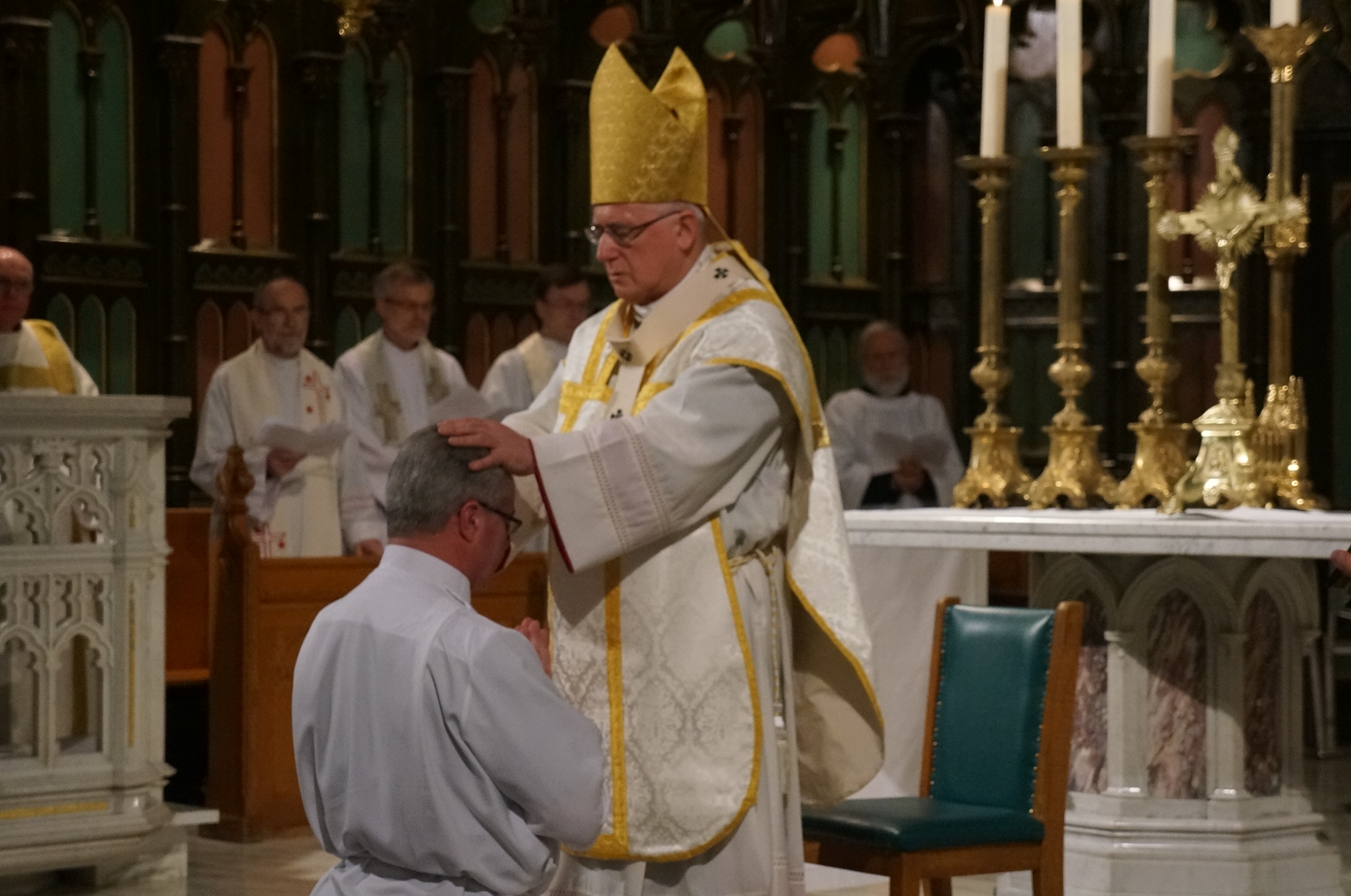
Diaconal Ordination of Carl L. Reid

St. Patrick Basilica, Ottawa, ON—January 12, 2013
THE DIACONAL ORDINATION OF CARL LEONARD REID
[Texts: Numbers 3.5–9; Psalm 89; 1 Timothy 3.8–10, 12–13; Luke 12.35–44]

DSC00317

My dear Brothers and Sisters in Christ,

During a formal ad limina visitation I made to Rome with other Canadian bishops, Pope Benedict XVI presented each of us with a beautiful pectoral cross. It features a replica of a twelfth century processional cross found in the museum of the Lateran cathedral basilica that is striking for the many biblical images found on it.

The scenes represent family life and dreams, vocations and sacrifice, separations and the joy of reunion. We can indentify with many of these consoling sentiments on this important day.

At the centre of both the vertical and horizontal bars of the cross is a depiction of the crucifixion of Jesus, with his Mother and the Beloved Disciple being bound into the new family of the Church. The Risen Christ constantly says to the Church, “behold, I make all things new.” Among these things is today’s gesture of reconciliation that recognizes the spiritual leadership of Carl Leonard Reid. It also calls him to develop his gifts along a new dimension.

On this day, the liturgy commemorates our first Canadian woman saint, Marguerite Bourgeoys. We rejoice that family faith, vocational discernment, self-offering, and openness to the Holy Spirit have brought us together in celebration of the Eucharist.

DSC00321

The experience of family is at the core of each person’s life journey. I extend a most cordial welcome to the wife and siblings, friends and associates of our brother in Christ, Carl Leonard Reid. We give thanks to God for the way in which his family and friends nurtured faith in him, primarily but not solely in the Anglican tradition.

Carl, my son, your life up to now has been one of profound commitment and witness. Your formation and ministry within the Anglican tradition have provided you solid spiritual bedrock. You have been a bold witness to Christ and to the truths of Catholic Christianity–often at great cost to yourself.

Coming into communion with the Catholic Church through the Ordinariate, you bring with you the rich spiritual patrimony of the Anglican Church. Now, your ministry of bridge-building extends to creating bonds of friendship and communion between the Catholic Church and ecclesial communities of the Anglican and other Christian traditions.

In the Book of Numbers that we heard at the beginning of the Liturgy of the Word, Moses appoints Levites to assist in the devotional life of God’s holy people. The role of Levites, as is the case with deacons, was to assist the priests and to perform duties for Aaron the high priest and for the whole assembly. They were, in effect, to help the people have access to God’s sanctuary. But they were also to set boundaries between the sanctuary and the camp, and to teach distinctions between virtue and sin to keep God’s people out of harm’s way. There is an order and harmony in the design of God’s creation. If proper teaching and practice are not instilled, then life and goodness suffer. Chaos and death ensue.

Beloved brothers and sisters: this, our son who is your relative and friend, is now to be advanced to the Order of Deacons, that is anticipated in the role of Levites.

Strengthened by the gift of the Holy Spirit, he will help the Bishop and his priests in the ministry of the word, of the altar, and of charity. He will be a servant to all. As a minister of the altar, he will proclaim the Gospel, prepare the sacrifice, and distribute the Lord’s Body and Blood to the faithful.

DSC00339

In addition, it will be his duty, at the Bishop’s direction, to exhort believers and unbelievers alike. He will instruct them in holy doctrine. He will preside over public prayer, administer Baptism, assist at and bless Marriages, bring Viaticum to the dying, and conduct funeral rites.

Consecrated by the laying on of hands that comes down to us from the Apostles, he will perform works of charity in the name of the Bishop or the pastor. With the help of God, his labour will be a public testimony of a disciple of the Lord who, as we heard him describe humble service in the gospel lection, came not to be served, but to serve.

As a Deacon, do the will of God from your heart. Serve the people in love and joy as you would the Lord. Because no one can serve two masters, in the spirit of the warnings Paul gave Timothy in the second lesson, look upon all defilement and avarice as serving false gods.

Like those chosen by the Apostles for the ministry of charity, you should be a man of good reputation, filled with wisdom and the Holy Spirit. See your ministry of caring for the poor and needy as an extension of God’s compassionate mercy.

As Pope St. Leo the Great said so marvellously, “there is nothing more worthy of man than that he become an imitator of his Creator and ... the executor of the divine plan. For when the hungry are fed, the naked are clothed and the sick are strengthened–is this not the divine assistance that the hand of the minister accomplishes, and is not the goodness of the servant the hand of the Lord at work? For when God finds a helper to realize his merciful touch, he so limits his omnipotence, that he alleviates the sufferings of man through the actions of men.” In your ministry, invite other disciples to enter into this outreach to the poor with you.

Firmly rooted and grounded in faith, you are to show yourself chaste and beyond reproach before God and man, as is proper for a steward of God’s mysteries.

Never allow opposition to turn you away from the hope offered by the Gospel. Now you are not only a hearer of this Gospel but also its minister. Express by your actions the word of God that your lips proclaim, so that the Christian people, brought to life by the Spirit, may be a pure offering accepted by God.

Then on the last day, when you meet the Lord face to face, he will say, “Well done, good and faithful servant, enter into the joy of your Lord.”

DSC00393

Photos: courtesy of Deborah Gyapong


Sunday, January 13, 2013

Celebrating the Lord's Baptism

Pietro Vannucci, also known as il Perugino, The Baptism of Christ

Today the Church celebrates the Solemnity of the Baptism of Our Lord. This brings to an end the season of Christmas. The Church recalls Our Lord's second manifestation or epiphany which occurred on the occasion of His baptism in the Jordan. Jesus descended into the River to sanctify its waters and to give them the power to beget sons of God. The event takes on the importance of a second creation in which the entire Trinity intervenes.

In the Eastern Church this feast is called Theophany because at the baptism of Christ in the River Jordan God appeared in three persons. The baptism of John was a sort of sacramental preparatory for the Baptism of Christ. It moved men to sentiments of repentance and induced them to confess their sins. Christ did not need the baptism of John. Although He appeared in the "substance of our flesh" and was recognized "outwardly like unto ourselves", He was absolutely sinless and impeccable. He conferred upon the water the power of the true Baptism which would remove all the sins of the world: "Behold the Lamb of God, behold Him Who takes away the sin of the world".

Many of the incidents which accompanied Christ's baptism are symbolical of what happened at our Baptism. At Christ's baptism the Holy Spirit descended upon Him; at our Baptism the Trinity took its abode in our soul. At His baptism Christ was proclaimed the "Beloved Son" of the Father; at our Baptism we become the adopted sons of God. At Christ's baptism the heavens were opened; at our Baptism heaven was opened to us. At His baptism Jesus prayed; after our Baptism we must pray to avoid actual sin. (— Excerpted from Msgr. Rudolph G. Bandas)   Source: www.catholicculture.org

* * *
Almighty ever-living God, who, when Christ had been baptized in the River Jordan and as the Holy Spirit descended upon him, solemnly declared him your beloved Son, grant that your children by adoption, reborn of water and the Holy Spirit, may always be well pleasing to you. Through our Lord Jesus Christ, your Son, who lives and reigns with you in the unity of the Holy Spirit, one God, for ever and ever.

* * * * * *

TIME IN ROME


I have just arrived in Rome (via Frankfurt) to take part in meetings with benefactors of CNEWA, which provides assistance to Christians and others in need in the Middle East and to the Oriental Churches in India and Eastern Europe (www.CNEWA.org).

As I am still having difficulty uploading photos on my blog (I can do it via a circuitous route which is tedious but most problematic, time-consuming). Efforts are being made to resolve the issue, but perhaps the blog will have to migrate to another site or another approach taken. Thanks for your patience and understanding.

Prayers and Masses will be offered for those who frequent this site during these days in the Eternal City.

Saturday, January 12, 2013

Memoire de Sainte Marguerite Bourgeoys - Homily at Archbishop Joseph-Aurele Plourde's Funeral


Inspirée par la «Vierge voyagère», Marguerite Bourgeoys fonde les Dames de la Congrégation. Celles-ci ont été parmi les premières communautés féminines à sortir de leur monastère pour porter la foi et soutenir la culture auprès des premiers habitants de Ville Marie (Montréal).

Dans un pays alors à feu et à sang, Marguerite transmet la lumière et l’amour qui font vivre. La force et le courage démontrés par Marguerite Bourgeois, en relevant tant de défis avec si peu de moyens, font d'elle une femme actuelle qui peut redonner un souffle au monde de l'éducation.

Marguerite est représentée dans une grande simplicité, dans un grand dépouillement, pour laisser passer l'essentiel: l'amour et la lumière divine. Elle est en position de contemplation devant les âmes que Dieu lui a confiées. Sa mission est l'éducation des jeunes. Elle porte le livre de La Parole aux étudiantes stupéfiées devant la grandeur de tous ces mystères.

* * *

Almighty God, who called Saint Marguerite Bourgeoys to leave her homeland so as to educate young people in the Christian life, direct, we pray, our words and our deeds that along the varied paths which lead to you, we too, by her example and prayer, may proclaim the loving presence of our Saviour. Who lives and reigns with you in the unity of the Holy Spirit, one God, for ever and ever. Amen.

* * *

Almighty ever-living God, who through your Only Begotten Son have made us a new creation for yourself, grant, we pray, that by your grace we may be found in the likeness of him in whom our nature is united to you. Who lives and reigns with you in the unity of the Holy Spirit, one God, for ever and ever. Amen.

* * * * * *

Liturgie des funérailles de Mgr Joseph-Aurèle Plourde

Huitième évêque et septième archevêque d’Ottawa
Cathédrale Notre-Dame, Ottawa,
Le 11 janvier 2013


[Textes : Isaïe 25, 6-9 (Psaume 22 (23); 2 Timothée 1, 8b-14; Jean 15,9-17]

Sur les armoiries de Mgr Plourde – qui ont déjà été gravées sur le tombeau dans lequel son corps sera déposé, dans la crypte de cette cathédrale – on remarque qu’une étoile y tient une place de premier choix. Cette étoile représente « Stella Maris, l’étoile de la mer », cette Marie, Mère de Dieu, qui attire les croyants à son Fils tout comme l’étoile de Bethléem attira les Mages à l’Enfant Jésus. Les derniers papes ont reconnu en Marie l’étoile qui saura nous guider dans la nouvelle évangélisation, celle qui est capable de ramener les chrétiens qui se sont éloignés du Christ et de son Église dans la maison qui est leur.

Archbishop Plourde’s coat of arms is already etched onto the sarcophagus in the crypt below this cathedral that will soon enclose his mortal remains. On it, a star is prominently displayed. It is a depiction of Stella Maris, the Star of the Sea, a symbolic illustration of Mary. She helps draw each believer to Christ, just as the Star of Bethlehem drew the Magi to the Christ Child. Recent popes have seen in Mary the lodestar of the New Evangelization, needed now to draw errant Christians back to their true home.

Joseph-Aurèle Plourde, disciple of Christ, priest, and bishop, died in the Christmas season on the eve of the Epiphany, when followers of Jesus are full of joy at his manifestation as God Incarnate. Our Lord God, by his very appearance in a human body, began to put an end to the reign of sin. This he would definitively overcome by his death and resurrection, giving all believers hope for a homeland where we “need no star to guide, where no clouds God’s glory hide.”

Joseph-Aurèle Plourde, chrétien, prêtre, évêque et disciple du Christ, est décédé pendant le temps de Noël, la veille du jour de l’Épiphanie, alors que les cœurs sont remplis de joie devant la manifestation de Jésus Christ, Dieu fait homme. En prenant chair parmi nous, notre Seigneur a déjà commencé à mettre fin au règne du péché.

Les lectures que nous avons choisies pour cette messe viennent soulager notre peine. Elles nous aident à prier le Seigneur de bien vouloir recevoir, pardonner et accompagner notre frère—notre pasteur, notre guide, notre ami, celui avec qui nous avons travaillé à la Vigne du Seigneur—dans les doux pâturages qui sont siens, et lui accorder de connaître le bonheur éternel comme il l’a promis à ses disciples.


La vie de tous chrétiens se déroule durant la période de temps qui se situe entre les deux grands événements de l’histoire : le mystère pascal du Verbe de Dieu fait chair, sa mort et sa résurrection, et le retour du Seigneur qui viendra accomplir dans la gloire le plan de Dieu pour ses disciples.

La liturgie nous rappelle que nous devons être attentifs. Le Seigneur Jésus reviendra à la fin des temps, certes, mais il se manifestera également à nous au moment de notre mort, au sujet de laquelle, comme ce fut le cas pour Mgr Plourde, nous ne connaissons ni le jour, ni l’heure.

Le concile Vatican II dont nous célébrons le cinquantième anniversaire cette année, et auquel Mgr Plourde était fier d’avoir pu participer, nous rappelle avec insistance que le moment le plus important dans la vie de tout chrétien est le moment de son baptême – car c’est à ce moment-là qu’il est transformé alors qu’il renonce au péché et participe à l’amour du Christ.

Pour Joseph-Aurèle Plourde, le huitième dans une famille de onze enfants, cela s’est déroulé il y a près de 98 ans. C’est au moment de son baptême qu’il a entrepris son long pèlerinage de chrétien.

Plus tard, au moment de sa confirmation, il reçut la force de l’Esprit Saint qui lui permit d’accomplir sa mission. La fréquentation des sacrements de la Réconciliation et de l’Eucharistie permit à Joseph-Aurèle de se rapprocher du Seigneur. Jeune adulte, Joseph-Aurèle entendit l’appel du Seigneur à devenir prêtre et plus tard il répondit généreusement à l’appel de l’Église qui l’invita à servir le peuple de Dieu comme évêque, rôle apostolique qu’il exerça pendant 48 ans.

Baptismal imagery permeates Christian funerals. The lit paschal candle symbolizes Christ’s presence among us. The celebrants wear white garments. Our brother also wears white in his coffin. This reminds us that we are clothed with the new life of Christ at baptism.

A rich sacramental life, the precious Word of God, and deep personal prayer stirred our brother, Joseph-Aurèle Plourde. He expounded on these in his ministry, gave conferences about them in his retirement, and wrote about them in several publications.

We have many memories of this intricate man. He could be at the same time hospitable, crusty, humorous, tender, and brilliant. But these stories must await another occasion.

For now, I would like to situate the man and his achievements in the context of faith. God accompanies us through the darkest valley—even the shadow of death. He does not abandon us. Our Lord is there to guide us with his crook and his staff. He anoints our heads with oil. He causes our cups to overflow. And he endows us with his goodness and mercy all the days of our life.

C’est ce rôle de Bon Berger que Joseph-Aurèle Plourde, ce successeur des apôtres, s’est efforcer de remplir tout au long de son ministère. En tant que président de la Conférence des évêques catholiques du Canada puis membre fondateur de ce qui est devenu l’Assemblée des évêques catholiques de l’Ontario, Mgr Plourde exerça son rôle de pasteur en coopération avec les autres pasteurs de l’Église, cherchant toujours à encourager les autres à accomplir fidèlement la mission dont nous parle saint Paul dans la deuxième lecture. Ce texte nous raconte comment le prêtre-évêque est prêt à souffrir avec le Christ pour proclamer l’Évangile en comptant sur la force que Dieu donne, sur celui qui nous a sauvé et nous a appelé à cette vocation sainte, non à cause de nos bonnes actions mais à cause de son propre projet et de sa grâce.

Avec saint Paul, Mgr Plourde nous dit à nous tous qui sommes rassemblés autour de lui aujourd’hui : « Prends comme modèle les paroles véritables que je t’ai communiquées, tiens bon dans la foi et l’amour que nous avons dans la communion avec Jésus-Christ. Garde les bonnes instructions qui t’ont été confiées, avec l’aide du Saint-Esprit qui habite en nous. »

Il n’y a pas de don ou de talent qui ne puisse être mis à contribution par le Seigneur au service de son Église. Mgr Joseph-Aurèle Plourde a mis ses talents d’analyste des questions sociales au service des pauvres d’ici et d’ailleurs. Il a défendu la dignité et les droits des travailleurs et de la population francophone de l’Ontario, surtout en ce qui a trait à l’accès à l’éducation en français. Comme l’a fait Mgr Plourde, il est important encore aujourd’hui d’encourager les jeunes hommes à mettre leurs talents au service du peuple de Dieu.

Always sociable, Archbishop Plourde enjoyed company. He would love a card game, particularly bridge, followed by sharing food. He would have no trouble accepting the Lord’s invitation to the eschatological banquet at the end of time that Isaiah foretold in the first reading.

In the gospel, we recall the invitation Joseph-Aurèle Plourde received to be in relation with Jesus, not as a servant, but as a friend. In his ordination homilies and ministry, he invited those called to be deacons, priests, and bishops to become Jesus’ companions and friends. Our entire church is to become a fellowship of disciples and friends in the Lord who would go forth and bear fruit, fruit that will last. This is what Archbishop Plourde had in mind as he encouraged the people of his diocese, at the start of his ministry in Ottawa, to confide in him their thoughts, fears, and hopes.

In this Year of Faith, let us be grateful for this wonderful High Priest, whom God called to himself at the end of a lifetime of service. Let us pray that Christ the Good Shepherd bless him with a merciful reward. May the Saviour lead him to the springs of eternal life, which he contemplated, preached, and yearned for from his earliest days until his final breath.

Alors que nous contemplons le mystère de l’Épiphanie, rappelons-nous que « les Mages ont suivi l’étoile, et ainsi ils sont parvenus jusqu’à Jésus, jusqu’à la grande Lumière qui éclaire tout homme venant en ce monde (cf. Jn 1, 9) Comme pèlerins de la foi, les Mages sont devenus eux-mêmes des étoiles qui brillent dans le ciel de l’histoire et nous indiquent la route. » (Benoît XVI, Homélie pour la solennité de l’Épiphanie, le 6 janvier 2013)

Rendons grâce à Dieu pour Mgr Plourde qui à l’exemple des Mages a guidé son peuple avec courage et générosité. Imprégné de l’amour de Dieu, il est devenu lui-même une étoile cherchant toujours à le faire connaître aux autres et à le faire aimer.

Friday, January 11, 2013

"Shine like stars in the world" (Philippians 2.15) - Les saints sont les vraies constellations de Dieu


Allocution pour la vigile de prière pour Mgr Joseph-Aurèle Plourde-huitième évêque et septième archevêque d’Ottawa
SE FAIRE DISCIPLES: SUIVRE L’ÉTOILE DU CHRIST ET, À NOTRE TOUR, DEVENIR DES ÉTOILES POUR LES AUTRES
[Texte: Philippiens 2, 14-18]

Remarks for the Vigil of Prayer for Archbishop Joseph-Aurèle Plourde-Eighth Bishop and Seventh Archbishop of Ottawa
Basilique-cathédrale Notre Dame Cathedral Basilica
January 10 janvier 2013
DISCIPLESHIP: FOLLOWING THE STAR TO CHRIST
AND, IN TURN, BECOMING STARS FOR OTHERS
[Text: Philippians 2.14-18]

“The obedience of the star calls us to imitate its humble service: to be servants, as best we can, of the grace that invites all men to find Christ.”

These words of Pope St. Leo the Great for the Solemnity of the Epiphany remind us that our brother in Christ, Archbishop Joseph-Aurèle Plourde, died on the eve of the feast of the Magi. These searchers from the East—not unlike Joseph-Aurèle—sought the Christ Child, the one born as King of the Jews.

Momentarily saddened when the star eluded their view, they sought in the Scriptures where God’s anointed one could be found and learned from scribes skilled in the law that it would be in Bethlehem. Heeding the Scriptures, they continued their journey’s quest and rejoiced when the star reappeared and guided them to Jesus with Mary his Mother.

Bowing down before him in obeisance, they worshipped him and presented him with their costliest treasures: gold and frankincense and myrrh.

Le Saint-Père Benoit XVI a évoqué cette recherche de Dieu faite par les Mages à l’occasion de l’ordination de quatre évêques en la basilique Saint-Pierre dimanche dernier :

« Pour l’Église croyante et priante », disait le pape, « les Mages d’Orient qui, sous la conduite de l’étoile, ont trouvé la route vers la crèche de Bethléem sont seulement le début d’une grande procession qui s’avance dans l’histoire.

« Ceux-ci étaient aussi et surtout des hommes qui avaient du courage, le courage et l’humilité de la foi. Il fallait du courage pour accueillir le signe de l’étoile comme un ordre de partir, pour sortir – vers l’inconnu, l’incertain, sur des chemins où il y avait de multiples dangers en embuscade. Nous pouvons imaginer que la décision de ces hommes a suscité la dérision : la plaisanterie des réalistes qui pouvaient seulement se moquer des rêveries de ces hommes.

« Celui qui partait sur des promesses aussi incertaines, risquant tout, ne pouvait apparaître que ridicule. Mais pour ces hommes touchés intérieurement par Dieu, le chemin selon les indications divines était plus important que l’opinion des gens. La recherche de la vérité était pour eux plus importante que la dérision du monde, apparemment intelligent…

« Les Mages ont suivi l’étoile, et ainsi ils sont parvenus jusqu’à Jésus, jusqu’à la grande Lumière qui éclaire tout homme venant en ce monde (cf. Jn 1, 9). »

Quel est le point final de ce pèlerinage, de ce cheminement comme celui entrepris par les Mages et auquel s’est adonné Joseph-Aurèle en tant que prêtre, évêque, pasteur, leader (religieux et civil) et disciple du Christ rempli de cette sagesse qui vient avec l’âge – de ce pèlerinage auquel nous sommes tous appelés à nous engager jusqu’au plus profond de nous-mêmes?

Le Saint-Père nous dit que de tels croyants deviennent des étoiles eux-mêmes et qu’ils sont appelés eux aussi à guider les autres dans les dures réalités de la vie vers celui qui est la Vérité et la Vie, Jésus-Christ, notre Seigneur et Sauveur.

What is the outcome of all this journeying procession such as the Magi undertook, such as Aurèle Plourde engaged himself in by becoming a priest, a bishop, a significant religious and civic leader, a Christian disciple grown old in wisdom, age and grace, such as each of us is called to be in their truest self?

The Holy Father suggests that such believers become stars themselves, guiding others to the truth of reality and to the embodiment of that true reality in Jesus Christ, the Lord and Saviour of the world.

This is precisely what St. Paul invited the Christians of Philippi to be and to become, as we heard in the brief reading this evening from the epistle to the Philippians: “be blameless and innocent, children of God without blemish in the midst of a crooked and perverse generation, in which you shine like stars in the world”.

« Les Mages ont suivi l’étoile, et ainsi ils sont parvenus jusqu’à Jésus, jusqu’à la grande Lumière qui éclaire tout homme venant en ce monde (cf. Jean 1, 9). Comme pèlerins de la foi, les Mages sont devenus eux-mêmes des étoiles qui brillent dans le ciel de l’histoire et nous indiquent la route. Les saints sont les vraies constellations de Dieu, qui éclairent les nuits de ce monde et nous guident. »

Thursday, January 10, 2013

New Eparchial Bishop for the Maronite Catholics of Canada


Today in Rome it was announced that His Holiness Pope Benedict XVI accepted the resignation of His Excellency Joseph Khoury as Bishop of the Eparchy of the Maronites in Canada, according to canon 401 §1; and appointed the Reverend Father Marwan Tabet, M.L., currently General Counselor of the Congregation of the Missionaries of Lebanon, Bishop of the Eparchy of the Maronites in Canada; and appointed His Excellency Joseph Khoury as Apostolic Administrator of the Eparchy until the new Eparchial Bishop takes canonical possession of the Eparchy.


Mgr Joseph Khoury

Aujourd’hui a Rome, on a annonce que Sa Sainteté le Pape Benoît XVI a accepté la démission de Son Excellence Monseigneur Joseph Khoury, comme évêque de l’Éparchie des Maronites catholiques au Canada, conformément au canon 401 §1; a nommé le Révérend Père Marwan Tabet, M.L., présentement conseiller général de la Congrégation des missionnaires libanais, évêque de l’Éparchie des Maronites catholiques au Canada; et a nommé Son Excellence Monseigneur Joseph Khoury comme administrateur apostolique de la même Éparchie, jusqu’à la prise de possession canonique du nouvel évêque éparchial.

* * * * * *
 
The Maronite Catholic Church

St. Charbel Maronite Church, 245 Donald Street, Ottawa
 
The Maronites of Lebanon traditionally trace their origin back to the late 4th century when a group of disciples gathered around the charismatic figure of the monk St. Maron. They later founded a monastery located midway between Aleppo and Antioch and evangelized the surrounding population. In the 5th century the monastery vigorously supported the christological doctrine of the Council of Chalcedon.

By the 8th century, the monks had moved with their band of followers into the remote mountains of Lebanon, where they existed in relative isolation for centuries. It was also during this period that they began to develop a distinct identity as a church and to elect a bishop as their head, who took the title of Patriarch of Antioch and All the East.

The Maronites came into contact with the Latin Church in the 12th century, when the Latin crusader principality of Antioch was founded. In 1182 the entire Maronite nation formally confirmed its union with Rome. There is a strong tradition among the Maronites that their church never lacked communion with the Holy See.

Patriarch Jeremias II Al-Amshitti (1199-1230) became the first Maronite Patriarch to visit Rome when he attended the Fourth Lateran Council in 1215. This marked the beginning of close relations with the Holy See and a continuing latinizing tendency. The 16th century saw the conquest of the Maronite homeland by the Turks and the beginning of long centuries of Ottoman domination.

A major reforming synod took place at Mount Lebanon in 1736. It drafted an almost complete Code of Canons for the Maronite Church, created a regular diocesan structure for the first time, and established the main lines of Maronite ecclesial life that endure to this day.

By the 19th century the western powers, especially France, began to offer protection to the Maronites within the Ottoman Empire. A massacre of thousands of Maronites in 1860 provoked the French to intervene with military forces. After World War I both Lebanon and Syria came under French control.

When France granted Lebanon full independence in 1943, it attempted to guarantee the safety of the Maronite community by drawing boundaries that would ensure a permanent Maronite majority, and leaving behind a constitution guaranteeing, among other things, that the president would always be a Maronite. This arrangement was threatened by the 15-year long civil war that erupted in Lebanon in 1975. Soon Christians were no longer a majority in the country since many thousands of Maronites left the country to make new lives for themselves in the West, and the very existence of Lebanon seemed uncertain.

On September 7, 1989, Pope John Paul II issued an Apostolic Letter on the Situation in Lebanon to all the bishops of the Catholic Church. In the text he warned that “without doubt, the disappearance of Lebanon would be one of the world’s greatest sorrows,” and said that saving Lebanon is “one of the most urgent and most noble tasks that the contemporary world must take upon itself.” The civil war ended in 1990, but much of the country was left in ruins. The Pope later called for a Special Assembly for Lebanon of the Synod of Bishops, which took place in Vatican City from November 26 to December 14, 1995. It recommended that the various Catholic churches in Lebanon work together more effectively, develop closer ecumenical relations with other churches not in full communion with Rome, and foster a spirit cooperation and mutual respect with Lebanese of other religions. Pope John Paul II visited Lebanon, in May 1997.

In view of the new situation in Lebanon, a three-year Maronite Patriarchal Assembly began in June 2003. The first session was attended by 433 people, including the patriarch, the bishops, other prominent clergy and 255 laymen. The goals of the Assembly were to rediscover the Maronite heritage and traditions, to consolidate Maronite identity, to promote the renewal of ecclesial life, and to confirm the unity of the Maronite Church both within Lebanon and abroad. The results of the Assembly were gathered into an 853-page book that was presented at the Assembly's conclusion on June 11, 2006.

The Maronite Patriarchs have resided at Bkerke, about 25 miles from Beirut, since 1790. Today there are ten dioceses in Lebanon with over 800 parishes, and seven other jurisdictions in the Middle East. No national census has been taken in Lebanon since 1932. But it is clear that over the past sixty years, there has been a steady decline in the number of Christians as compared to Muslims, mostly through emigration of large numbers of Maronites. Christians now make up about one third of the total population of four million. Official Vatican statistics indicate that there were 1, 413,652 Maronites in Lebanon at the end of 2006.

There is a Maronite Patriarchal Seminary at Ghazir and a diocesan seminary at Karm Sadde, near Tripoli. Advanced theological education is provided at the University of the Holy Spirit at Kaslik. A Maronite College was founded in Rome in 1584. The college moved to a new building in 1893, but was closed during the Second World War. It did not reopen until February 2000.

The Maronite liturgy is of West Syrian origin, but it has been influenced by the East Syrian and Latin traditions. The Eucharist is essentially a variation of the Syriac liturgy of St. James. Originally celebrated in Syriac, the liturgy has been for the most part in Arabic since the Arab invasions.

The steady emigration of Maronites from Lebanon in recent years has produced flourishing communities abroad. In the United States, there are two dioceses with a total of 60 parishes and 99 priests serving about 75,000 faithful. The diocese of St. Maron of Brooklyn is presided over by Bishop Gregory J. Mansour (Pastoral Center, 109 Remsen Street, Brooklyn, New York, 11201), and Bishop Robert J. Shaheen heads the diocese of Our Lady of Lebanon of Los Angeles (1021 South Tenth St., St. Louis, Missouri 63104), founded in 1994. In Canada, the diocese of St. Maron of Montreal, headed by Bishop Joseph Khoury (12475 Grenet Street, Montreal, Quebec H4J 2K4) has 14 parishes for about 80,000 faithful. Bishop Ad Abikaram oversees the diocese of St. Maron of Sydney (105 The Boulevard, PO Box 385, Strathfield, NSW 2135 Australia), which has ten parishes for an estimated 150,000 Maronites in Australia.

There is also a very large Maronite presence in Latin America. Three Maronite dioceses are based in Buenos Aires with an estimated 700,000 faithful, in Sao Paolo, Brazil, with 468,000 members, and in Mexico City with about 150,000 faithful. But for these estimated 1,318,000 Maronites there are only 17 parishes served by 48 priests.

Location: Lebanon, Syria, Cyprus, Egypt, Brazil, USA, Canada, Australia
Head: Patriarch Bechara Peter Rai (born 1940, elected 2011)
Title: Patriarch of Antioch of the Maronites; Residence: Bkerke, Lebanon
Membership: 3,291,000; Website: www.bkerke.org.lb [www.cnewa.org]