Thursday, November 22, 2012

Saint Cecilia, Virgin-Martyr - Confirmations célébrées à Montfort et à Casselman


St. Cecilia

Cecilia was so highly venerated by the ancient Roman Church that her name was placed in the Canon of the Mass. Already in the fourth century there was a church of St. Cecilia in Trastevere, erected on the site where her home had stood. Her martyrdom probably occurred during the reign of Emperor Alexander Severus, about the year 230.

In 1599 her grave was opened and her body found in a coffin of cypress wood. It lay incorrupt, as if she had just breathed forth her soul. Stephen Maderna, who often saw the body, chiseled a statue that resembled the body as closely as possible.

Since the Middle Ages, Cecilia has been honored as patroness of Church music, a practice having its source in a false application of a passage from the Office (cantantibus organis).

Apart from the fact of her martyrdom, we know practically nothing about her that is historically genuine. Among other details the breviary offers the following:

Cecilia led a life of prayer and meditation and had vowed lifelong virginity, but a youth by the name of Valerian, relying upon the approval of her parents, hoped to marry her. When the wedding night arrived, she confided to Valerian, "There is a secret, Valerian, I wish to tell you. I have as a lover an angel of God who jealously guards my body." Valerian promised to believe in Christ if he would be enabled to see that angel. Cecilia explained how such was impossible without baptism, and Valerian consented to be baptized.

After he was baptized by Pope Urban and had returned "He found Cecilia in her little room lost in prayer, and next to her the angel of the Lord was standing. When Valerian saw the angel, he was seized with great terror." The angel handed to them a bouquet of fiery red roses and snow-white lilies as a reward for Cecilia's love of chastity, a bouquet that would not wither, yet would be visible only to those who love chastity. As a further favour Valerian besought the conversion of his brother Tiburtius.

Upon arriving to congratulate the newlyweds, Tiburtius was astounded by the unspeakably beautiful roses and lilies. As soon as he was informed regarding their origin, he too asked for the waters of baptism. "St. Cecilia said to Tiburtius: Today I acknowledge you as a brother-in-law, because the love of God has made you despise the idols. Just as the love of God gave me your brother as a spouse, so it has given you to me as a brother in-law."

When Almachius, the prefect, heard of the conversions, he ordered Maximus, his officer, to arrest and imprison all of them. Before being put to death, they instructed Maximus and his family, and baptized them during the night preceding execution.

At dawn Cecilia roused the two brothers to struggle heroically for Christ, as the glow of morning disappeared, Cecilia called: "Arise, soldiers of Christ, throw away the works of darkness and put on the armor of light."

Cecilia pursued her victory as the soldiers willingly listened, "We believe that Christ is the true Son of God, who has chosen such a servant." Led before the prefect, she professed her faith in Christ, "We profess His holy Name and we will not deny Him."

In order to avoid further show, the prefect commanded her to be suffocated in the baths. She remained unharmed and prayed, "I thank You, Father of my Lord Jesus Christ, that through Your Son the fire was extinguished at my side."

Beheading was next in order. The executioner made three attempts (the law prohibited more) and let her lie in her blood. She lived for three days, encouraging the poor and dedicating her home into a church. [Pius Parsch, The Church's Year of Grace]

* * *

O God, who gladden us each year with the feast day of your handmaid Saint Cecilia, grant, we pray, that what has been devoutly handed down concerning her may offer us examples to imitate and proclaim the wonders worked in his servants by Christ your Son. Who lives and reigns with you in the unity of the Holy Spirit, one God, for ever and ever.

* * * * * *

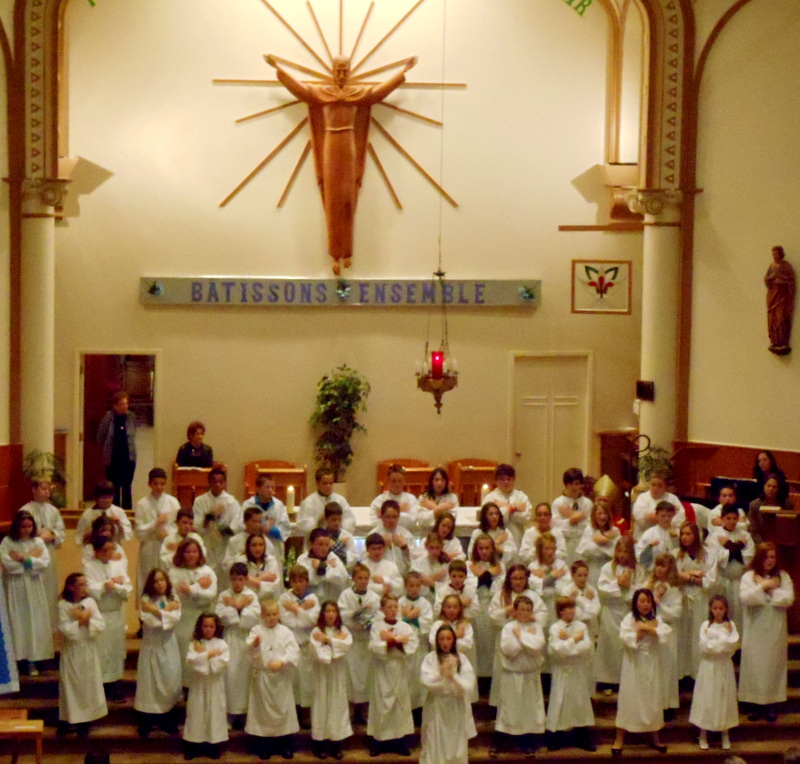
LES CONFIRMATIONS:
ST. LOUIS DE MONTFORT (OTTAWA)


C’est vraiment le temps pour la confirmation des jeunes. Voici des photos de deux célébrations tenues samedi passé.


SAINTE EUPHEMIE (CASSELMAN):


Wednesday, November 21, 2012

The Presentation of Mary in the Temple - Christ the King (Year B)

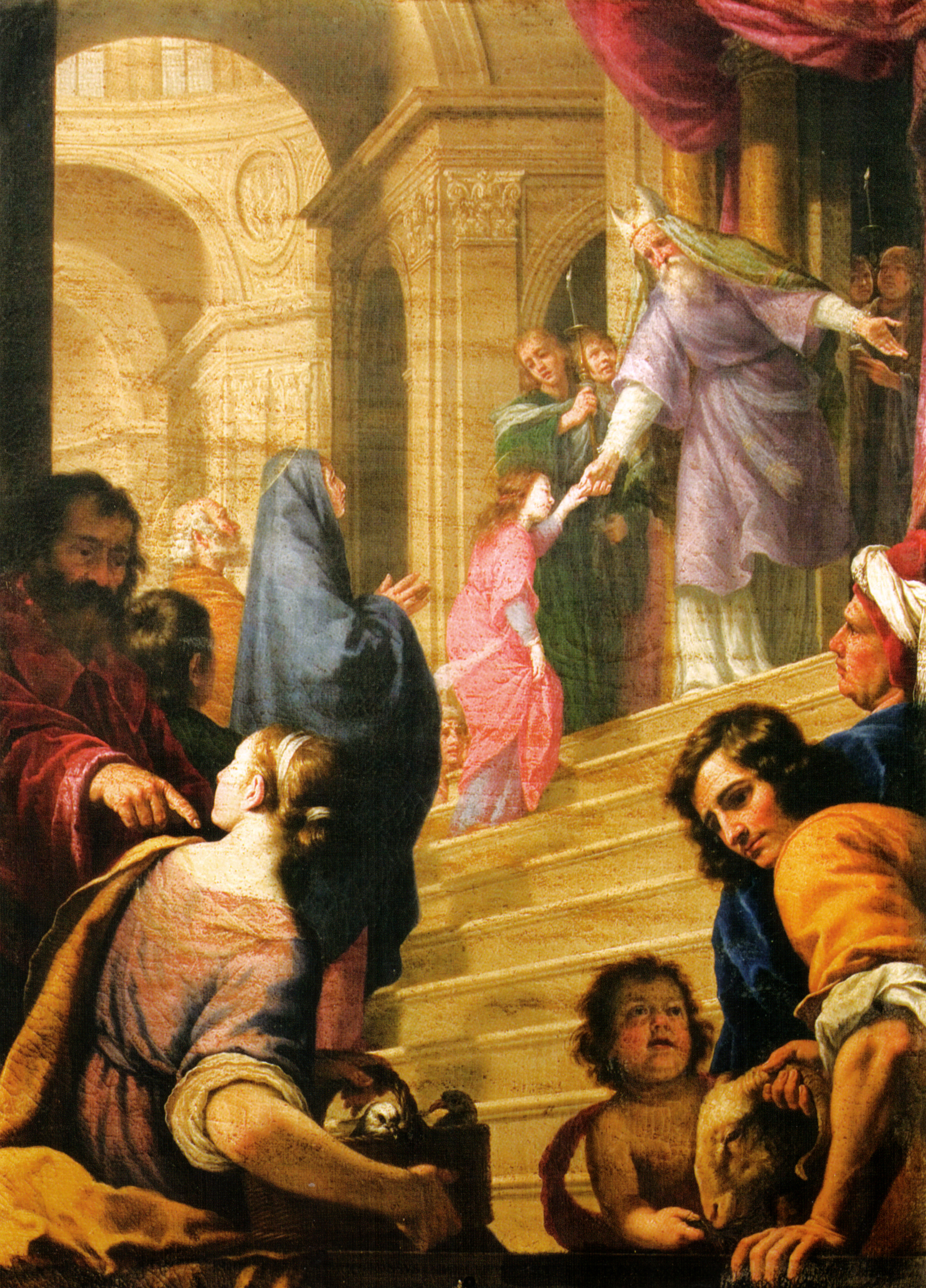
Alfonso Boschi (Florence, 1615-1649), The Presentation of Mary in the Temple

The Presentation of Mary

Today the Church celebrates the memorial of the Presentation of Mary. The three feasts of the birthday of Our Lady, the Holy Name of Mary and her Presentation in the Temple correspond in the Marian cycle with the first three feasts of the cycle of feasts of our Lord: namely, Christmas, the Holy Name of Jesus, and His Presentation in the Temple (February 2).

"Sacred Scripture contains no text concerning the event commemorated in today's liturgy. For something of a historical background one may consult the apocryphal works, particularly the Protoevangel of St. James (ch. 4:1ff). After an angel had revealed her pregnancy, Anna is said to have vowed her future child Mary to the Lord. Soon after birth the infant was brought to the sacred precincts at which only the best of Israel's daughters were admitted. At the age of three she was transferred to the temple proper (7:2). According to legend, here she was reared like a dove and received her nourishment from the hand of an angel (8:1).

"In the East, where the feast, celebrated since the eighth century, is kept as a public holiday, it bears the name, 'The Entrance of the Mother of God into the Temple'. It was introduced at Rome by a Cypriotic legate to the papal court of Avignon in 1371. In 1472, Sixtus IV extended its observance to the whole Church. Abolished by Pius V, it was reintroduced some years later (1585)." [from Pius Parsch, The Church's Year of Grace]

As we venerate the glorious memory of the most holy Virgin Mary, grant, we pray, O Lord, through her intercession, that we, too, may merit to receive from the fullness of your grace. Through our Lord Jesus Christ, your Son, who lives and reigns with you in the unity of the Holy Spirit, one God, for ever and ever.

* * * * * *

Christ the King (34th Sunday) (Year “B”) - November 25, 2012


“LOOK! JESUS CHRIST COMING WITH THE CLOUDS”
[Daniel 7.13-14 [Psalm 93]; Revelation 1.5-8; John 18.33b-37]

Today brings the current liturgical year to an end. Today's solemnity focuses on Christ the King and, particularly, on his coming in glory at the end of time, the Parousia.

The Book of Daniel is a prophetic writing that sought to interpret events that took place around the time of the Maccabean uprising against King Antiochus IV (about 165 B.C.) In this writing, Daniel witnessed—in revelatory dreams—the conquest by God's people of mighty earthly empires symbolized by a lion, a bear, a leopard and a final beast who was fearsome and utterly devoured its victims, trampling everything underfoot (Daniel 7.1-8).

When all seemed hopeless on earth, Daniel's prophetic dream shifted to the court of heaven, where a mysterious figure, “one like a human being” (literally “one like a son of man”), was seen “coming with the clouds of heaven”. After this figure had approached “the Ancient One” (that is, God), dominion, glory and kingship were given to him so that “all peoples, nations and languages should serve him”.

Apocalyptic literature such as the Book of Daniel was generally written in a code that simultaneously revealed truths to those with insight into the message and concealed its truth from enemies and others who were not to be let in on the communication.

The elasticity of the symbols has allowed Daniel's message to be interpreted as applying to various historical eras. In the New Testament period, Israel's enemy became identified with Rome. During the American Revolution, Christians believed their intended enemy was clearly identified as King George III, while during the French Revolution other Christians just as assuredly understood the enemy of believers to be Louis XIV.

In the gospels, Jesus regularly referred to Himself as “the Son of Man”, a term pointing both to his humanity and his exalted status within God's Kingdom. Indeed, Jesus' usage of this title has been understood as a veiled claim to divine Sonship. And to the role he would exercise at the end of time by ushering in the Final Days and presiding at the Last Judgment. Then as the Son of Man, Jesus Christ would completely defeat the power of sin and death, whose reign have, in principle, been toppled through his paschal mystery.

This is also the point being made by John, the Seer of Patmos, in the reading from Revelation, a key apocalyptic text of the early church. The One to come “with the clouds”—likely to be understood as a sign of divine power—is the same Jesus Christ who had been “pierced” on the Cross, that moment when he “freed us from our sins by his blood”.

Indeed, by his passion, death and resurrection, Jesus has been constituted the “faithful witness, the firstborn of the dead, and the ruler of the kings of the earth”.

In the Fourth Gospel drama that was played out in the Roman procurator's chambers, Jesus seemed anything but regal. But as the encounter between Jesus and Pilate came to its conclusion, Pilate the judge was undergoing judgment by the accused who stood in his presence, Jesus of Nazareth (cf. John 18.28-19.16). By answering Pilate's question (“Are you the King of the Jews?”) with another question (“Do you ask this on your own, or did others tell you about me?”), Jesus turned the tables on Pilate and positioned himself as interrogator.

After showing disdain for Jews, Pilate inquired about Jesus' status and activity (“Are you a king? ... What have you done?”) Jesus described the nature of his kingship (“My kingdom is not from this world”), underscoring the difference between belonging to God's kingship and to one only of this world.

Unlike the realm of Rome that Pilate served, Jesus' kingship was not secured by force. Without directly affirming or denying Pilate's question whether he was a king (“You say that I am a king... for this I came into the world, to testify to the truth”), Jesus went on to describe those who have pledged him allegiance: “Everyone who belongs to the truth listens to my voice”.

Tuesday, November 20, 2012

Messe avec la Communauté malgache d'Ottawa - Monthly Malagasy Community Mass


Le 11 novembre j’ai participé dans la messe mensuelle de la communauté catholique de Madagascar à l’église Holy Canadian Martyrs, rue Main, Ottawa. Après, il y a avait une réception.  [Photos: L'abbé Francis Jaozanaka, OFM Cap.]

On Sunday, November 11, I joined the Malagasy community at a special Mass to commemorate the canonization of the first saint of Madagascar, the Jesuit martyr St. Jacques Berthieu. The community gathers on the second Sunday of the month at Canadian Martyrs Church.

The liturgy was initiated by and is sustained by priest graduate students in the Capital region, such as currently by Jesuit Father Hasiniaina Rakotoarisoa, a doctoral student in Canon Law at St. Paul’s University.


Monday, November 19, 2012

Restless Heart Film a Success - Quo Vadis Group Meets Too


There was a wonderful turn-out for the film on St. Augustine's Confessions--some 600!

A good and joyful event that adds an attractive dimension to our archdiocesan Year of Faith observances. 

Kudos to English Sector Youth Office Director Ted Hurley and Fr. Tim Mccauley for their labours with Ottawa Family Cinema at Notre Dame High School to make it happen.

Some other photos:


* * * * * *

QUO VADIS SUPPER


This month's vocational discernment gathering (Quo Vadis?) met at the Newport on Richmond Road prior to the film. 

Some priests and seminarians joined in for the fish and chips Friday repast.


Sunday, November 18, 2012

The Risen Lord Is Coming!


On this [next to] last Sunday of the liturgical year, Jesus’ discourse about the end times (in technical terms, his “eschatological” discourse) is proOn claimed at Mass (cf. Mark 13:24-32). This discourse is also found, with some variations, in Matthew and Luke, and it is probably the most difficult text in the Gospels.

This difficulty derives both from the content and the language: Jesus speaks of a future that is beyond our categories, and because of this Jesus uses images and words taken from the Old Testament, but, importantly, he inserts a new center, namely, himself, the mystery of his person and his death and resurrection.

Today’s passage too opens with some cosmic images of an apocalyptic nature: “The sun will be darkened, the moon will no longer give its light, the stars will fall from the sky and the powers in the skies will be shaken” (Mark 13:24-25); but this element is relativized by what follows: “Then the Son of Man will come upon the clouds in the sky with great power and glory” (13:26). The “Son of Man” is Jesus himself, who links the present with the future; the ancient words of the prophets have finally found a center in the person of the Messiah of Nazareth: he is the central event that, in the midst of the troubles of the world, remains the firm and stable point.

Another passage from today’s Gospel confirms. Jesus says: “The sky and the earth will pass away but my words will not pass away” (13:31). In fact, we know that in the Bible the word of God is at the origin of creation: all creatures, starting with the cosmic elements – sun, moon, sky – obey God’s Word, they exist insofar as they are “called” by it.

This creative power of the divine Word (“Parola”) is concentrated in Jesus Christ, the Word (“Verbo”) made flesh, and also passes through his human words, which are the true “sky” that orients the thought and path of man on earth. For this reason Jesus does not describe the end of the world and when he uses apocalyptic images he does not conduct himself like a “visionary.”

On the contrary, he wants to take away the curiosity of his disciples in every age about dates and predictions and wishes instead to give them a key to a deep, essential reading, and above all to indicate the right path to take, today and tomorrow, to enter into eternal life. Everything passes – the Lord tells us – but God’s Word does not change, and before this Word each of us is responsible for his conduct. It is on this basis that we will be judged.

Dear friends, even in our times there is no lack of natural calamities, nor, unfortunately, of war and violence. Today too we need a stable basis for our life and our hope, much more because of the relativism in which we are immersed. May the Virgin help us to accept this center in the Person of Christ and in his Word. [Benedict XVI, Angelus Message, November 18, 2012]

* * *

Grant us, we pray, O Lord our God, the constant gladness of being devoted to you, for it is full and lasting happiness to serve with constancy the author of all that is good. Through our Lord Jesus Christ, your Son, who lives and reigns with you in the unity of the Holy Spirit, one God, for ever and ever.


Saturday, November 17, 2012

Memorial: St. Elizabeth of Hungary


St. Elizabeth of Hungary

Elizabeth was the daughter of the Hungarian King Andrew II. At the age of four (b. 1207), she was brought to the court of her future husband, Ludwig, landgrave of Thuringia. After her marriage in 1221, she very conscientiously fulfilled her duties both toward her husband and as a servant of God. During the night she would rise from bed and spend long periods in prayer.

Zealously she performed all types of charitable acts; she put herself at the service of widows, orphans, the sick, the needy. During a famine she generously distributed all the grain from her stocks, cared for lepers in one of the hospitals she established, kissed their hands and feet. For the benefit of the indigent she provided suitable lodging.

After the early death of her husband (in 1227 while on a crusade led by Emperor Frederick II), Elizabeth laid aside all royal dignities in order to serve God more freely. She put on simple clothing, became a tertiary of St. Francis, and showed great patience and humility. Nor was she spared intense suffering – the goods belonging to her as a widow were withheld, she was forced to leave Wartburg. In Eisenach no one dared receive her out of fear of her enemies. Upon much pleading a shepherd of the landgrave permitted her to use an abandoned pig sty. No one was allowed to visit or aid her; with her three children, of whom the youngest was not more than a few months old, she was forced to wander about in the winter's cold.

In 1228 she took the veil of the Sisters of the Third Order of St. Francis at Marburg and there built a hospital with some property still belonging to her. She retained for herself only a small mud house. All her strength and care were now devoted to the poor and the sick, while she obtained the few things she needed by spinning. Young in years but rich in good works, she slept in the Lord in 1231, only twenty-four years old.  [Pius Parsch, The Church's Year of Grace]

* * *

O God, by whose gift Saint Elizabeth of Hungary recognized and revered Christ in the poor, grant, through her intercession, that we may serve with unfailing charity the needy and those afflicted. Through our Lord Jesus Christ, your Son, who lives and reigns with you in the unity of the Holy Spirit, one God, for ever and ever.

Friday, November 16, 2012

Journée pastorale sur la croissance de l’Église avec M. Pierre-Alain Giffard - OM: Saint Margaret of Scotland or Saint Gertrude


Mercredi, le secteur français a tenu une journée pastorale avec M. Pierre-Alain Giffard, du diocèse de Valleyfield, comme conférencier: son sujet la croissance des églises et l'importance de la mission d'évangéliser dans ce processus et aussi l’utilité d'une expression de la vision de la congrégation comme principe de base pour attirer des bénévoles de la paroisse pour aller chercher les brebis disparus. Voici quelques photos prises à l’occasion.


* * * * * *

OPTIONAL MEMORIALS FOR NOVEMBER 16


Father Alexander Lucie-Smith is a Maltese priest and a Doctor of Moral Theology who writes an occasional column for the Catholic Herald in England on a wide variety of issues.  Today's reflection focuses on the saints who may be recalled in an optional memorial this day; I found his linking of the two very interesting.  Here is an excerpt from his article. 


Saint Margaret is Scotland’s only royal saint, famous for her love of the poor and her civilizing influence over her husband. She and Edward the Confessor, and their relative Edward the Martyr, along with Saint Edmund of East Anglia are England’s only royal saints, unless you count Henry VI, who has never been officially canonized. Odd to think that here has not been a canonized royal saint since the Norman Conquest!

The other saint venerated today is Saint Gertrude. Here the literary connection is not to Shakespeare, but to Gerard Manley Hopkins. Gertrude was brought up in a Benedictine monastery and later took vows, and is famous as a mystic and theologian. In his notoriously difficult poem, The Wreck of the Deutschland, Hopkins has these lines about the five drowned nuns:

She was first of a five and came
Of a coifèd sisterhood.
(O Deutschland, double a desperate name!
O world wide of its good!
But Gertrude, lily, and Luther, are two of a town,
Christ’s lily and beast of the waste wood:
From life’s dawn it is drawn down,
Abel is Cain’s brother and breasts they have sucked the same.)

The point is that Saint Gertrude was supposedly born in Eisleben in Saxony, the town that was later to produce Martin Luther. Hopkins’ way of describing Luther would perhaps not be considered very ecumenical nowadays.

* * *

 O God, who made Saint Margaret of Scotland wonderful in her outstanding charity towards the poor, grant that through her intercession and example we may reflect among all humanity the image of your divine goodness. Through our Lord Jesus Christ, your Son, who lives and reigns with you in the unity of the Holy Spirit, one God, for ever and ever.

* * *


O God, who prepared a delightful dwelling for yourself in the heart of the Virgin Saint Gertrude, graciously bring light, through her intercession, to the darkness of our hearts, that we may joyfully experience you present and at work within us. Through our Lord Jesus Christ, your Son, who lives and reigns with you in the unity of the Holy Spirit, one God, for ever and ever.