Monday, April 16, 2012

Happy 85th, Holy Father! - The Reception of Some Anglicans into Full Communion with the Church

Peter Paul Rubens, St. Peter as Pope (c. 1611)

This is a week of milestones for the Holy Father. 

Today is Pope Benedict XVI's 85th birthday and the 85th anniversary of his baptism (he was born on Holy Saturday morning and his parents took him straight over to the church for they knew that the new baptismal water had just been blessed). 

Thursday, April 19, is the seventh anniversary of his election as pope. We rejoice with him and keep him in our thoughts and prayers: Ad multos annos!

O God, who chose your servant Benedict in succession to the Apostle Peter as shepherd of the whole flock, look favourably on the supplications of your people and grant that, as Vicar of Christ on earth, he may confirm his brethren and that the whole Church, may be in communion with him in the bond of unity, love and peace, so that in you, the shepherd of souls, all may know the truth and attain life eternal.  Through our Lord Jesus Christ....


* * * * *

THE RECEPTION OF ANGLICANS INTO FULL COMMUNION
ST. PATRICK’S BASILICA—OTTAWA, ONTARIO
ON DIVINE MERCY SUNDAY
The Second Sunday of Easter–Year “B”–April 15, 2012
[Texts: Acts 4.32–35 [Psalm 118]; 1 John 5.1–6; John 20.19–31]


Dear brothers and sisters in Christ,

“Behold, how good and pleasant it is when brothers dwell in unity!

It is like the precious oil upon the head, running down upon the beard, upon the beard of Aaron, running down on the collar of his robes!

It is like the dew of Hermon, which falls on the mountains of Zion! For there the LORD has commanded the blessing, life for evermore.”

Some scholars believe that Psalm 133 was used to dedicate the second temple. Clearly, God blesses unity, and God is pleased today. Today, the Body of Christ is a little more healed, a little more unified. Today, after half a millennium, separated brethren are separated no more! We are brethren, rejoicing at the same banquet table! Hallelujah!

In the opening words of his document Anglicanorum coetibus, Pope Benedict foretold this afternoon’s celebration:

“In recent times, the Holy Spirit has moved groups of Anglicans to petition repeatedly and insistently to be received into full Catholic communion individually as well as corporately. The Apostolic See has responded favourably to such petitions. Indeed, the successor of Peter, mandated by the Lord Jesus to guarantee the unity of the episcopate and to preside over and safeguard the universal communion of all the Churches, could not fail to make available the means necessary to bring this holy desire to realization.”

After a long journey, we will soon receive a significant number of Anglicans into full communion with the Roman Catholic Church. As you may know, Cardinal Thomas Collins is responsible for implementing Anglicanorum coetibus in Canada. Msgr. Jeffrey Steenson is head of the United States Ordinariate, with which Canadian Anglicans will be associated. I am overjoyed to be a part of your journey today and to welcome members of the Anglican Catholic Church of Canada into full communion with the Roman Catholic Church.

This celebration takes place on the eighth day of Easter, a solemn end to the first period of the “Great Fifty Days” during which the Church universal celebrates the mystery of the Resurrection of Jesus Christ, until its conclusion at Pentecost. The chronology groups the early Church’s experience of the Risen Lord into three milestones: Jesus’ resurrection, his ascension, and the gift of the Holy Spirit. This follows Luke’s pattern in the Acts of the Apostles.

The Fourth Gospel emphasizes the underlying unity of these same mysteries of the risen Lord Jesus Christ. Today’s gospel notes that on the evening of the day of his resurrection, Jesus conferred the Spirit on the disciples and the authority to forgive sins in Jesus’ name.

In John the Evangelist’s perspective, Jesus’ new, risen life; the conferral of the Spirit; and the proclamation and celebration of the forgiveness of sins; are intimately connected. To anyone who thinks that the sacrament of penance is a bit of a downer, please note that it was given to the Church on the most joyous day in history!

The account of Jesus’ meeting with Thomas explores the notion of the healing of memories associated with forgiveness. When the disciples told Thomas of their meeting with Jesus, he could remember only Jesus’ suffering and death. This painful memory did not allow Thomas to grasp, and rejoice in, the resurrection.

On such an occasion as this, both Anglicans and Roman Catholics will have memories, painful or bittersweet, of communal and individual experiences. Please ask the Holy Spirit to heal those memories. The healing may be gradual, but it is an important part of the reconciliation process.

Thomas has done a favour to generations of believers prone to his outlook. Known as the Twin, Thomas appeared earlier in the Fourth Gospel. He presents himself as a loyal but pessimistic follower of Jesus, ready to die with him (John 11.16). At the Last Supper, he found it difficult to follow Jesus’ train of thought and plainly told him so (14.5).

Thomas’s doubt raises the issue of the link between seeing and believing. In his gentle handling of Thomas, we can see how Jesus addresses the doubts, fears and concerns of his disciples: “Reach out your hand and put it in my side. Do not doubt but believe.”

The challenge to believe evokes from Thomas a most profound expression of faith in Jesus’ identity: “My Lord and my God!” It is a prayer that has found a place on the lips of Christians down the ages. Jesus’ response encourages Christians living in times after the Ascension: “Blessed are those who have not seen and yet have come to believe.”

On April 30—the Second Sunday of Easter in the Great Jubilee Year 2000—in his homily at the canonization of St. Faustina Kowalska, Pope John Paul II declared that this Sunday “from now on throughout the Church will be called Divine Mercy Sunday.”

The liturgy points to the path of mercy. God’s mercy invites each person to go to Him. It also creates new relations of fraternal solidarity among human beings.

In a meditative and circular style of presentation, the First Epistle of John captures the thrust of God’s infinite mercy. It speaks of a circuit of love moving between God and the one “born of God.” In his view, this dynamic interchange must overflow into love of one’s neighbour who, in turn, comes to love God.

The supreme expression of love is the self-sacrificing gift made by Jesus “who came by water and blood.” “Water and blood” can mean several things.

“Water” may represent Christian baptism and “blood” the Eucharist. These are the primary ways in which disciples encounter Jesus sacramentally.

“Water” and “blood” recall a controversy about how Holy Communion should be interpreted in the early church. This was reported by St. Cyprian, bishop of Carthage in North Africa, from about AD 249 until his martyrdom in 258.

In speaking of the Eucharist, Cyprian recalls the union of the people with their Lord. Cyprian suggests that the water in the cup represents the people of God. The wine, of course, is the shed blood of the Saviour. When the priest mixes the water with the wine in the cup, it depicts the unbreakable union of love that Christians have with one another and with their Lord. It is therefore improper to use either water or wine alone. Similarly, the bread that is broken consists of “wheat gathered and ground down and kneaded together” with water to form one loaf. For Cyprian, the Eucharist is a powerful experiential witness to the “sworn bond” (the sacramentum) that binds together believers as one body in Christ.*

This was important for Cyprian as he sought to deal with communities in the North African churches that departed from, but were later reconciled with, the full church. For Cyprian, the uniting of the community in Christ became the major function of the Eucharist, as it will be for all of us sharing in Holy Communion this afternoon.


I commend the courage and fortitude of our brothers and sisters of the Anglican Catholic Church of Canada; your journey has not been easy. I commend your humility and your sacrifice; you have suffered much. I commend your tradition and your zeal; you will bless and strengthen the Roman Catholic Church by your presence.

You are not just favoured guests. This is your home. We love you. I love you. May our public witness of unity draw many from the edges of faith into God’s Kingdom, no longer subject to judgement but to Divine Mercy.  Amen.
_________
* Cf. HAYKIN, Michael A.G., Rediscovering the Church Fathers – who they were and how they shaped the Church [Wheaton, IL: Crossway Press, 2001], p.97.

Sunday, April 15, 2012

Second Sunday of Easter or of the Divine Mercy - Easter Visit to the "Lift Jesus Higher" Community


Caravaggio's amazing "Incredulity of St. Thomas," dated around 1602,  brings to life the scene of Thomas' encounter with the risen Jesus mentioned in John 20:26-29, where Thomas is invited to touch Jesus' wounds with his own finger and hand.

* * * * * *

THE SUNDAY OF DIVINE MERCY


Jesus, I trust in you
Jesus, j'ai confiance en toi

God of everlasting mercy, who in the very recurrence of the paschal feast kindle the faith of the people you have made your own, increase, we pray, the grace you have bestowed, that all may grasp and rightly understand in what font they have been washed, by whose Spirit they have been reborn, by whose Blood they have been redeemed. Through our Lord Jesus Christ, your Son, who lives and reigns with you in the unity of the Holy Spirit, one God, for ever and ever.
* * *
Dieu de miséricorde infinie, tu ranimes la foi de ton peuple par les célébrations pascales ; augmente en nous ta grâce pour que nous comprenions toujours mieux quel baptême nous a purifiés, quel Esprit nous a fait renaître, et quel sang nous a rachetés.


* * * * * *


EASTER MASS
AT LIFT JESUS HIGHER


On Easter Sunday, I joined the members of "Lift Jesus Higher", a charismatic community that worships at St. Ignatius Church in the Overbrook neighbourhood of Ottawa under the spiritual leadership of Father Bob Poole, pastor of St. Philip's, Richmond and St. Clare's, Dwyer Hill.

Here are some photos, taken by Robert Du Broy of the celebration and reception afterwards:


Saturday, April 14, 2012

Samedi de Paques - Easter Saturday - Holy Thursday Photos - Images du Jeudi saint


O God, who by the abundance of your grace give increase to the peoples who believe in you, look with favor on those you have chosen and clothe with blessed immortality those reborn through the Sacrament of Baptism. Through our Lord Jesus Christ, your Son, who lives and reigns with you in the unity of the Holy Spirit, one God, for ever and ever.

* * * * * *

Dieu qui donnes sans cesse ta grâce pour augmenter le nombre de tes enfants, veille sur ceux que tu viens d’agréger à ton peuple ; ils ont pris naissance dans le baptême : qu’ils soient revêtus de l’immortalité du Christ, pour se présenter à la table de ses noces. Lui qui règne.


* * * * * *


HOLY THURSDAY AT THE CATHEDRAL
JEUDI SAINT A NOTRE-DAME


Photos: Jean-Claude Grant

Friday, April 13, 2012

Friday in Easter Week - Vendredi de Paques - Easter Vigil Photos

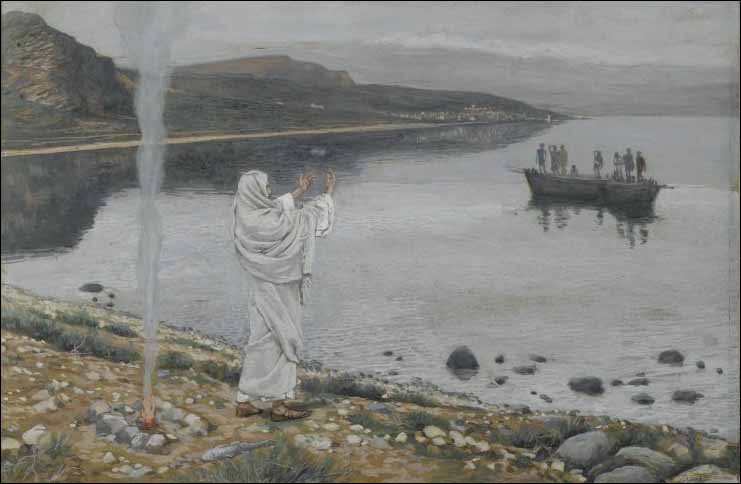
James Tissot (1836-1902), Jesus Appears by the Sea of Galilee


MYSTAGOGIA:
APPROPRIATING
THE CHRISTIAN MYSTERIES


Above are the neophytes: those baptized, confirmed and given Holy Communion at the Easter Vigil along with members of the Cathedral's RCIA team and one of the four additional members of our faith community who were confirmed that night.

Below are several other photos (courtesy of Jean-Claude Grant) of opening moments of the Vigil itself and other photos taken afterwards.  Accompanying the photos are Cyril an excerpt from  St. Cyril of Jerusalem's Catecheses in which he helps put into words what the newly initiated have undergone (it is the selection from today's Office of Readings).


The Catecheses of Cyril of Jerusalem


When we were baptized into Christ and clothed ourselves in him, we were transformed into the likeness of the Son of God. Having destined us to be his adopted sons, God gave us a likeness to Christ in his glory, and living as we do in communion with Christ, God’s anointed, we ourselves are rightly called “the anointed ones”. When he said: Do not touch my anointed ones, God was speaking of us.

We became “the anointed ones” when we received the sign of the Holy Spirit. Indeed, everything took place in us by means of images, because we ourselves are images of Christ. Christ bathed in the river Jordan, imparting to its waters the fragrance of his divinity, and when he came up from them the Holy Spirit descended upon him, like resting upon like.

So we also, after coming up from the sacred waters of baptism, were anointed with chrism, which signifies the Holy Spirit, by whom Christ was anointed and of whom blessed Isaiah prophesied in the name of the Lord: The Spirit of the Lord is upon me, because he has anointed me. He has sent me to preach good news to the poor.


Christ’s anointing was not by human hands, nor was it with ordinary oil. On the contrary, having destined him to be the Saviour of the whole world, the Father himself anointed him with the Holy Spirit. The words of Peter bear witness to this: Jesus of Nazareth, whom God anointed with the Holy Spirit. And David the prophet proclaimed: Your throne, O God, shall endure for ever; your royal sceptre is a sceptre of justice. You have loved righteousness and hated iniquity; therefore God, your God, has anointed you with the oil of gladness above all your fellows.

The oil of gladness with which Christ was anointed was a spiritual oil; it was in fact the Holy Spirit himself, who is called the oil of gladness because he is the source of spiritual joy. But we too have been anointed with oil, and by this anointing we have entered into fellowship with Christ and have received a share in his life. Beware of thinking that this holy oil is simply ordinary oil and nothing else. After the invocation of the Spirit it is no longer ordinary oil but the gift of Christ, and by the presence of his divinity it becomes the instrument through which we receive the Holy Spirit. While symbolically, on our foreheads and senses, our bodies are anointed with this oil that we see, our souls are sanctified by the holy and life-giving Spirit.


Thursday, April 12, 2012

Easter Sunday 2B - Jesuit Father Frederick E. Crowe, Lonergan Scholar and Theologian


Duccio di Buoninsenga, The Appearance behind Locked Doors (AD 1308)


Second Sunday of Easter (Year “B”) - April 15, 2012
“THERE WAS NOT A NEEDY PERSON AMONG THEM”
[Texts: Acts 4.32-35 [Psalm 118]; 1 John 5.1-6; John 20.19-31]


Jesus' resurrection unleashed extraordinary energy not only in the universe but also among his disciples. The Acts of the Apostles relates how the early church was moved by the Spirit of Jesus released among them to share their lives and possessions in common.

Luke describes the harmonious life of the early Christians to edify subsequent generations. Despite the idealized portrait of the early Church, there were different views about how people should handle their possessions. Luke does not suggest that all believers had to dispose of their assets. Clearly not all did.

Each person had to respond to the gospel message as he or she was moved by the Spirit. It is this openness to the Holy Spirit, resulting in joy and mutual support, that gives evidence that God's blessing rested on the Church (“and great grace was upon them all”).

The yearning of Greeks for “koinonia” (fellowship in sharing material and spiritual goods) and Jewish zeal that social justice permeate the lives of God's people (“there was not a needy person among them”) are fulfilled in the summary description of the community's life-style. The hinge anchoring these two dimensions and motivating their communal sharing was the apostles' powerful testimony to the resurrection of Jesus.

The Church invites Christians to celebrate the mystery of the Resurrection for the “Great Fifty Days” before Pentecost. This chronology, which separates the early Church's experience of the Risen Lord's presence into discrete moments (Jesus' resurrection, ascension and gift of the Spirit), owes much to the Lukan schema in Acts.

The Fourth Gospel stresses the underlying unity of these same mysteries of the risen Lord. Today's gospel notes that on the evening of the day of his resurrection (“the first day of the week”) Jesus conferred the Spirit on the disciples (“Receive the Holy Spirit”) and the authority to forgive sins in Jesus' name (“If you forgive the sins of any they are forgiven them; if you retain the sins of any, they are retained”).

In John the Evangelist's perspective, Jesus' risen life—the conferral of the Spirit and the proclamation and celebration of the forgiveness of sins—all are intimately connected. Though not stated explicitly, John implies that Jesus' ascension to the Father took place on Easter Day soon after his encounter with Mary Magdalene in the garden.

In a symbolic action, Jesus breathed on his apostles, a gesture reminiscent of God's breathing into Adam's nostrils the breath of life (Genesis 2.7). So, the formation of the Church at Easter is a kind of new creation. The disciples are created anew to fulfil a mission to the whole world, preaching repentance and the forgiveness of sins in anticipation of God's kingdom. Those who respond to the Church's preaching receive the forgiveness of their sins (“if you forgive the sins of any, they are forgiven them”). Those refusing the message thereby choose to remain in their sins (“if you retain the sins of any, they are retained.”)

Thomas, known as the Twin, appeared earlier in the Fourth Gospel where he was seen as a loyal but pessimistic follower of Jesus, ready to die with him (John 11.16). At the Last Supper, he found it difficult to follow Jesus' train of thought and was unembarrassed to tell him so (14.5).

We are not told why Thomas was absent on that evening when Jesus came to commission his disciples. But Christians in every age have found in his words (“unless I see the mark of the nails in His hands ... I will not believe”) an echo of their own struggle to believe in a Jesus they have not seen but have heard much about.

A week later, Jesus' sensitivity to Christian doubt met Thomas' concern by inviting him to touch his hands and put his hand into his side. With this came a challenge that we may translate as “Stop being an unbeliever; show yourself a believer”.

One tradition, narrated by Ignatius of Antioch, says Thomas did put out his finger and his hand and touched Jesus. The gospel narrative suggests only that Thomas was overwhelmed by Our Lord's kindness to him. In an act of supreme irony, the biggest sceptic expresses the greatest confession about Jesus, “[You are] my Lord and my God!”

* * * * * *
 
 
REVEREND FREDERICK E. CROWE, S.J.


Frederick E. Crowe, SJ
July 5, 1915 - April 8, 2012


Father Fred Crowe was my professor when I studied the Trinity; we also lived together in the Pedro Arrupe Community for several years when I was Rector of Regis College. His life work was the interpretation of the writings of his fellow Jesuit Bernard J. F. Lonergan, a native of Buckingham, Quebec (at that time part of the Archdiocese of Ottawa). He has relatives and friends in the Saint John, NB area as well as in the Montreal, Ottawa and Toronto areas, to all of whom I offer my sympathy.  His wake will take place in the St. Joseph Chapel at Regis College, 100 Wellesley St. West, Toronto, on Monday, April 16 from 2:00-4:00 and 7:00-9:00 PM; the funeral Mass will be celebrated there on Tuesday, April 17 at 11 o'clock. R.I.P.

The following is an adaptation of the obituary provided by the Jesuits in English Canada and the Lonergan Research Institute:


Father Frederick E. Crowe died peacefully on Easter Sunday, April 8, 2012, at René Goupil House, Province Infirmary, Pickering, Ontario, in the 97th year of his life and the 76th year of his religious life.

Frederick Crowe was born on July 5, 1915, in Jeffries Corner, New Brunswick, the son of Jeremiah Crowe and Margaret (Mahoney). He attended high school in Sussex, NB, and then received a Bachelor of Science degree in Electrical Engineering from the University of New Brunswick in 1934.

After entering the Guelph novitiate on September 6, 1936, he studied philosophy at the Jesuit Seminary in Toronto from 1940 to 1943 and did a teaching stint at Saint Mary’s University in Halifax from 1943 to 1946, then returned to Toronto for theological studies at the Jesuit Seminary (1946 to 1950).

Ordained a priest in Toronto on June 27, 1949, he pursued doctoral studies in theology at Rome’s Gregorian University from 1951 to 1953. On his return to Canada, he joined the faculty of the Jesuit Seminary in 1953 and taught there and at Regis College until he retired from teaching at age 65, when he became Professor Emeritus and devoted his energies full-time to research and writing.

Father Crowe served as President of Regis College from1969 to 1971, then became the first Director of the Lonergan Research Institute (LRI) in 1985, and served in that capacity until 1992.

From 1992 to 2006 he continued work at the LRI as one of the General Editors of the Collected Works of Bernard Lonergan and as author of numerous writings. He lived in the Regis Jesuit Community, notably at Pedro Arrupe House from 1983 until 2006 when he transferred to the Jesuit Infirmary in Pickering.

Father Fred discovered his principal work during his years studying theology in Toronto in the late 1940s. For it was then that he became a student not only of theology but in particular of the work of Bernard Lonergan, who was on the faculty of the Jesuit Seminary at the time. When Fr Lonergan left Toronto for the Gregorian University in 1953, he assumed the task of preparing the index for Insight, a book that for all practical purposes was complete at the time, even if it was not published until 1957.

Slowly he began the task of collecting the data on Lonergan’s work after Father Lonergan entrusted to him a number of his papers in 1953 and another set in 1972. These became the first instalments of the Lonergan Archive, the basic research source in the Lonergan Center that Father Crowe established at Regis College in 1970. However, the Center contained much more: dissertations, articles, and books written on Lonergan or using his work, along with audio recordings of lectures by Lonergan. In 1985 the Center became the Lonergan Research Institute.

Father Crowe oversaw the establishment of this distinct institution and was its Director in the early years of its existence. In 1986, he signed a contract with University of Toronto Press for the publication of the Collected Works of Bernard Lonergan, a project for which, with Father Robert Doran, he served as General Editor. He will be remembered as the foremost Lonergan scholar of the twentieth century and as the person without whom Lonergan’s work would not have become as accessible as it is.

There is a large international community grateful to him for what he did to make the Lonergan legacy possible. But his work is not limited to promoting the writings of his great teacher. The list of publications in his own name comes to roughly 200 items, including books and articles. His work involved in teaching Trinitarian theology is legendary. Some of his writings are landmark interpretations of Lonergan’s work, but some are original contributions, including a few that will achieve status as permanent advances in systematic theology. Among the latter is the work he did interpreting and advancing Lonergan’s later thought regarding the Christian approach to world religions.

Father Crowe also owns the distinct achievement of having published an original book at the age of 90, Christ in History: The Christology of Bernard Lonergan from 1935 to 1982. This book is an indispensable guide to the development of Lonergan’s thought on Christology.

Wednesday, April 11, 2012

Mercredi de Paques - Easter Wednesday - A Young Jesuit Photographer on the Titanic


Dieu qui nous donnes chaque année la joie de fêter la résurrection du Seigneur, ouvre-nous, à travers ces fêtes d'ici-bas, le chemin vers la joie éternelle. Par Jésus le Christ notre Seigneur, qui règne avec toi et le Saint Esprit, maintenant et pour les siècles des siècles. Amen

 O God, who gladden us year by year with the solemnity of the Lord's Resurrection, graciously grant that, by celebrating these present festivities, we may merit through them to reach eternal joys. Through our Lord Jesus Christ, your Son, who lives and reigns with you in the unity of the Holy Spirit, one God, for ever and ever. Amen.
* * * * * *

TITANIC CENTENNIAL


Father Browne's Titanic Album" was reprinted to mark the centenary of the demise of the massive liner.
(CNS/courtesy Father Browne S.J. Collection)

Since my years in Halifax, where more than 300 victims of the sinking of the Titanic are buried, I have appreciated the significance of the disaster a little more each time I hear its tale.

Over the years I have also heard on numerous occasions the story of a Jesuit scholastic (seminarian) who was on the first leg of the ship's maiden journey but who left it before the transatlantic portion of the voyage that ended in calamity. 

Mr. (later Father) Francis Browne became famous for some of the photos he took--as well as many others in his lifetime of ministry--of the very human moments on Titanic. 

The following CNS story fills in many of the details:

Jesuit seminarian took photographs of Titanic's infamous voyage
By Sarah MacDonald
Catholic News Service

DUBLIN (CNS) - Commemorations of the sinking of the Titanic 100 years ago will put the spotlight on a young Irish priest whose photographs are some of the only surviving images of life onboard the liner on its first and last voyage.

Jesuit Father Frank Browne, 1880-1960, became a prominent documentary photographer and a much-decorated chaplain in the British army in World War I.

A collection of his photographs, "Father Browne's Titanic Album" has been reprinted to mark the centenary of the demise of the massive liner, which was constructed in Belfast, Ireland, and was believed to be unsinkable.

More than 1,500 people died when it sank April 15, 1912.

The new edition of the book is edited by Jesuit Father Edward O'Donnell, and the foreword is written by Robert Ballard, who first located the ship's wreckage in September 1985, the same month as a chance finding of 42,000 of Father Browne's photographs in the basement of the Jesuits' headquarters in Dublin.

Frank Browne lived an eventful life. As a novice he met Pope Pius X in 1909 when he accompanied his uncle, Bishop Robert Browne of Cloyne, to a private audience at the Vatican. He was also a university classmate of Irish writer James Joyce, who featured the young seminarian as "Mr. Browne the Jesuit" in his masterpiece "Finnegans Wake."

In 1912, the Jesuit novice was still three years from ordination. Because of a gift from his uncle, he was able to experience the Titanic's luxurious accommodation in the initial stages of its maiden voyage, from Southampton, England, to Cherbourg, France, and on to Queenstown, Ireland.

While onboard, the self-taught photographer managed to obtain pictures of the first-class accommodation and dining rooms. He also captured the gymnasium, the library and passengers enjoying a stroll on the promenade, as well as many passengers in third class, recording some of those who would later perish in the freezing waters of the Atlantic. He took the last image of the Titanic's captain, Edward Smith.

Father Browne's images of the ship's accommodation and passengers have been pored over by maritime historians, engineers and filmmakers seeking answers to a tragedy that still grips the public's imagination. Hollywood film director James Cameron used his photographs to re-create sets for his blockbuster movie.

The Jesuit's image of 6-year-old Robert Douglas Spedden playing with his spinning top on the promenade, watched by his father Frederic, is one of the most famous of the collection. Cameron re-created the image in the film.

The young Jesuit photographed the Titanic leaving port for the last time as it left Queenstown, in County Cork, for New York. He could have been onboard: An American couple he befriended on the ship offered to fund the final leg of the journey to New York.

From the Titanic, he sent a telegram to his provincial in Dublin to request permission. However, a frosty telegram awaited him in Queenstown: "Get off that ship."

When news of the Titanic's disastrous fate reached Father Browne, he folded the telegram and put it into his wallet and kept it there for the rest of his life. He later said it was the only time holy obedience had saved a life.
- - -
Editor's Note: "Father Browne's Titanic Album," edited by E.E. O'Donnell (2nd edition 2011), is published by Messenger Publications, www.messenger.ie.

Tuesday, April 10, 2012

Easter Tuesday - Mardi de Paques


O God, who have bestowed on us paschal remedies, endow your people with heavenly gifts, so that, possessed of perfect freedom, they may rejoice in heaven over what gladdens them now on earth. Through our Lord Jesus Christ, your Son, who lives and reigns with you in the unity of the Holy Spirit, one God, for ever and ever. Amen.

* * * * * *
 Dieu qui nous as fait passer de la mort à la vie en nous offrant les sacrements de Pâques, poursuis toujours l’œuvre de ta grâce : que ton peuple trouve une liberté parfaite et parvienne à la joie du ciel dont tu lui donnes déjà le goût sur la terre. Par Jésus Christ… Amen.

* * * * * *

RETREAT / RETRAITE

Les évêques de l’Ontario passent ces jours-ci en retraite au nord de Toronto et confient cette intention a vos prières.

Please pray for the Bishops of Ontario, who are spending these first days of Easter Week on retreat north of Toronto.