Thursday, December 13, 2012

St Lucy of Syracuse, Virgin-Martyr


Lucie, la brillante, en marche vers la lumière de Noël.

Il est très facile aujourd’hui d’harmoniser la fête du jour avec les pensées de l’Avent. Lucie (en français : la brillante) rentre dans le symbolisme de l’Avent. Au milieu des ténèbres (nous sommes au moment où les jours sont le plus courts) elle « luit » comme une vierge prudente qui va, avec sa lampe allumée, à la rencontre de l’Époux. Lucie est le modèle de l’Église et de l’âme qui doivent revêtir la parure nuptiale pour aller au-devant de l’Époux.

Sainte Lucie. — Jour de mort : 13 décembre, vers 304. Tombeau : à Venise. Image : On la représente avec une épée et deux yeux sur un plat. Sa vie : Lucie est une des plus illustres vierges martyres de l’ancienne Église. Un jour, elle se rendait avec sa mère, qui souffrait d’un épanchement de sang, à Catane pour honorer le corps de sainte Agathe. Elle pria à son tombeau.

Alors la sainte lui apparut en songe et la consola ainsi : « O vierge Lucie, pourquoi me demandes-tu ce que tu peux toi-même accorder à ta mère : ta foi aussi vient à son secours, c’est pourquoi elle est guérie. Tu as par ta virginité préparé à Dieu une demeure agréable » (Brév.). Elle obtint en effet la guérison de sa mère. Aussitôt, elle lui demanda la permission de rester vierge et de distribuer aux pauvres du Christ la dot qui devait lui revenir.

A son retour à Syracuse, elle consacra aux pauvres tout le produit de la vente de ses biens. A cette nouvelle, un jeune homme auquel ses parents avaient, contre son gré, promis sa main, la dénonça comme chrétienne au gouverneur.

« Tu parleras moins », lui dit le gouverneur, « quand une grêle de coups tombera sur toi. »

« Les serviteurs de Dieu », répondit la vierge, « ne manquent jamais des mots qui conviennent, car c’est le Saint-Esprit qui parle par notre bouche.

« Est-ce que le Saint-Esprit est en toi ? » lui demanda Paschasius. « Oui », répondit-elle, « tous ceux qui vivent avec piété et chasteté sont les temples du Saint-Esprit. » « C’est bien », reprit le gouverneur, « je te ferai conduire dans une maison de débauche pour que le Saint-Esprit s’éloigne de toi. » « Si tu me fais déshonorer malgré moi », répondit la vierge, « la couronne victorieuse de ma pureté sera doublée. »

Enflammé de colère, le juge ordonna de conduire Lucie dans cette maison, mais Dieu la rendit tellement immobile qu’aucune force ne put la déplacer. Alors on versa sur elle de la poix et de la résine ainsi que de l’huile bouillante, mais comme tout cela ne lui causait aucun mal, on lui trancha la tête avec le glaive. C’est ainsi qu’elle acheva victorieusement son martyre. – Dom Pius Parsch, le Guide dans l’année liturgique

* * * * * *

SAINT LUCY VIRGIN, MARTYR
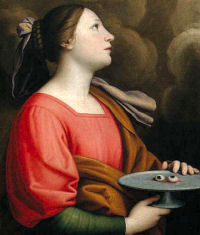
The traditional story of St. Lucy tells us that she was of noble Greek parentage, born in Syracuse, Sicily, and brought up as a Christian by her mother, Eutychia. Although Lucy, like Cecilia, wished to dedicate herself to God, Eutychia arranged for her a marriage with a young pagan. The mother, who suffered from hemorrhage, was persuaded to make a pilgrimage to Catania, to offer prayers at the tomb of St. Agatha.

Lucy accompanied her mother, and their prayers for a cure were answered. Then Lucy made known to Eutychia her desire to give her own share of their fortune to the poor and devote herself to God's service. Eutychia, in gratitude for her cure, gave permission. This so angered the young man to whom Lucy had been unwillingly betrothed that he denounced her as a Christian to the governor, Paschius.

The persecutions instituted by the Emperor Diocletian were then at their height, and when Lucy steadfastly clung to her faith, she was sentenced to prostitution in a brothel. God rendered her immovable and the officers were not able to carry her off to the place of evil. An attempt was then made to burn her, but boiling oil and pitch had no power to hurt her or break her strong spirit. At last she was put to death by the sword.

At Rome in the sixth century Lucy was honored among the other virgin martyrs, and her name was inserted in the Canon of the Mass. A reference to her sanctity occurs in a letter written by Pope Gregory the Great. In the Middle Ages, she was invoked by persons suffering from eye trouble, perhaps because Lucy (in Italian, Lucia) derives from , the Latin word for light. The first church writer to give an account of St. Lucy from her was the English bishop St. Aldhelm of Sherborne at the end of the seventh century.

This saint's relics are venerated at Venice and at Bourges, in France. She is patroness of Syracuse; her emblems are a cord and eyes.

* * *


May the glorious intercession of the Virgin and Martyr Saint Lucy give us new heart, we pray, O Lord, so that we may celebrate her heavenly birthday in this present age and so behold things eternal. Through our Lord Jesus Christ, your Son, who lives and reigns with you in the unity of the Holy Spirit, one God, for ever and ever.
* * * * * *
 
 RECALLING A VISIT TO SIRACUSA
 

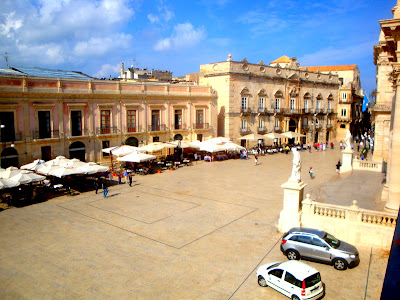
During my time in Italy in October, I was able to travel for several days in Sicily, including to Siracusa, the city of the martyrdom of Santa Lucia. 

Everywhere the legendary Sicilian hospitality was in evidenece: Archbishop Salvatore Pappalardo graciously showed us around his Curia and residence and a hospital chaplain gave us a tour of the cathedral built on the foundations of a pagan temple. 

The church here has existed from earliest times and the cathedral is dedicated to Saints Peter and Paul, the latter having made a three-day stop-over in Syracuse en route to Rome (Acts 28.12) while the former, while in Antioch, is said to have sent the first bishop St. Marcianus to exercise apostolic leadership in the Siracusan Church.

The relics and traditions about St. Lucy are strongly emphasized in the cathedral. 

 Some photos:  


Wednesday, December 12, 2012

Our Lady of Guadalupe - Photos of Immaculate Conception Feast - December 12: Day of Prayer in Solidarity with Indigenous People


JUAN DIEGO AND 'THE MAIDEN'

Then [Juan Diego] dared to go to where the voice was coming from, his heart was not disturbed and he felt extremely happy and contented, he started to climb to the top of the little hill to go see where they were calling him from. And when he reached the top of the hill, where a Maiden was standing, who spoke to him, and who called to him to come hither.

And when he reached where she was, he was filled with admiration for the way her perfect grandeur exceeded all imagination: her clothing was shining like the sun, as if it were sending out waves of light, and the stone, the crag on which she stood, seemed to be giving out rays; her radiance was like precious stones, it seemed like an exquisite bracelet; the earth seemed to shine with the brilliance of a rainbow in the mist.

And the mesquites and nopals and the other little plants that are generally up there seemed like emeralds. Their leaves seemed like turquoise. And their trunks, their thorns, their prickles, were shining like gold. He prostrated himself in her presence. He listened to her voice, her words, which give great, great glory, which were extremely kind, as if she were drawing him toward her and esteemed him highly.

She said to him, "Listen, my dearest-and-youngest son Juan: where are you going?"

And he answered her: "My Lady, my Queen, my Beloved Maiden! I am going as far as your little house in Mexico-Tlatelolco, to follow the things of God that are given to us, that are taught to us by the ones who are the images of Our Lord: our priests."

Then she talks with him, she reveals her precious will, and she says to him: "Know, be sure, my dearest-and-youngest son, that I am the Ever Virgin Holy Mary, mother of the one great God of truth who gives us life, the inventor and creator of people, the owner and Lord of what is around us and what is touching us or very close to us, the owner and Lord of the sky, the Lord of the earth. I want very much that they build my sacred little house here, in which I will show him, I will exalt him on making him manifest; I will give him to the people in all my personal love, in my compassionate gaze, in my help, in my salvation, because I am truly your compassionate mother, yours and of all the people who live together in this land, and of all the other people of different ancestries, those who love me, those who cry to me, those who seek me, those who trust in me, because there I will listen to their weeping, their sadness, to remedy, to cleanse and nurse all their different troubles, their miseries, their suffering. And to bring about what my compassionate and merciful gaze is trying to do, go to the residence of the bishop of Mexico, and you will tell him how I am sending you, so that you may reveal to him that I very much want him to build me a house here, to erect my temple for me on the plain; you will tell him everything, all that you have seen and marveled at, and what you have heard. And know for sure that I will appreciate it very much and reward it, that because of it I will enrich you, I will glorify you; and because of it you will deserve very much the way that I reward your fatigue, your service in going to request the matter that I am sending you for. Now, my dearest son, you have heard my voice, my word: go, do what you must do."

And immediately he prostrated himself in her presence; he said to her: "My Lady, my Beloved Maiden, now I am going to make your venerable voice, your venerable word, a reality. I, your poor Indian, am leaving you for a while." – from NICAN MOPOHUA ("HERE IS TOLD"), the Narrative of Juan Diego’s encounter with Our Lady of Guadalupe.

* * *

 O God, Father of mercies, who placed your people under the singular protection of your Son's most holy Mother, grant that all who invoke the Blessed Virgin of Guadalupe, may seek with ever more lively faith the progress of peoples in the ways of justice and of peace. Through our Lord Jesus Christ, your Son, who lives and reigns with you in the unity of the Holy Spirit, one God, for ever and ever.

* * * * * *


IMMACULATE CONCEPTION SOLEMNITY
AT NOTRE DAME CATHEDRAL


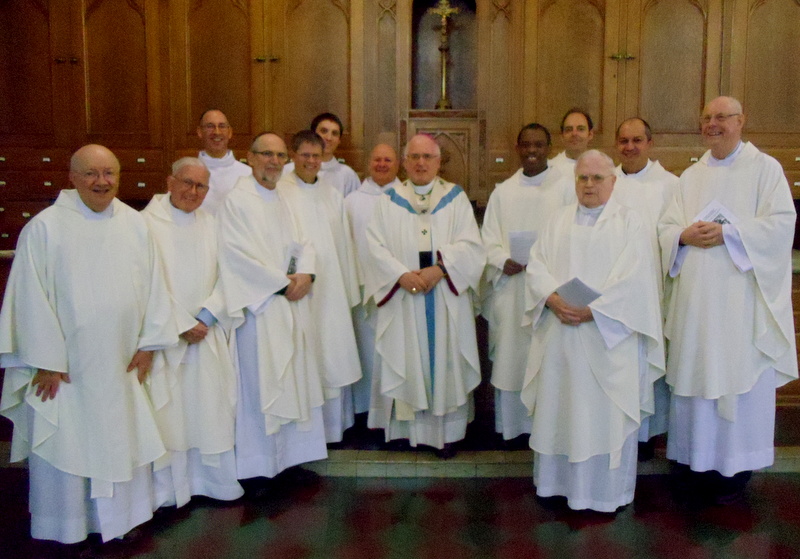
On Saturday, December 8, priests, religious, seminarians and lay faithful gathered at the Cathedral of Notre Dame of the Immaculate Comception, for the patronal feast (it is also the patronal feast of the Ottawa ecclesiastical province, which includes the dioceses of Hearst, Pembroke and Timmins. 

Some photos courtesy of Paul Lauzon.


* * * * * *

In response to an invitation earlier this year by the Canadian Catholic Aboriginal Council, the Canadian Conference of Catholic Bishops offers the following message for the 12 December 2012 Day of Prayer in Solidarity with Indigenous People:


Saint Kateri Tekakwitha: A Model for Loving and Following Jesus


This year, through the miracles of God and the prayers of the Church, we are celebrating the solemn declaration that Kateri Tekakwitha is a saint and model for all Christians. What meaning does her life and death have today? Her message is the same that Jesus the Christ proclaimed 2000 years ago, and which he continues to teach us today.

The heart of Our Lord’s teaching is found in the Beatitudes (Matthew 5.3-11; Luke 6.20-23). Their light shines brightly in the Blessed Virgin Mary and the saints. It is this light that the Church also recognizes in Kateri. This message of Jesus is daily and eternal, inviting us to decide how to respond to the deepest desire for happiness which God has placed in our heart.

Blessed are the poor in spirit, for theirs is the kingdom of heaven. Kateri lived simply and austerely, searching how to love Jesus and at the same time be faithful to the traditions of her people. Blessed are they who mourn, for they will be comforted. All her life, she was weak, scarred and partially blind because of the smallpox which had killed her parents and a younger brother when she was between four and six years old.

Blessed are the meek, for they will inherit the earth. Already as a young girl, Kateri learned to carry firewood and fetch water, to make soup and bread. Later, she used sticks to make crosses, a sign of Christ’s mercy, and place these in the woods. Her prayer at death was as simple as her life itself: “Jesus, I love you.” Blessed are those who hunger and thirst for righteousness, for they will be filled. Kateri participated in the winter hunts, and worshipped God in the woods and forest. She is recorded as saying, “My body is served most luxuriously in the forest, but the soul languishes there, and is not able to satisfy its hunger.”

Blessed are the merciful, for they shall obtain mercy. Kateri taught the young, and assisted the sick and elderly. She refused to speak ill of others. Although infirm, she was always the first to work. Blessed are the pure in heart, for they shall see God. She insisted on making a promise of perpetual virginity, and wanted to form a community of Sisters who would all be Aboriginal women. “I have consecrated myself entirely to Jesus, son of Mary,” she said.

Blessed are the peacemakers, for they will be called children of God. Kateri is described as joyful, patient and always wanting to help others. She would ask, “Who can tell me what is most pleasing to God that I may do it?”Blessed are they are persecuted for righteousness’ sake, for theirs is the kingdom of heaven. After her baptism, she was derided for becoming a Christian, outcast from her native village, and so ended her years at a mission. Blessed are you when people revile you and persecute you and utter all kinds of evil against you falsely on my account. Rejoice and be glad, for your reward is great in heaven. Ridiculed because of her baptism, she sought refuge over 300 kilometres away, walking through woods, rivers and swamps.

When she was beatified in 1980, Blessed John Paul II described Kateri as “a kind, gentle and hardworking person, spending her time working, praying, and meditating”. In the last months of her life, he said, we continue to see a woman of “solid faith, straight-forward humility, calm resignation and radiant joy, even in the midst of terrible sufferings.”

This past October, when Kateri was canonized, Pope Benedict XVI said she had led a simple life, remaining faithful to her love for Jesus, to prayer and to daily Mass. “Her greatest wish was to know and to do what pleased God,” the Pope continued. “She lived a life radiant with faith and purity. Kateri impresses us by the action of grace in her life, in spite of the absence of external help, and by the courage of her vocation.”

Pope Benedict has entrusted the renewal of faith in the First Nations and of all North America to Saint Kateri Tekakwitha, “Protectress of Canada”. In the words of the Holy Father, may she, with all the saints, be a witness to us of lives “generously spent for love of Christ,” strengthening and sustaining the whole Church and each of us in our mission of proclaiming the Gospel. For as Jesus said when concluding his teaching on the Beatitudes (Matthew 5.13,14), we are called to be the salt of the earth and the light of the world.

Tuesday, December 11, 2012

OM: Pope Saint Damasus I - Confession Has Social Benefits - Ottawa Catholic Principals Meet


Pope St. Damasus I, (305-384), was of Spanish descent; he summoned synods and councils, notably, the First Council of Constantinople, to defend the Church against schismatics and heretics. He widely promoted the veneration of the martyrs. It was he who commissioned St. Jerome's translation of the Bible and who changed the liturgical language from Greek to Latin.

* * *

On Pope Liberius' death, riots broke out over the election of a successor. The majority favored Damasus, who was born in Rome of Spanish descent. He had served as a deacon under Liberius and upheld the Nicene Creed.

In less than a month, Damasus was installed in the Lateran palace. A minority, however, refused to accept the decision; they set up the antipope Ursinus. As the violence continued, Emperor Valentinian, who now ruled the West, was compelled to intercede and expel the antipope.

Pope Damasus fostered the development of the Church during this period of peace by publishing a list of the books of both the Old and New Testaments. He also encouraged his longtime friend and secretary, St. Jerome, to translate the Bible into Latin. This Vulgate edition continues to serve the Church usefully. Damasus himself composed eloquent verse which he had inscribed on marble slabs and placed over the tombs of martyrs and popes alike.

But Damasus is best known for his devoted project in the catacombs. He ardently searched for the tombs of martyrs which had been both blocked up and hidden during previous persecutions. He lighted the passages and stairwells of the catacombs, encouraging pilgrimages to the martyrs. He did much to beautify existing churches, such as building the baptistery in St. Peter's and laying down marble pavement in the basilica of St. Sebastian.

Damasus was a vigorous defender of the orthodoxy, as well. He condemned the heresies of such men as Macedonius and Apollinaris and continued the march against Eastern Arians. Although Emperor Valentinian was a Catholic, his less capable brother Valens was under the Arian influence. Valens kept the Eastern bishops in turmoil until his death in 378 by the determined Goths.

Emperor Theodosius, who succeeded Valens, supported the orthodox and convened the Second Ecumenical Council at Constantinople in 381. The council settled the dispute by recondemning Arianism and adopting the pope's teachings.

The chair of St. Peter was never more respected than during the pontificate of Damasus. He tirelessly promoted the Roman primacy, successfully persuading the government to recognize the Holy See as a court of first instance, although it declined to give the pope himself any particular immunity against the civil courts.

Next in hierarchy came Alexandria, founded by St. Mark, and then Antioch, where Peter reigned before leaving for Rome.

Pious Pope Damasus died on December 11, 384 after a reign of eighteen years. — J. V. Bartlett, The Popes: A Papal History

* * *

Grant, we pray, O Lord, that we may constantly exalt the merits of your Martyrs, whom Pope Saint Damasus so venerated and loved. Through our Lord Jesus Christ, your Son, who lives and reigns with you in the unity of the Holy Spirit, one God, for ever and ever.

* * * * * *

ANOTHER REASON FOR AN ADVENT CONFESSION


The following was picked up by CBC News last week--fascinting in its analysis of the fruits of confession in people's lives: Jesus used the same analogy of sums of money being forgiven to explain the love of the forgiven sinner (Luke 7.36-50). I wonder whether the commitment of generous giving is restricted inside the church (which the article focuses on) or giving generally.

Catholic absolution boosts donations

People who recall, or even imagine, being absolved of their sins tend to donate more money to the church, according to British researchers.

"Recent evidence has suggested that people are more likely to behave pro-socially, such as helping, sharing, donating, co-operating and volunteering, when they feel guilty," said Ryan McKay, from the Department of Psychology at Royal Holloway College of the University of London.

"This raises the question of whether religious rituals of absolution, in which people are absolved of their sins and released from guilt, would actually make people less pro-social."

In a study done by the University of Oxford and Royal Holloway, published in the journal Religion, Brain and Behaviour, researchers posed the question: "If sin is a form of capital, might absolution rituals squander that capital?"

In the study, volunteers – all devout Catholics —were provided two memory tasks.

First, they were asked to remember a sin, privately, that they had committed in the past.

Secondly, they had to recall if they attended confession for this sin or, if they hadn't done it in reality, just to imagine doing so.

Each person was given an opportunity to donate to a local Catholic church by putting some money in an envelope.

The participants were divided between those whose money was collected before they remembered being absolved and those who donated after trying to make that recollection.

Researchers discovered that the participants who recalled being absolved, or who merely imagined being absolved, increased their donations.

In addition, donations were extra generous if the person had a strong belief in divine judgment and engaged in religious activities such as praying or Bible reading.

"The results of our study suggest … that 'releasing' people from their sin has a positive pro-social effect. This indicates that the Catholic ritual of confession is an effective means of promoting commitment to the church."

Other religions, including Islam and Hinduism, also have concepts of absolution. Researchers say they would like to analyze adherents of those religions the next time around to see if the results are comparable to Catholics.

* * * * * *

CATHOLIC EDUCATIONAL LEADERS
 MEET AT DIOCESAN CENTRE


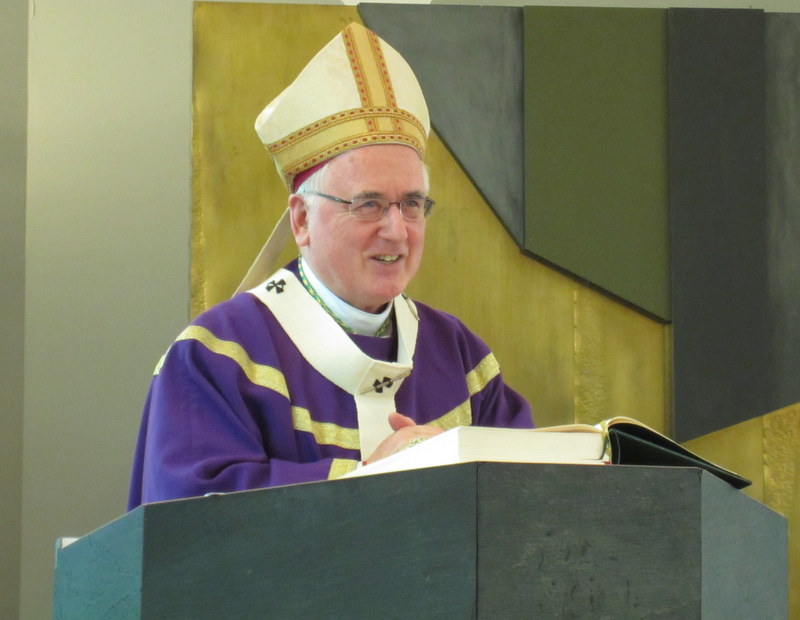
Last Wednesday, the Ottawa Catholic School Board Principals and several OCSB supervisory staff held one of their planning meetings in the Diocesan Centre.  I addressed them on the New Evangelization and the Year of Faith and celebrated Mass before the lunch break in the Chapel.

Among the questions presented by my Vicar, Father Geoffrey Kerslake, was the implementation in the English Sector of the restoration of Confirmation within the sixth grade programs in our parishes, schools and families.

Some photos from the Eucharist: courtesy Sarah DuBroy.


Monday, December 10, 2012

OM: St. John Roberts - Proceeds from the Archbishop's Dinner Distributed to Beneficiaries


St. John Roberts, Welsh Priest and Martyr

John Roberts was born in Wales to Anna and John Roberts. Although he was not a Catholic, he was taught by an elderly priest and at heart he was always a Catholic.

John went to Oxford University in England for a few years before going to study law. He then took a trip to France to have a good time. But his trip turned out to be more than fun.

It was in Paris, France, that another Englishman who was Catholic had great influence on him and John found great happiness in joining the Catholic Church.

John lost no time after this in taking steps to become a priest. He went to an English college in Spain and became a Benedictine monk.

Then his great dream of going back to England came true three years later when he and another monk were given permission to go. They knew the dangers they would face because Catholics were not welcome there, especially not priests.

In fact, they did not have long to wait before trouble began. They entered England wearing plumed hats and swords at their sides. But soon they were arrested for being priests and sent out of the country.

Father John managed to return to England again. He worked day and night to keep the Catholic faith alive during Queen Elizabeth's terrible persecution. Several times he was captured, put in prison, and exiled, yet he always returned.

The last time Father John was arrested, he was finishing Mass. This time there was no escape. When asked, he boldly said that he was a priest and a monk.

He explained that he had come to England to work for the salvation of the people. "Were I to live longer," he added, "I would continue to do what I have been doing." St. John was then condemned to death.

The night before he was to be hanged, a good Spanish lady arranged for him to have supper with eighteen other prisoners. They were also suffering for Christ's sake.

During their supper together, St. John was full of joy. Then he thought perhaps he should not show so much happiness. "Do you think I may be giving bad example by my joy?" he asked his hostess.

"No, certainly not," she replied. "You could not do anything better than to let everyone see the cheerful courage you have as you are about to die for Christ."

The next day, St. John was hanged. The crowds were so attracted by the personality of this young priest that they did not let the executioners make him suffer.

St. John Roberts was martyred on this day in 1610; an optional memorial in his native Wales is permitted today.   [http://saintscatholic.blogspot.com]

* * * * * *

ADVENT COLLECT
TUESDAY WEEK II

May our prayer of petition rise before you, we pray, O Lord, that, with purity unblemished, we, your servants, may come, as we desire, to celebrate the great mystery of the Incarnation of your Only Begotten Son. Who lives and reigns with you in the unity of the Holy Spirit, one God, for ever and ever.

* * * * * *

FOLLOW-UP TO THE
ARCHBISHOP'S BENEFIT DINNER


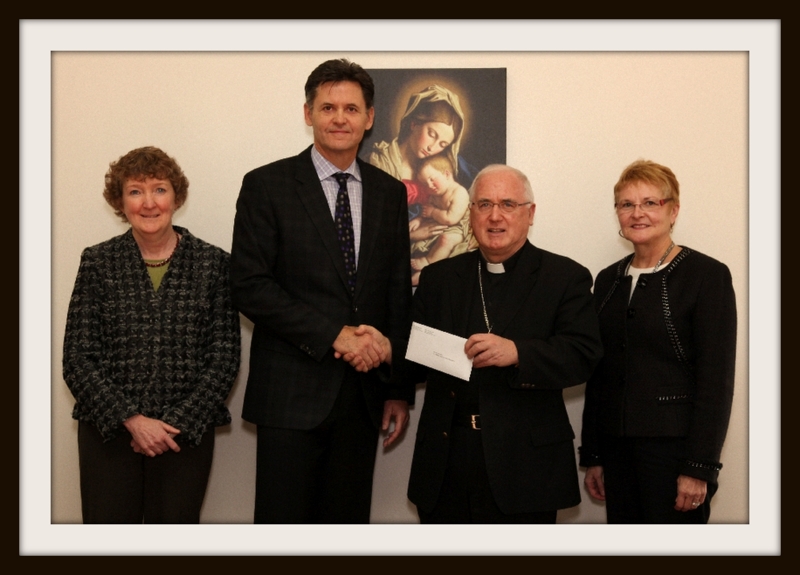
This year’s Archbishop’s Dinner was in favour of our elderly, who are supported through the excellent work on their behalf at the Centre d’Accueil Roger-Seguin in Clarence Creek and at St. Patrick’s Home of Ottawa.

On Thursday, December 6, representatives of these two institutions came to the Diocesan Centre to receive the cheques distributing the proceeds from the dinner, some $36,000 to each, which also included a contribution from the diocese’s charitable fund.

Thanks again to all who were sponsors of the dinner or attended; your generosity is much appreciated.

Next year’s Archbishop’s Dinner will be held on Wednesday, October 16.

St. Patrick's Home of Ottawa
 
Centre d'Accueil Roger-Seguin, Clarence Creek


Photo credit: Robert DuBroy

Sunday, December 9, 2012

The Baptist Heralds Repentance - Saint Clement Feast Day Dinner


Almighty and merciful God, may no earthly undertaking hinder those who set out in haste to meet your Son, but may our learning of heaven wisdom grain us admittance to his company. Through our Lord Jesus Christ, your Son, who lives and reigns with you in the unity of the Holy Spirit, one God, for ever and ever.

* * * * * *


Jerusalem

In Palestine Christians gather today in Jerusalem for the celebration of holy Mass. In Rome they proceed to the stational church "Holy Cross at Jerusalem" which serves to give the atmosphere of the Holy City.

Why "Jerusalem"? Excavations of ancient sites often reveal a number of strata. When enemies destroyed a city, a new one would rise on the same location, so that today there are several layers of remains, one city, as it were, above the other. Our Jerusalem likewise has four strata. The bottommost layer is the Jerusalem of the Jews, that venerable land where the Lord Jesus began His mission of redemption, where He suffered and died. This is the historical Jerusalem so dear to us Christians. Anyone making a pilgrimage to the Holy Land enters that ancient city with holy awe. That Jerusalem, however, lies buried deep.

For us another has been built upon it, the Jerusalem of Christians, God's kingdom on earth, the holy Church. This city still stands; it is the one which the divine King will enter at Christmas. Now we understand why we will hear so mach about Jerusalem during the coming week. We should now clean and adorn our city, improving its streets and avenues through which the Saviour will make His entrance. As a motto we should take the words of the precursor, St. John the Baptist: "Prepare the way of the Lord, make straight His paths; let every valley be filled, every hill be leveled." Holy Mother Church's message today is that the Saviour is coming to the Jerusalem of the Christians, to the Church.

Above the second stratum there arises a third, the heavenly Jerusalem at the end of time. Already now the Church sings of this Jerusalem. For during Advent we await the Saviour who will appear on the Last Day to take all into "the new Jerusalem coming down from heaven."

Finally, there may be recognized a fourth Jerusalem, our souls in sanctifying grace. This city too must be adorned and prepared, for the King will want to enter. That is our present task.

On Epiphany, the climax to the current season, the Church will cry out: "Arise, shine, O Jerusalem, for the glory of the Lord has risen upon thee." That is the goal. Today we must prepare for the great King's visit to our city. The whole coming week must be devoted to it. The Church prays: "Awaken our hearts to prepare the way for Your only-begotten Son that we may serve Him with purified hearts."

In the time of the Roman Empire, rulers rode from city to city for the purpose of official visitations. Their appearance, called epiphany or parousia, was a great event, one preceded by months of preparation. Something analogous takes place in the Jerusalem of our souls. From a high watchtower we see the Lord coming afar off. Suddenly John the Baptist appears; he hurries into the city to announce the King's approach. God condescends to manifest Himself to us in grace; but He demands the proper reception. [Excerpted from Pius Parsch, The Church's Year of Grace].


* * * * * *

ST. CLEMENT'S FEAST DAY CELEBRATION


A couple of Saturdays ago, I joined members of  St. Clement's Parish for their annual benefit dinner at the Marconi Centre. Music greeted us during during service of the aperitifs, followed by a festive meal. Father Garrick Huang sang a few operatic airs, while pastor Father Philip Creuer gave an update on the parish's move from its church on Mann Avenue to the classical Sainte Anne's Church in Lower Town.  In my blogging in past weeks this item slipped from my scheduling. 

Some photos: 


* * * * * *

NOW ON TWITTER


This week I entered the Twitterverse and am now tweeting in English and French: you may follow me @archterentius.

Cette semaine j’ai commencé à publier en anglais et en français des courts messages avec Twitter : suivez moi @archterentius (nom en Latin pour être inclusif).

Saturday, December 8, 2012

Solemnity of the Blessed Virgin Mary's Immaculate Conception


O God, who by the Immaculate Conception of the Blessed Virgin prepared a worthy dwelling for your Son, grant, we pray, that, as you preserved her from every stain by virtue of the Death of your Son, which you foresaw, so, through her intercession, we, too, may be cleansed and admitted to your presence. Through our Lord Jesus Christ, your Son, who lives and reigns with you in the unity of the Holy Spirit, one God, for ever and ever.
* * *


Immaculate Conception of Mary


"Hail Mary, full of grace". For thousands of centuries, millions of times per day the Virgin Mary is greeted by the faithful with the greeting of the Archangel, that we hear resonating anew in today’s Gospel. The sons of the Church learn from the words of the Archangel Gabriel that the fullness of the mystery of God’s grace was realized in Holy Mary. St Paul the Apostle teaches us that the Father made all fullness dwell in His Incarnate Son (c.f. Col 1:12-20), which overflows from Christ’s head and spills out on His Mystical Body that is the Church. Before descending in Body, Christ’s fullness was spread in a unique and unrepeatable way on Mary, predestined from eternity to be the Mother of God.

Significantly in the first reading, the liturgy recalls the figure of Eve, the mother of all the living. The Fathers of the Church saw in Mary, the new Eve that unties the knot bound by the first woman. The knot of disobedience tied by Eve, was untied by the obedience of Mary. As Eve was created in purity and integrity, also the new Eve was miraculously preserved from the contamination of original sin because she had to give humanity the Word, who was incarnated for our ransom.

Saint Irenaeus compares the virginity of the pure earth from which Adam was drawn to the virginity of the immaculate humanity of Mary from which the Second Adam was drawn. ‘And as the protoplast himself, Adam, had his substance from untilled and as yet virgin soil (for God had not yet sent rain, and man had not tilled the ground (Genesis 2:5)) so did He who is the Word, recapitulating Adam in Himself, rightly receive a birth, enabling Him to gather up Adam [into Himself], from Mary, who was as yet a virgin’ (Adversus hereses III, 21:10).

Blessed Pope Pius IX on the 8th of December 1854 proclaimed the Dogma of the faith revealed by God that the Blessed Virgin Mary "in the first instant of her conception, by a singular privilege and grace granted by God, in view of the merits of Jesus Christ, the Saviour of the human race, was preserved exempt from all stain of original sin" (Denz.-Schonm, 2083). If the official proclamation of the dogma is relatively recent, the profession of faith by Christians and the liturgy is very ancient in this regard. Furthermore, four years later the same Virgin Mary, appearing in Lourdes to St Bernadette, confirmed the truth of the doctrine by presenting herself with the title ‘I am the Immaculate Conception’.

Mary’s predestination to this singular grace—consistent with the suspension of the universal decree by which every man, from the moment of his conception is contaminated with original sin—leads us to ponder in the deepest depths the mystery of the Most Holy Trinity’s salvific plan. God, One and Triune, had foreseen from the very beginning the future incarnation of the Word culminating in the redemption of human nature that had fallen into sin. He therefore predestined pure Mary, so that He could draw from her uncontaminated humanity, which the Son could adopt in order to re-establish in Himself the original purity of creation and reorientate it to eternal glory.

For this reason, in the second reading of today’s liturgy, St Paul reminds us that God wants to see us holy and immaculate before Him. The purity of our origins seemed to be irredeemably lost. However, in Immaculate Mary, God found the perfect solution to reverse the disaster made from the misuse of our liberty, and returned humanity to the original purity that seemed hopelessly lost.

Mary’s Immaculate Conception is a direct consequence of her Divine Maternity. St Anslem of Aosta wrote: ‘Assuredly, it was fitting that the Virgin be beautified with a purity than which a greater cannot be conceived, except for God's. For, toward her, God the Father was so disposed to give His only Son who was naturally one and the same common Son of God the Father and of the Virgin.’ (De conceptu virginali et originali peccato, XVIII)


This link between the privilege of Divine Maternity and Mary’s Immaculate Conception results also in her superiority with respect to us. She is a perfect image of the Church in heaven, the new triumphant Jerusalem, that won’t have any marks nor will there be pain and death. This is why today’s preface recites: '…she was to be a worthy mother of your Son, your sign of favour to the church at its beginning, and the promise of its perfection as the bride of Christ, radiant in beauty’. Also in heaven Mary is not and will never be only a disciple, but her Son’s most exalted. She is and will always be the Mother of God, the Mother of the Church, the Queen of the Angels and Saints. Therefore, the preface of the Mass adds: ‘…You chose her from all creatures to be our advocate with you and our pattern of holiness.’

Mary was Immaculate because she had to be the Mother of God. She, herself has received the original grace of purity and the final state of the blessed life that we also, by collaborating with Divine Grace, hope one day to receive.

Immaculate Mary is full of grace. She is not only Christ’s disciple, who with the help of grace has overcome the chains of sin, but she is totius Trinitatis nobile triclinium, the noble resting place of the Holy Trinity (St Thomas Aquinas, Exposito Salutationis Angelicae, I). The Immaculate, full of grace, will always be Mother and Queen for that elect part of the Church that we hope one day to join, that will one day joyfully sing before the Almighty. [Congregation for the Clergy]