Monday, June 18, 2012

Statio Orbis Closing ICE Liturgy - Heading Home to Ottawa & Canada


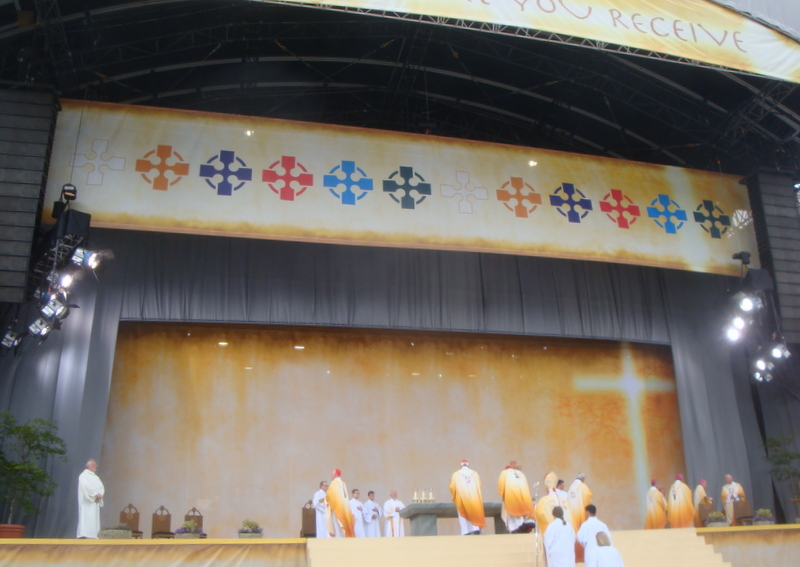
The Statio Orbis Mass was an extraordinary rich experience: an hour of music and testimonies broadcast by RTE, the Irish National Broadcasting System (picked up by Salt + Light and other Catholic networks), a reverent final Mass for the more than 70,000 faithful in Croke Park and the Holy Father's closing message, which included the announcement that Cebu, Philippines would host the next ICE in 2016.

We journeyed to Croke Park by bus, hoofing the last good stretch to the stadium (including completely circling it outside and inside to get to our places. Following the liturgy, we had a great time trying to find our coach for the return trip but made it back for a closing festive dinner in the hotel dining-room.  Today we have a 6am Mass, then breakfast and off to the airport for a 10:45 departure on Air Canada to Toronto, customs procedures and transfer to an Ottawa connecting flight arriving at YOW at 4:15 and home, it is hoped an hour later. 

Deo gratias!

A selection of pictures of the marvellous, sunny, cloudy, rainy day:


Sunday, June 17, 2012

11th Sunday of Ordinary Time ("B") - Statio Orbis at Croke Park Today - More Pix of the IEC


O God, strength of those who hope in you, graciously hear our pleas, and, since without you mortal frailty can do nothing, grant us always the help of your grace, that in following your commands we may please you by our resolve and our deeds. Through our Lord Jesus Christ, your Son, who lives and reigns with you in the unity of the Holy Spirit, one God, for ever and ever.


* * * * * *

STATIO ORBIS AT CROKE PARK


Statio Orbis is the Liturgy on the final day of the 50th International Eucharistic Congress that will take place on Sunday 17th June 2012 in Croke Park, a soccer stadium in Dublin, Ireland.

The Mass will be celebrated by the Papal Legate, Cardinal Marc Ouellet.

It is a time of pause (statio) and come to terms with what it means to celebrate, receive and live the Eucharist.

In February 2008, the Holy Father had a Q & A with his priests in Rome and one of them expressed his lack of comfort with a Mass celebrated outdoors during a large gathering of Youth at Loreto.  In his reply, Pope Benedict attributed the development of the concept of statio orbis to the great Jesuit liturgical scholar Jozef Jungmann:


A great problem, however, is that of the liturgies in which masses of people participate. I remember in 1960, during the great International Eucharistic Congress of Munich, there was an endeavour to give a new physiognomy to the eucharistic congresses, which up to that point had solely been acts of adoration. The intent was to put the celebration of the Eucharist at the centre as the act of presence of the mystery being celebrated. But immediately the question arose how that would be possible.

To adore, it was said, is possible also at a distance; but to celebrate, a limited community is necessary which can interact with the mystery, therefore a community which must be the assembly around the celebration of the mystery. Many were opposed to the public celebration of the Eucharist with hundreds of thousands of people. They said it was not possible precisely because of the very structure of the Eucharist, which requires the community for the communion.

There were also great personalities, very much respected, who objected to this solution. Then professor Jungmann, a great liturgist, one of the great architects of the liturgical reform, created the concept of statio orbis, namely reverting to the statio Romae where even in the time of Lent the faithful assembled at a point, the statio: there they are in statio as soldiers for Christ, and then they go together to the Eucharist. If that, he said, was the statio of the city of Rome, where the city of Rome came together, then this is the statio orbis [statio of the world].

And from that moment on we have the eucharistic celebrations with the participation of masses. To me, I must say, this remains a problem, because the concrete communion in the celebration is fundamental, and therefore I do not find that the definitive answer has been found. Also in the last Synod [of Bishops on the Eucharist, in 2005] I have made this question emerge, which has not, however, found an answer. I have also made another question be raised, regarding concelebrations en masse: because if there are concelebrating, e.g., a thousand priests, one does not know if this is still the structure willed by the Lord. In any case, these are questions.

And so, you encountered a problem with participating in an en masse celebration in which it is not possible for everyone to be equally involved. Therefore, one must choose a certain style to preserve that dignity that is always necessary for the Eucharist, and hence the community is not uniform and the experience of participation in the event is diverse; for some it is certainly insufficient. But this did not depend on me; rather on those who have taken care of the preparations.

Hence it must be reflected well on what to do in such situations, how to respond to the challenges of such situations. In Loreto, if I am not mistaken, it was an orchestra of handicapped people who performed the music, and perhaps the idea was just to demonstrate that handicapped persons can contribute to the sacred celebration, in which not only are they not excluded but become primary agents. And this way, loving them, everyone does not feel excluded, but even involved. This seems to me a very respectable consideration which I share. Of course, the fundamental problem [of en masse celebrations] remains.

But it seems to me that also in this regard, knowing what the Eucharist is, even if one does not have the opportunity of an external activity as one might wish in order to feel one is fully participating, we should be in it with the heart, as the ancient imperative of the Church says, created perhaps precisely for those who were at the back of the basilica: "Lift up your hearts! Now, let us all go out of ourselves, so that we all are with the Lord and are together."

As I said, I don't deny the problem, but if we really follow this word "Lift up our hearts", we will all find, even in difficult and sometimes questionable situations, true and active participation.

* * * * * *

When we celebrated the Statio Orbis Mass in Quebec City in 2008, a torrential rain just at Communion time caused great havoc.  Some of that was present yesterday when a downpour (not torrential but substantial) occurred just before Communion, but stopped as people were communicating, and this was the case on several other occasions this week, requiring concelebrating bishops and priests to make use of plastic ponchos (in Quebec, all the Masses except the closing one were indoors in an arena, which meant all the liturgies were quite fine, even if we too suffered from rain almost every day of the ICE).

The forecast for today is rain again, but I'm hoping the skies will remain shut during the Mass.

* * * * * *

MORE PHOTOS FROM DUBLIN;
CLOSING STAGES OF THE IEC


Rainwear was standard attire this week

Father Kevin Doran, CEO of the ICE receives Congress texts in Swahili from a Tanzanian bishop


Lunch with Communion and Liberation members from Dublin, Rome

Irish writer and Commentator John Waters (Lapsed Agnostic, Beyond Consolation: On How We Became Too Clever for God...and Our Own Good)

Irish seminarians include Thomas on the left who will be ordained a priest by Cardinal Brady in Armagh on July 1

Saturday evening supper with Irish Jesuits

Fathers Alan McGuckian (left) with the Jesuits in Belfast and Tom Layden, Jesuit Provincial 


Saturday, June 16, 2012

Immaculate Heart of Mary - More Photos from the International Eucharistic Congress in Dublin


Immaculate Heart of Mary


The attention of Christians was early attracted by the love and virtues of the Heart of Mary. The Gospel itself invited this attention with exquisite discretion and delicacy. What was first excited was compassion for the Virgin Mother. It was, so to speak, at the foot of the Cross that the Christian heart first made the acquaintance of the Heart of Mary. Simeon's prophecy paved the way and furnished the devotion with one of its favourite formulae and most popular representations: the heart pierced with a sword. But Mary was not merely passive at the foot of the Cross; "she cooperated through charity", as St. Augustine says, "in the work of our redemption".

It is only in the twelfth, or towards the end of the eleventh century, that slight indications of a regular devotion are perceived in a sermon by St. Bernard (De duodecim stellis).

Stronger evidences are discernible in the pious meditations on the Ave Maria and the Salve Regina, usually attributed either to St. Anselm of Lucca (d. 1080) or St. Bernard; and also in the large book De laudibus B. Mariae Virginis (Douai, 1625) by Richard de Saint-Laurent.

In St. Mechtilde (d. 1298) and St. Gertrude (d. 1302) the devotion had two earnest adherents. A little earlier it had been included by St. Thomas Becket in the devotion to the joys and sorrows of Mary, by Blessed Hermann (d.1245), one of the first spiritual children of St. Dominic, in his other devotions to Mary, and somewhat later it appeared in St. Bridget's Book of Revelations.

St. Ambrose perceived in her the model of a virginal soul. St. Bernardine of Siena (d.1444) was more absorbed in the contemplation of the virginal heart, and it is from him that the Church has borrowed the lessons of the Second Nocturn for the feast of the Heart of Mary. St. Francis de Sales speaks of the perfections of this heart, the model of love for God, and dedicated to it his Theotimus.

In the second half of the sixteenth century and the first half of the seventeenth, ascetic authors dwelt upon this devotion at greater length. It was, however, reserved to St. Jean Eudes (d. 1681) to propagate the devotion, to make it public, and to have a feast celebrated in honor of the Heart of Mary, first at Autun in 1648 and afterwards in a number of French dioceses.

In 1799 Pius VI, then in captivity at Florence, granted the Bishop of Palermo the feast of the Most Pure Heart of Mary for some of the churches in his diocese. In 1805 Pius VII made a new concession, thanks to which the feast was soon widely observed. Such was the existing condition when a twofold movement, started in Paris, gave fresh impetus to the devotion.

The two factors of this movement were first of all the revelation of the "miraculous medal" in 1830 and all the prodigies that followed, and then the establishment at Notre-Dame-des-Victoires of the Archconfraternity of the Immaculate Heart of Mary, Refuge of Sinners, which spread rapidly throughout the world and was the source of numberless graces. On 21 July 1855, the Congregation of Rites finally approved the Office and Mass of the Most Pure Heart of Mary without, however, imposing them upon the Universal Church. [Excerpted from Catholic Encyclopedia, 1913 edition.]

* * * * * *
MORE PHOTOS FROM THE ICE, DUBLIN

One of many reflections on the Eucharist on RDS grounds

The past few days have been quite rainy, but everyone remains in good cheer, sometimes disappointed that presentations they wished to attend are oversubscribed.

Some have also taken excursions on one or other day: I spent Thursday morning with my friend and colleague, Fr Peter Sexton, SJ making a visit to Sleaty (Sleibthe), near Carlow City, the location of the titular diocese assigned to me when I was an auxiliary bishop in Toronto--more on that in days to come.  Others have gone to Belfast to see the Titanic exhibit, to Armagh to visit previously-unknown relatives, to climb Croagh Patrick, to attend Mass this morning with Cardinal Ouellet at the shrine of Our Lady of Knock.

We are all preparing for the Statio Orbis ("the whole world pauses") closing liturgy tomorrow at Croke Park.

Meantime, some photos from the past few days:


Delegation from India


Canadian Bishops


Sr. Briege McKenna & Fr. Kevin Scanlon engaged in support of priests


Vancouver Archbishop Michael Miller addresses assembly in the Arena


Adoration Chapel, usually thronged outside major events


Some Ottawa delegates in hotel dining room

Friday, June 15, 2012

Sacred Heart of Jesus - World Day for the Sanctification of Priests - New Archbishop for Moncton


SOLEMNITY OF THE MOST SACRED HEART OF JESUS


"I promise you in the excessive mercy of my Heart that my all-powerful love will grant to all those who receive Holy Communion on the First Fridays in nine consecutive months the grace of final perseverance; they shall not die in my disgrace, nor without receiving their sacraments. My divine Heart shall be their safe refuge in this last moment" (Jesus to St. Margaret Mary).

Sixteenth century Calvinism and seventeenth century Jansenism preached a distorted Christianity that substituted for God's love and sacrifice of His Son for all men the fearful idea that a whole section of humanity was inexorably damned.

The Church always countered this view with the infinite love of our Savior who died on the cross for all men. The institution of the feast of the Sacred Heart was soon to contribute to the creation among the faithful of a powerful current of devotion which since then has grown steadily stronger. The first Office and Mass of the Sacred Heart were composed by St. John Eudes, but the institution of the feast was a result of the appearances of our Lord to St. Margaret Mary Alacoque in 1675. The celebration of the feast was extended to the general calendar of the Church by Pius IX in 1856.

* * *

Grant, we pray, almighty God, that we, who glory in the Heart of your beloved Son and recall the wonders of his love for us, may be made worthy to receive an overflowing measure of grace from that fount of heavenly gifts. Through our Lord Jesus Christ, your Son, who lives and reigns with you in the unity of the Holy Spirit, one God, for ever and ever.

* * * * * *

DAY FOR THE SANCTIFICATION OF PRIESTS

Unless another day is determined for good reason by a local Church, the Congregation for the Clergy has ask that this day be designated the World Day of Prayer for the Sanctification of Priests.

In the Archdiocese of Ottawa we will hold our observance of this special day for the sanctification of priests on Thursday, June 21, when the priests of Ottawa will attend presentations by Mgr Noel Simard, Bishop of Valleyfield.


* * * * * *

ARCHBISHOP VALERY VIENNEAU
SUCCEEDS ARCHBISHOP RICHARD

 
Mgr Andre Richard, CSC

Today it was announced in Rome that His Holiness Pope Benedict XVI had accepted the resignation of the Most Reverend André Richard, C.S.C., as Archbishop of Moncton, according to canon 401 §1 and has named as his successor the Most Reverend Valéry Vienneau, currently Bishop of Bathurst.

Mgr Valerie Vienneau

Congratulations, Archbishop-elect VIENNEAU!

Thursday, June 14, 2012

Mass in the Extraordinary Form at the 2012 International Eucharistic Congress in Dublin, Ireland


Several weeks before the International Eucharistic Congress (ICE), I received a letter from the CEO of the ICE, Father Kevin Doran, inviting me in Archbishop Diarmuid Martin's name to preside at a Mass in the Extraordinary Form at St. Kevin's Church, Harrington Street, Dublin.

Father Gerard Deighan, Administrator of St. Kevin's and Chaplain to the those attending the Latin Mass, facilitated arrangements: I was to bring the miters and gloves, etc. and he would arrange for ministers (deacon and subdeacon), an MC who could guide us all in a Pontifical Mass on the Feast of the Apostle St. Barnabas (hence the red vestments) and well-trained servers. 

The choir of the Parish sang beautifully and the church itself is very fitting for the Mass in the Extraordinary Form; somewhere around 400+/- were in attendance, and a friendly reception took place in the parish fall after the liturgy. The photographer, John Yung, who was very busy later returning home to Singapore from medical school studies, has just sent me a selection of photos he took, which are interspersed with the text of my homily that day. 

* * * * * *

The Feast of St. Barnabas, Apostle–June 11, 2012
Mass in the Extraordinary Form—during the 50th IEC
St. Kevin’s Church, Dublin, Ireland

“THE EUCHARIST: COMMUNION WITH CHRIST
AND WITH ONE ANOTHER”
[Texts: Acts 11.21–26; 13.1–3; Psalm 18, 5, 2; Matthew 10.16–22]

I want to begin by thanking Father Deighan and this parish of St. Kevin’s for the invitation to preside at Mass today. Je salue tous ceux et celles qui sont venus de partout dans le monde et de toutes les langues pour le Congrès eucharistique international et à cette messe ce matin.


The first reading from Acts tells us something of the activity of Joseph, who was given the name Barnabas, meaning “son of encouragement.” He was, in the words of Scripture, “a good man, full of the Holy Spirit and of faith” (Acts 11.24). Elsewhere, we learn that he was a Levite. He was a native of Cyprus, later to become its patron saint, had sold some land and gave the proceeds to the apostles in Jerusalem (4.36–37). He was also a cousin of John Mark (Colossians 4.10). Barnabas and Paul eventually parted ways as missionaries of the gospel. This was because impetuous John Mark had left them (Acts 13.13; 15:37-38) at the early stage of the first missionary voyage (13.2–14.28; 15.39). Barnabas, ever the encourager, chose to travel with John Mark again. We believe Barnabas and Paul later reconciled.


How should we portray Barnabas when it comes to the issue of tradition? Could he not be branded as an agent of rupture with the past? He introduced Paul to the church at Antioch, where the followers of the way of the Lord Jesus were first called Christians. He argued strenuously for a new way of looking at the relationship of Christ to Judaism. Opposing the Judaizers, Barnabas sought to permit converts to enter the community of faith without complying with the full demands of the covenant community, but only some requisites that would allow all to live in peace (15.19–21).


Surely, Barnabas and Paul were agents of change. However, Luke goes to great pains to show that Peter introduced the Gentiles into the Church. In addition, Luke reminds us that James, who represented tradition, agreed with this new focus of evangelisation. In other words, the Holy Spirit was guiding the process of change within continuity, and that it was Peter who kept the Church together, even if at times he vacillated.

This is an important point as we gather to celebrate the Mass in its Extraordinary Form during an International Eucharistic Congress when most of our fellow Catholics—and we ourselves—will celebrate in the Ordinary Form.

For, sometimes many in the Church make the mistake of thinking that the Roman Rite has two different Masses, and it’s a matter of taste, which one a person prefers. But the beautiful, profound truth is that we have only one, holy sacrifice of the Mass in two usages: the ordinary and extraordinary forms. This is perhaps one of the best examples of that most Catholic expression of “both/and” and not “either/or.”

It can be a challenge, though, to explain to people who know little of the Church’s history, how we embrace as Catholic, valid, holy and beautiful, these two different forms of the Eucharist. The differences most often grab our attention. We can overlook the shared, fundamental basis of the sacrament of the Eucharist. Sadly, for some, a particular devotion to one form can result in a reluctance to appreciate the truth, goodness and beauty of the other. Tragically, the preferred form of celebrating the sacrament of the Most Holy Body and Blood of our Lord Jesus Christ can divide Catholics. In our human weakness, we can become competing camps rather than a united Mystical Body of Christ.

In his Apostolic Letter Summorum pontificum, Pope Benedict XVI, eloquently reminded us of the heritage of the Roman Rite for Latin Catholics. He praised Pope Pius V who, “sustained by great pastoral zeal and following the exhortations of the Council of Trent, renewed the entire liturgy of the Church.”


The Holy Father reminds us that throughout her history, the Church’s liturgy has undergone change and clarification. There are still Catholics alive today, for example, who can remember a time before 1952 when the Easter Vigil was celebrated at noon on Holy Saturday! Every Catholic can agree on the real pastoral need to present the Church’s faith with clarity, dignity and beauty, in harmony with the faith of our ancestors.

Both usages of the Roman Rite, when celebrated with attention, devotion, and full and conscious participation, are beautiful, dignified, and moving expressions of our Catholic Christian faith. The Holy Father expressed the hope that each form might have a positive influence on the other. There is a lot of speculation about what that might mean. What it does not mean is that we blend the forms together. We must celebrate each form according to its proper Rite. Instead, perhaps, we might see each one’s strengths enhancing the other.


From the Ordinary Form, for example, we might hope to see a more robust presentation of the texts of Sacred Scripture. We can include new saints whom the Church has declared since 1962, who themselves celebrated or attended the Mass of what we know today as the Extraordinary Form. St. Padre Pio, St. Maximilian Kolbe, and St. André Bessette—whose faith led to the building of St. Joseph’s Oratory in my home town of Montreal—immediately come to mind.

From the Extraordinary Form, we might hope to see the influence of a careful attention to the words and gestures. We also hope to see the sober, careful dignity so characteristic of the Roman Rite.


We are blessed in our Catholic faith to have two usages of the Roman Rite to nourish and sustain us in our Christian faith. As we lift our hearts and minds in worship, adoration, and praise of the Lord our God, we are conscious of our rich liturgical heritage. We take humble pride in expressing, with the same intent, the faith of those who have gone before us.

In the Ordinary and Extraordinary Forms of the Eucharist, we are united in the Mystical Body of Christ under Jesus, our One High Priest. And, in keeping with the theme of this 50th International Eucharistic Congress, we are called in all our celebrations of the Eucharist to discover Communion with Christ and with One Another.


All of the apostles, except St. John, gave their lives as martyrs. So did Barnabas, who, according to tradition, founded the Cypriot Church and died as a martyr at Salamis in the year 61. The gospel in our day, in promising persecutions, may be bracing us for future conflicts. The Church’s message runs counter current to our radically secularizing culture.

Take courage, then, brothers and sisters, in Our Lord’s pledge to strengthen us with the gift of the Holy Spirit. We are called to witness and persevere to the end. Let us be perseverant encouragers, like Barnabas. Take this as an added encouragement to find communion with all our brothers and sisters.

SUNDAY 11B: Resuming Readings from Mark's Gospel

Eleventh Sunday of Ordinary Time (Year “B”)—June 17, 2012


JESUS' PARABLES SURPRISE AND CHALLENGE
[Ezekiel 17.22-24 [Psalm 92]; 2 Corinthians 5.6-10; Mark 4.26-34]

Parables are short stories taken from everyday life that offer a surprising turn or reversal of expectations. The unusual twist in the story provokes reflection, inviting its hearer to make a decision about how he or she might live in light of the truth revealed by the parable. For, as Paul reminded the Christians of Corinth, “all of us must appear before the judgment seat of Christ, so that each may receive recompense for what has been done in the body, whether good or evil”.

In chapter four, Mark draws together several parables to show how Jesus helped His listeners imagine the new reality of God's kingdom (4.1-34). The parable of a farmer sowing seeds that produced extraordinary yields—even a hundredfold (Mark 4.1-20)—appeared in the liturgy last year when Matthew's account was read.

This week we explore a parable unique to Mark's narrative—the “seed growing secretly” (4.26-29)—along with the parable of the “mustard seed” (4.30-32), which appears in several versions in the synoptic gospels, as well as in the apocryphal Gospel of Thomas. Lastly, we see how Mark brings the parable collection to a conclusion with comments on the reason Jesus taught in parables (4.33-34).

One parable said God's kingdom was like seed planted by a farmer that grew day and night until the harvest came. This parable noted three distinct moments in the dynamic process of the kingdom: sowing, growth and harvest.

This brief similitude moves back and forth between the seed and the farmer. The first part stresses the farmer's action in sowing and the conclusion his role in harvesting. The central part observes that the seed sprouts and grows on its own, even though the farmer “does not know how”.

The parable invites people to grasp that God's kingdom germinates, grows and matures without enhancement from visible, external causes. The parable challenged those who saw little evidence of God's presence in Jesus' ministry or the church's early days. It invited them to believe in a hidden mystery at work in their midst.

The parable says little about the time between seeding and harvest. All the while, however, growth is taking place, and the time of harvest—the consummation of God's reign—must be near. In biblical literature, images of harvest implied notions of judgment. People would be called to account—did they act when they learned that God's kingdom was in their midst and required a response from them?

The mustard seed parable stresses a surprising contrast, between the smallness of the seed and its growth into a plant where birds can nest in its shade. The metaphor seems a surprising choice for Jesus' description of God's kingdom. One would have thought that discussion of God's sovereignty over people's lives would have demanded a stress on the kingdom's greatness!

Jesus' use of the mustard seed to illuminate God's kingdom underlined the infinitesimal dimension of God's rule relative to popular expectations in his time. Still, smallness was not the whole story. For the fully grown mustard plant “becomes the greatest of all shrubs”.

In contrast with Ezekiel (17.3-4; 31.2) and Daniel (4.20-22), who called on tree imagery to represent various kingdoms, Jesus used a bush to represent God's fully-developed kingdom. The mustard seed parable tells of a kingdom which, for all its marvellous expansion, remains lowly.

By comparison with worldly kingdoms (great trees), God's kingdom (the mustard bush) does not seem unusually large. But it has branches large enough “that the birds of the air can make nests in its shade”.

Ezekiel had spoken of God taking a cedar twig and causing a great tree to sprout from it. In the shade of this tree's branches would “nest winged creatures of every kind”. When Jesus spoke of nesting birds, he suggested the inclusive nature of God's kingdom open to all nations on earth.