Sunday, September 23, 2012

Sunday 25B: Jesus & the Children


But they were silent; for on the way they had discussed with one another who was the greatest. And he sat down and called the twelve; and he said to them, "If any one would be first, he must be last of all and servant of all." And he took a child, and put him in the midst of them; and taking him in his arms, he said to them, "Whoever receives one such child in my name receives me; and whoever receives me, receives not me but him who sent me (Mark 9.34-37)."

* * *


O God, who founded all the commands of your sacred Law upon love of you and of our neighbor, grant that, by keeping your precepts, we may merit to attain eternal life. Through our Lord Jesus Christ, your Son, who lives and reigns with you in the unity of the Holy Spirit, one God, for ever and ever.

* * * * * *

Saturday, September 22, 2012

The Servants of the Cross Renew Their Promises - Saint Maurice


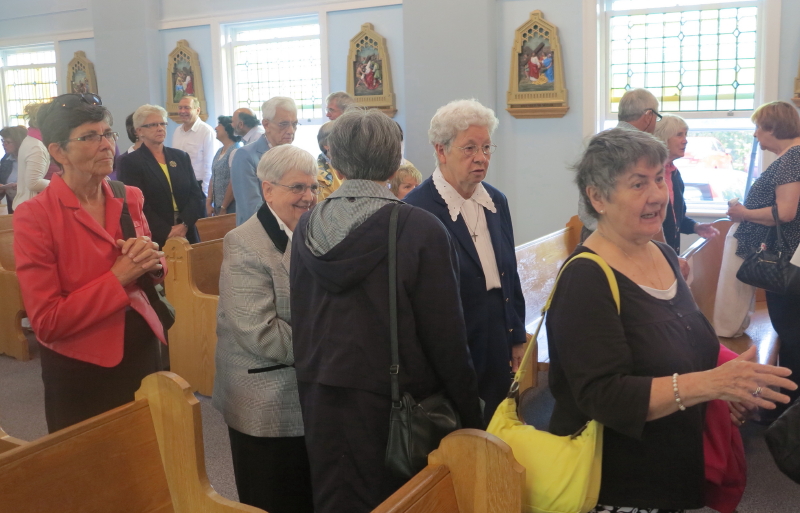
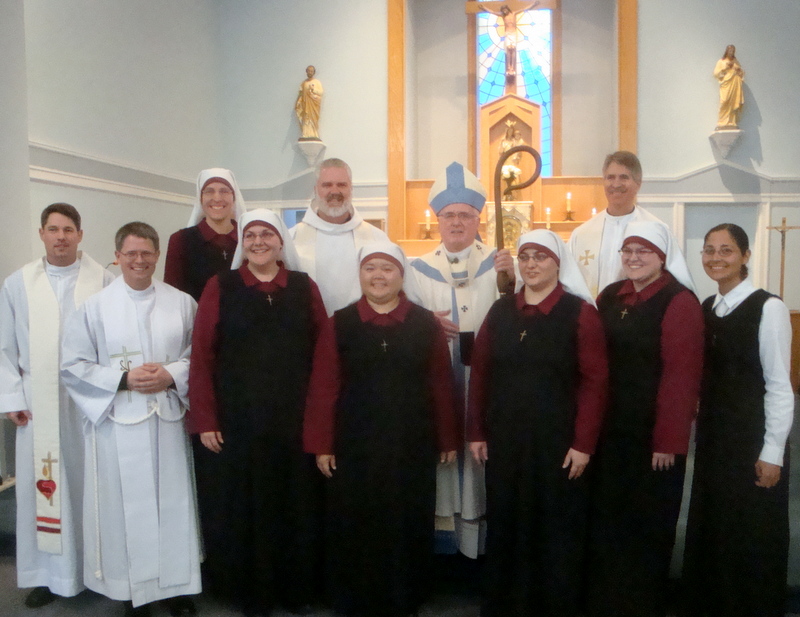
The renewal of promises by the Servants of the Cross took place last Saturday in Queen of the Most Holy Rosary Church here in Ottawa.  The Sisters are celebrating ten years of existence this year though it was some time before they were formally recognized as a public association of Christ`s faithful two years ago.

Here are some photos, courtesy of Paul Lauzon:


* * * * * *

ST. MAURICE & COMPANIONS,
SOLDIERS AND MARTYRS

In Switzerland and in other countries, dioceses and parishes, this early martyr-saint's feast day is observed (we have a parish dedicated to St. Maurice in our archdiocese (in Nepean):


El Greco, The Martyrdom of St. Maurice

Saint Maurice (also Moritz, Morris, or Mauritius) was the leader of the legendary Roman Theban Legion in the 3rd century, and one of the favorite and most widely venerated saints of that group. He was the patron saint of several professions, locales, and kingdoms. He is also a highly revered saint in the Coptic Orthodox Church.

According to the hagiographical material, the legion, entirely composed of Christians, had been called from Thebes in Egypt to Gaul to assist Maximian to defeat a revolt by the bagaudae.

However, when Maximian ordered them to harass some local Christians, they refused and Maximian ordered the unit to be punished. Every tenth soldier was killed, a military punishment known as decimation. More orders followed, they still refused, partly because of Maurice's encouragement, and a second decimation was ordered. In response to their refusal to use violence against fellow Christians, Maximian ordered all the remaining members of the 6,666 unit to be executed.

The place in Switzerland where this occurred, known as Agaunum, is now Saint Maurice-en-Valais, site of the Abbey of Saint Maurice-en-Valais.

Though I cannot find the collect for the feast in English, here it is from my French breviary:

Seigneur, la gloire de tes élus est un reflet de ta splendeur, et tu as consacré ce jour par le martyr de saint Maurice et de ses compagnons; accorde à ton Église, qui fête avec joie leur entrée dans le ciel, de trouver, à leur exemple et par leur prière, le chemin de ta miséricorde.

Friday, September 21, 2012

St. Matthew, Apostle & Evangelist - Le PortiK at University of Ottawa

Lucio Massari, Saint Matthew (Rome: Church of St. Mary Immaculate on the Via Veneto)

O God, who with untold mercy were pleased to choose as an Apostle Saint Matthew, the tax collector, grant that, sustained by his example and intercession, we may merit to hold firm in following you. Through our Lord Jesus Christ, your Son, who lives and reigns with you in the unity of the Holy Spirit, one God, for ever and ever.
* * *

THE GOSPEL OF MATTHEW


Scholars remain undecided about several aspects concerning this longest of the gospels which for centuries held pride of place in the Church's teaching and life.

Mainstream scriptural interpreters place its composition towards the end of the first century (80-90 AD), possibly in a mixed Jewish-Gentile community such as was found at Antioch in Syria.

Matthew's gospel stresses that Jesus is the Son of God who fulfils what the Old Testament foretold of the Messiah (for example, “This was to fulfil what had been spoken by the Lord through the prophet, ‘Out of Egypt I have called my Son’” [2:15]).

Inviting the follower of Jesus to confess in both word and deed that Jesus is Lord (cf. Matthew 7:21), Matthew depicts Jesus as a prophet powerful in word and deed (4:23; 9:35).

To underline this emphasis on Jesus’ words and deeds, the evangelist intersperses narrative blocks depicting Jesus' healings and miracles with five major speeches.

The Sermon on the Mount constitutes the first of the five great addresses Jesus gives (chapters 5-7). Later, Jesus shares instructions with his apostles as he sends them out on mission (chapter 10), then proclaims to them the parables of the kingdom of heaven and their meaning (chapter 13).

In chapter 18, Jesus describes how life should be lived in the Church, focusing on the need to care for vulnerable “little ones”—easily led astray by bad example—and on the enduring need for forgiveness among His disciples.

The climax to Jesus' instructions are found in His eschatological parables and teaching which culminate in the Last Judgment (chapters 24-25). At the end of the ages, as the glorious Son of Man, Jesus uncovers the criterion for inheriting the Father's kingdom: what was done or not done “for the least of my brethren” (25:40, 45) was given or refused to him. All will be judged on their deeds.

This gospel emphasis on “doing” has often coloured the way people interpret the message of the beatitudes. Some are led to think that only when they have conformed their lives to the program Jesus enunciates will they become pleasing to God. There is a risk here of getting Jesus’ message backwards.

Jesus proclaims Good News from God to the poor in spirit, the mourning, those who hunger and thirst for righteousness (right relations between God and humanity and among members of the human family).

Jesus declares that God has chosen to give humans, struggling in their yearnings, the free gift of the kingdom. In this vein, one dynamic equivalence translation rendered the “poor in spirit” of the first beatitude as “those who know their need for God” (J.B. Phillips).

In beginning with God, all is grace, all is gift. Then comes the challenge to every person who would remain a charter member of God's household: Be what you are! Live the life of the kingdom!


The message of the Sermon on the Mount constantly oscillates between the call God makes possible (“You are the light of the world”) and the challenge to live it out (“Let your light shine before others”). Putting all the onus on oneself could lead to frustration or to self-righteousness.

Yet, to do nothing but wait on God would be to fall into the error of spiritual passivity. Life in the kingdom is a partnership begun and sustained by God, but which his children rejoice in making their own. They go so far as to rejoice in suffering willingly for Jesus’ sake (when people “utter all kinds of evil against you falsely on my account” [5:11]).

Matthew’s is the gospel of the risen, cosmic Christ. The Messiah, son of Abraham, son of David, Son of Man, Son of God, who fulfils all messianic expectations through the cosmic event of his death and resurrection is present in the reading or proclamation of the Gospel (“for where two or three are gathered in my name, there am I there among them” [18:20]).

Jesus is God’s chosen, powerful in word and deed, who calls others to have a consistency between what they say and do. All disciples are moving towards the last judgment but need not fear this occurrence because the Lord who is to come is already with his Church (“remember, I am with you always until the end of the age” [28:20]). [Living God's Word: Reflections on the Sunday Readings for Year A [Toronto: Novalis, 2010, pp. 14-16]

* * * * * *

THE PORTICO:
PLACE OF ENCOUNTER
BETWEEN CLASS AND CHAPEL


All week long, Eglise Sacre-Coeur welcomes many U of O students for courses taught in the large classroom that on Sundays serves to handle congregational overflow or affords meeting space.

The students are able to spend time before class in the hallway leading to the church, offices, etc.  Light refreshments are available and a cordial openness is extended to all.

Le PortiK saw light in the 2011-12 academic year and is being repeated this year.  Allowing people to sign up for programs linking parish interests and the university's various constituencies was the focus of an "open house" held early in the term. 

Mgr Daniel Berniquez and I dropped in for a mid-day hot dog lunch and a chance to socialize. 

Herewith some photos, kindness of the pastor Pere Pierre-Olivier Tremblay, o.m.i.


Thursday, September 20, 2012

St. Andrew Kim & Companions, Martyrs of Korea - Opening of the Law Courts and The Red Mass


Andrew Kim Taegon, Paul Chong Hasang
& Companions, Martyrs

This first native Korean priest was the son of Korean converts. His father, Ignatius Kim, was martyred during the persecution of 1839 and was beatified in 1925. After Baptism at the age of 15, Andrew traveled 1,300 miles to the seminary in Macao, China. After six years he managed to return to his country through Manchuria. That same year he crossed the Yellow Sea to Shanghai and was ordained a priest. Back home again, he was assigned to arrange for more missionaries to enter by a water route that would elude the border patrol. He was arrested, tortured and finally beheaded at the Han River near Seoul, the capital. Paul Chong Hasang was a lay apostle and married man, aged 45.

Christianity came to Korea during the Japanese invasion in 1592 when some Koreans were baptized, probably by Christian Japanese soldiers. Evangelization was difficult because Korea refused all contact with the outside world except for bringing taxes to Beijing annually. On one of these occasions, around 1777, Christian literature obtained from Jesuits in China led educated Korean Christians to study. A home Church began. When a Chinese priest managed to enter secretly a dozen years later, he found 4,000 Catholics, none of whom had ever seen a priest. Seven years later there were 10,000 Catholics. Religious freedom came in 1883.

When Pope John Paul II visited Korea in 1984 he canonized, besides Andrew and Paul, 98 Koreans and three French missionaries who had been martyred between 1839 and 1867. Among them were bishops and priests, but for the most part they were lay persons: 47 women, 45 men.

Among the martyrs in 1839 was Columba Kim, an unmarried woman of 26. She was put in prison, pierced with hot tools and seared with burning coals. She and her sister Agnes were disrobed and kept for two days in a cell with condemned criminals, but were not molested. After Columba complained about the indignity, no more women were subjected to it. The two were beheaded. A boy of 13, Peter Ryou, had his flesh so badly torn that he could pull off pieces and throw them at the judges. He was killed by strangulation. Protase Chong, a 41-year-old noble, apostatized under torture and was freed. Later he came back, confessed his faith and was tortured to death.

Today, there are almost 4.7 million Catholics in Korea.

Comment: We marvel at the fact that the Korean Church was strictly a lay Church for a dozen years after its birth. How did the people survive without the Eucharist? It is no belittling of this and other sacraments to realize that there must be a living faith before there can be a truly beneficial celebration of the Eucharist. The sacraments are signs of God's initiative and response to faith already present. The sacraments increase grace and faith, but only if there is something ready to be increased.

Quote: "The Korean Church is unique because it was founded entirely by lay people. This fledgling Church, so young and yet so strong in faith, withstood wave after wave of fierce persecution. Thus, in less than a century, it could boast of 10,000 martyrs. The death of these martyrs became the leaven of the Church and led to today's splendid flowering of the Church in Korea. Even today their undying spirit sustains the Christians in the Church of silence in the north of this tragically divided land" (Pope John Paul II, speaking at the canonization). [www.americancatholic.org/saintoftheday]


O God, who have been pleased to increase your adopted children in all the world, and who made the blood of the Martyrs Saint Andrew Kim Tae-gon and his companions a most fruitful seed of Christians, grant that we may be defended by their help and profit always from their example. Through our Lord Jesus Christ, your Son, who lives and reigns with you in the unity of the Holy Spirit, one God, for ever and ever.

* * * * * *

This is the season of the opening of the Law Courts (this afternoon here in Ottawa). So, the annual Red Mass, sponsored by the Thomas More Society, took place earlier this week, on Tuesday afternoon. Here are photos taken on the occasion by Robert DuBroy (with the exception of the 2nd and 3rd, taken by Paul Lauzon):

Basilique-cathédrale Notre Dame d’Ottawa


Homily for the Red Mass/Messe rouge
September 18 septembre 2012
[Readings: 1 Corinthians 12.12–14, 27–31; Psalm 100.1–2, 3, 4, 5; Luke 7.11–17]

My dear brothers and sisters in Christ,

Why are you here this evening? I would like to think that each of you is here because you are an integrated Catholic. Your faith informs everything you do and everything you do gives glory to God. You could be a hundred other places this evening, but you chose instead to come here, to worship, and to receive a blessing. A blessing is a pronouncement over your life that you come into your destiny: that God’s perfect plan for you be realised in home life, health, and career. You’ve come to the right place!


Steve Covey is known for his book on the seven habits of highly effective people. One of those habits is to “Sharpen the saw.” He wrote that you can’t use a tool, like your saw or your mind, day in and day out without some maintenance, a time of refreshing. Tonight, you are sharpening the saw, and I am grateful that you are here.


The Red Mass, as you know, is a special ceremony for judges, attorneys, law school professors, students, and government officials. You have a high calling. Your decisions have a huge impact on people’s lives, sometimes life itself. The consequences of your decisions reach into future generations. It is no exaggeration to say that you need the wisdom of Solomon.

You deal with difficult questions. Do we punish or rehabilitate convicts? Why is a mother’s womb now the most dangerous place on earth? What is a just war? Should public policy encourage or discourage the traditional family model? What do we do when rights conflict with freedoms? Should the state encourage our children to experiment sexually? You must tease out crooked logic and get to the heart of each matter. This is something in which God specialises, if only you will listen to his still, small voice, rather than the cacophony of the world.


We call this the Red Mass because of the red vestments traditionally worn to symbolise the tongues of fire—the Holy Spirit—that descended on the Apostles at Pentecost (Acts 2.1–4). In our first reading, Paul writes about the vocations in the Church that the Holy Spirit inspired at Pentecost and, I might add, at your baptism. By God’s grace, I have been called to the apostolic role. What is your calling? Prophet? Teacher? Miracle worker? Healer? Helper? Administrator? Communicator?

Paul says that you are a member of the Body of Christ, his holy Church. Bear in mind that you don’t just go to church. You are Church. 24/7. God does not want to be sovereign in your life only for an hour on Sunday mornings. He wants to walk with you every minute of every day. The gifts of the Holy Spirit are not just operative in church buildings. They are gifts he has given you in the service of your professional and family life.


Thomas More knew this. He is an excellent example of someone who used his God-given gifts to serve his family, his country, and the Church. As the patron saint of civil servants, court clerks, lawyers, politicians, and statesmen, he is a model of putting truth above expediency or self-interest. Despite his brilliance, or perhaps because of it, he humbled himself before his Lord, taking every opportunity to pray. Yet he was a prolific writer, an energetic servant of the throne, and a loving husband and father. Here was a man who knew how to sharpen his saw.

God gave him the courage of his convictions. He gave up his life to uphold the truth. The red we wear also reminds us of his martyrdom.

Saint Thomas More is also the patron of widowers and difficult marriages. Practitioners of family law would do well to ask his intercession!

Today’s Gospel tells of a widow whose only son has died. Imagine two crowds colliding at the gates of a city called Naim. One is the dead man’s funeral procession, on its way out of the city to the cemetery. The other is Jesus’ entourage, on its way into the city. A miracle would give Jesus the credibility to minister to the people of Naim.

Mothers tug at Jesus’ heart. This mother now had no husband or son to sustain her. Maybe Jesus’ thoughts flashed forward to when Mary, also a widow, would have to get by without him. He had compassion on the mourning mother. Not just mercy, but a deep, gut-level suffering with her. In this same verse—verse 13—Luke calls Jesus “Lord” without quoting someone else for the first time. The Greek word for Lord—kyrios—means supreme authority.

Jesus touched the coffin, which was probably a plank or an open wooden box. This prefigured the wood of his cross. Apparently a conveyance of death, God can imbue wood with his power to give life.

Jesus uses his divine authority to say, “Young man…arise.” This is one of many confirmations of Jesus’ divinity, because only God can speak to a corpse and have his voice heard by the departed soul in the next life. In John’s Gospel (5.25), Jesus says, “the dead will hear the voice of the Son of God and those who hear will live.”

“The dead man sat up and began to speak.” Do you think people paid attention to his words? Of course! You, too, have an audience, a credibility. This is a great responsibility. I encourage you to pass all your deliberations through the filter of a formed conscience.


Our enactment of this 767-year-old ritual of the Red Mass connects us to the generations of jurists, functionaries and legislators who pursued their professions conscious that all humans need God. They sought divine grace and guidance, for consolation, for refreshment, and for hope. May these wonderful blessings of the Holy Spirit be yours today, through the intercession of Saint Thomas More and our Blessed Mother Mary. Amen.

Wednesday, September 19, 2012

OM: St. Januarius - Jesus Invites His Disciples to Welcome the Child


St. Januarius

Together with his deacons Socius and Festus, and his lector Desiderius, Januarius, bishop of Beneventum, was subjected to most atrocious torturing during the Diocletian persecution (about 304).

Nevertheless, with God's aid they were preserved unmaimed. The wild animals let loose upon them would not attack. Beheaded at Puteoli, their bodies were reverently interred in the neighboring cities. Eventually the remains of St. Januarius became the prized possession of the city of Naples.

"Even to the present time the blood of the saint that is preserved in a glass vial will become fluid shortly after it is brought close to the head of the saint; then it bubbles up in a remarkable manner, as if it had just been shed" (Breviary).

Cardinal Schuster makes this statement in his Liber Sacramentorum (vol. 8, p. 233): "The author has seen the marvel of the blood liquefaction at closest range and can give witness to the fact. Taking into consideration all the scientific investigations that have been made, he would say that a natural explanation of the phenomena does not seem possible."

[Excerpted from Pius Parsch, The Church's Year]


O God, who grant us to venerate the memory of the Martyr Saint Januarius, give us, we pray, the joy of his company in blessed happiness for all eternity. Through our Lord Jesus Christ, your Son, who lives and reigns with you in the unity of the Holy Spirit, one God, for ever and ever.

* * * * * *

Twenty-fifth Sunday of Ordinary Time (Year “B”) - September 23, 2012

A CHILD REPRESENTS JESUS AND GOD
[Wisdom 2.12, 17-20 [Psalm 54]; James 3.16-4.3; Mark 9.30-37]


In the first half of Mark's gospel, a key question was “who is this” Jesus. For in his ministry Jesus taught “as one having authority, and not as the scribes” (Mark 1.22), exorcised and healed (1.34). “Even the wind and the sea obey him' (4.41). Finally, at the mid-point of the gospel, Simon Peter confessed that Jesus was “the Messiah” (8.29).

The second half of the gospel begins to address a second question, “what kind of messiah will Jesus be?” How would he live his messiahship? Three times Jesus predicted that he would fulfil his role as God's anointed by suffering, dying on the cross and, after three days, rising from the dead (8.31; 9.:30-32; 10.:32-34).

These “passion predictions” are, in each case, followed by some gesture by the disciples that illustrates their incomprehension of—or resistance to—Jesus' teaching (8.32-33; 9.33-34; 10.35-41). Each time Jesus patiently explored with the disciples the implications of following a despised and rejected messiah (8.34-9.1; 9.35-37; 10.42-45).

A casual reader might be tempted to write the disciples off as hopeless cases. But this is not the tactic of Jesus. Rather, Jesus instructed them, knowing that their salvation was a possibility, since “for God all things are possible” (10.27).

This teaching is meant to encourage disciples in every era, since they often share the same resistance towards the teaching of Jesus as the Twelve did in their day.

In the first half of the gospel Jesus drew the disciples to comprehend his identity, paralleling in their spiritual lives what he did in healing the deaf-mute and the blind man. Jesus was opening the disciples' ears and eyes to his unique role as God's anointed one.

In the second half, Jesus starts to draw his disciples into the paradoxical mystery of a suffering—sanctioned by God—that redeems. These are the first lessons in the drama of the Cross, the trial of an innocent individual anticipated in the testing of the righteous person in the Book of Wisdom (“if the righteous one is God's child, God will help him, and will deliver him from the hand of his adversaries”).

Whereas the first passion prediction (Mark 8.31) had been quite specific (“the Son of Man must undergo great suffering, and be rejected by the elders, the chief priests and the scribes, and be killed”), the second was very general (“the Son of Man is to be betrayed into human hands, and they will kill him”). Still the disciples “did not understand” and—what is more ominous—they were “afraid to ask him” about it (9.32).

Meantime, Jesus kept teaching the implications of following a Lord whose mission passes by way of the Cross. He had noticed that they were arguing “on the way” (a phrase that can simply mean “along the road” but that can also stand for the path leading to the cross and resurrection) and inquired about the topic in dispute.

The disciples were silent, knowing the topic was “who was the greatest” among them and keenly aware that an argument about status among themselves was inappropriate. In the second reading, James says that divisions come about from “cravings that are at war within you”. He observed that even murder can result from people not being satisfied but that, generally, coveting leads to “disputes and conflicts”.

Jesus taught an alternative way to greatness. It passed by way of lowliness and service. Its model was the child.

While our social conventions idealize the child, the child was a nonentity in the world of Jesus. The child should have been with the women and not with the Teacher and his students. To suggest that receiving a child should have meaning for the male disciples was inconceivable in the first century Mediterranean world. Yet, the child becomes a stand-in for Jesus—and for God who sent him!

Their contention about who would be first among them was to ask who would stand in the place of Jesus. Jesus' answer is that his representative (“whoever wants to be first”), must be willing to be like the child (“last of all and servant of all”). This saying hints at Jesus' self-offering out of love for all, even his argumentative and ambitious followers. For the way of the cross offers the model of servant leadership in the church.

Tuesday, September 18, 2012

K of C Rosary Sunday at the Martyrs Shrine, Midland, ON


On Sunday, I journeyed with many of the faithful to the Martyrs Shrine at Midland, Ontario for the Knights of Columbus-sponsored 28th annual Rosary Sunday.

On arrival, I visited the Shrine Church (always edifying to see the reverence and devotion shown the relics of the Martyrs) and several of the newer (to me) national expressions of devotion. 

I noted that that very day was the anniversary of the martyrdom of St. Andrew Kim (put to death on September 16, 1846--his feast and that of his companions in martyrdom will be celebrated later this week).  This weekend was also the precise anniversary of Blessed Pope John Paul II's pastoral visit to the Archdiocese of Toronto and the Martyrs Shrine (September 14-16, 1984).

Here are photos of the occasion, some of them courtesy of Arthur Peters, Past Ontario State Deputy of the K of C.


Monday, September 17, 2012

Memorial of St. Robert Bellarmine, Cardinal & Doctor of the Church - Cardinal Dolan and Stephen Colbert on Being Joyful Catholics


St. Robert Bellarmine, SJ (1542–1621)

St. Robert Bellarmine, SJ, was one of the most important cardinals of the Catholic Reformation and became a Doctor of the Church.

Robert Bellarmine was born to an impoverished noble Italian family. His early intellectual accomplishments gave his father hope that Bellarmine would restore the family’s fortunes through a political career. His mother’s wish that he enter the Society of Jesus prevailed.

On completion of his studies, Bellarmine taught first at the University of Louvain in Belgium. In 1576 he accepted the invitation of Pope Gregory XIII (1572–1585) to teach polemical theology at the new Roman College.

Robert Bellarmine spent the next eleven years teaching and writing his monumental Disputations on the Controversies, a three-volume defense of the Catholic faith against the arguments of the Protestant reformers. A confidant to the popes, Bellarmine held a number of positions, including rector of the Roman College, examiner of bishops, Cardinal Inquisitor, archbishop of Capua, and bishop of Montepulciano.

Through his writings Bellarmine was involved in the political, religious, and social issues of the time. He argued with King James I of England and was a judge at the trial of Giordano Bruno. Bellarmine also communicated the decree of condemning the Copernican doctrine of the movements of the earth and sun, issued by Congregation of the Index to Galileo Galilei in 1616.

Although he was one of the most powerful men in Rome, Bellarmine lived an austere life. He gave most of his money to the poor. Once he gave the tapestries from his living quarters to the poor, saying that the walls wouldn’t catch cold. While he took little regard for his own comforts, he always saw to it that his servants and aides had everything they needed.

St. Robert Bellarmine was canonized by Pope Pius XI in 1930 and declared a Doctor of the Church in 1931 (www.Ignatianspirituality.com).

* * *

O God, who adorned the Bishop Saint Robert Bellarmine with wonderful learning and virtue to vindicate the faith of your Church, grant, through his intercession, that in the integrity of that same faith your people may always find joy. Through our Lord Jesus Christ, your Son, who lives and reigns with you in the unity of the Holy Spirit, one God, for ever and ever.

* * * * * *

STEPHEN COLBERT AND CARDINAL DOLAN
AT FORDHAM UNIVERSITY


Excerpts from an article by Laurie Goldstein, who covers the religion beat for the New York Times: 

The comedian Stephen Colbert and Cardinal Timothy M. Dolan of New York bantered onstage Friday night before 3,000 cheering, stomping, chanting students at Fordham University, in what might have been the most successful Roman Catholic youth evangelization event since Pope John Paul II last appeared at World Youth Day.

The evening was billed as an opportunity to hear two Catholic celebrities discuss how joy and humor infuse their spiritual lives. They both delivered, with surprises and zingers that began the moment the two walked onstage. Mr. Colbert went to shake Cardinal Dolan’s hand, but the cardinal took Mr. Colbert’s hand and kissed it — a disarming role reversal for a big prelate with a big job and a big ring.

Cardinal Dolan was introduced as a man who might one day be elected pope, to which he said, “If I am elected pope, which is probably the greatest gag all evening, I’ll be Stephen III.”

The event would not have happened without its moderator, the Rev. James Martin, a Jesuit priest and prolific author who has made it his mission to remind Catholics that there is no contradiction between faithful and funny. His latest book is “Between Heaven and Mirth: Why Joy, Humor and Laughter Are at the Heart of the Spiritual Life.”

Father Martin said in an interview earlier this week that the idea came from two young theology professors at Fordham. The university’s president, the Rev. Joseph M. McShane, invited Cardinal Dolan to participate, and he readily accepted. Father Martin, who has made enough appearances on “The Colbert Report” on Comedy Central to earn the title “official chaplain,” invited Mr. Colbert....

Three thousand students and faculty members filled the Rose Hill Gymnasium, stomping on the bleachers, doing the wave and chanting “Ste-PHEN” like the revved-up audiences for Mr. Colbert’s studio show....

Mr. Colbert shed his character for the evening and offered several sincere insights into how he manages to remain a faithful Catholic while making fun of his own religion and most others.

“Are there flaws in the church?” Mr. Colbert said, “Absolutely. But is there great beauty in the church? Absolutely.”

He said he did not make jokes about the sacraments, or put a picture of the crucifixion on screen. But he said he liked to poke fun at the use and misuse of religion, especially in politics. “Then I’m not talking about Christ,” he said, “I’m talking about Christ as cudgel.”

Mr. Colbert is the youngest of 11 children, raised by Catholic parents who both attended Catholic colleges. His father and two of his brothers died in a plane crash when Mr. Colbert was 10. He said that after the funeral, in the limousine on the way home, one of his sisters made another sister laugh so hard that she fell on the floor. At that moment, Mr. Colbert said he resolved that he wanted to be able to make someone laugh that hard.

He is raising his children as Catholics, and he teaches Sunday school at his parish in New Jersey. “The real reason I remain a Catholic is what the church gives me, which is love,” he said.

Cardinal Dolan introduced Mr. Colbert’s wife, Evelyn, who was sitting in the audience, and brought her up to the stage. The cardinal put his arm around her and gave her a kiss on the cheek, and when Mr. Colbert feigned offense, the cardinal said, in a remark that brought down the house, “I can kiss your wife. You can’t kiss mine....”

The audience sent in questions by Twitter and e-mail, which Father Martin pitched to the two men. Among them: “I am considering the priesthood. Would it be prudent to avoid dating?”

Cardinal Dolan responded that, on the contrary, “it’s good” to date, partly to discern whether the celibate life of a priest is what you want. Then he added, “By the way, let me give you the phone numbers of my nieces.”

Mr. Colbert said, “It’s actually a great pickup line: I’m seriously considering the priesthood. You can change my mind....”